AI SEO vs Traditional SEO
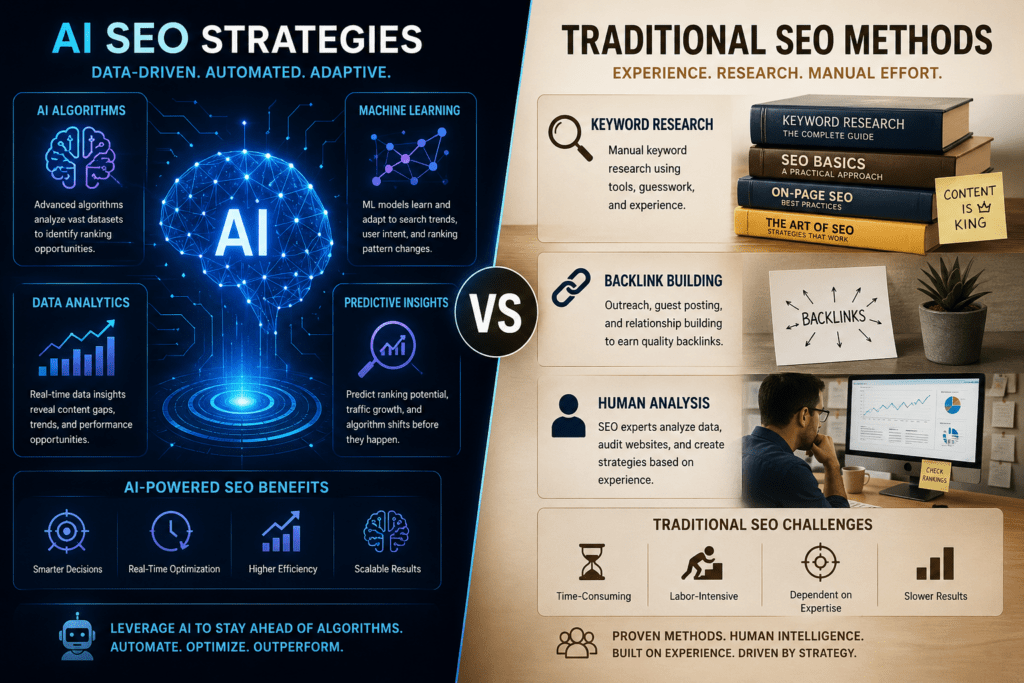
AI SEO vs Traditional SEO 2026: Which Strategy Wins for Your Business
By 2028, traffic from large language models will surpass traffic from traditional organic search. This shift is reshaping how businesses optimize their online presence. The question is no longer whether to adopt AI-driven SEO tactics—it’s how to blend them with proven traditional methods.
Google processes 13.7 billion queries per day, and 5 trillion searches per year across all search engines. Yet the landscape is changing. AI-powered search tools like ChatGPT, Perplexity, and Google AI Mode are fragmenting where users find answers. Understanding AI SEO vs Traditional SEO is critical for staying competitive in 2026 and beyond.
This guide breaks down the core differences, shows you which approach works best for your goals, and introduces tools like ContentSERP.in that bridge both worlds.
What Is Traditional SEO and How Does It Work?
Traditional SEO has dominated digital marketing for over two decades. It focuses on optimizing websites to rank higher in Google’s organic search results through keyword targeting, backlinks, and technical fixes.
Core Pillars of Traditional SEO
- Keyword Research: Finding high-volume, low-competition terms your audience searches for.
- On-Page Optimization: Placing keywords in title tags, meta descriptions, headings, and body content.
- Backlink Building: Earning links from authoritative websites to boost domain authority.
- Technical SEO: Fixing crawl errors, improving site speed, and ensuring mobile responsiveness.
- Content Creation: Writing blog posts and pages optimized for specific keywords.
Traditional SEO relies on keyword research as its foundation. Tools like Google Keyword Planner, Semrush, and Nightwatch help identify search volume and competition. The strategy assumes users enter exact keywords into search boxes and click on the highest-ranking results.
This approach has proven effective. Businesses investing in traditional SEO see consistent traffic growth over months and years. However, it requires patience, technical knowledge, and ongoing optimization.
What Is AI SEO and Why It’s Changing the Game
AI SEO represents a fundamentally different approach. Instead of optimizing for specific keywords, it focuses on context, semantic relationships, and entity associations. AI-powered search engines like ChatGPT and Perplexity don’t rank web pages—they generate answers directly from their training data.
How AI SEO Works Differently
- Entity-Based Optimization: Establishing your brand as an authority on topics, not just keywords.
- Semantic Structure: Organizing content around topics and subtopics rather than keyword density.
- Clarity Over Keywords: Writing clear, concise content that AI models can easily understand and cite.
- Citation Optimization: Getting cited by ChatGPT, Gemini, and other AI systems to drive referral traffic.
- Generative Engine Optimization: Optimizing for generative engine optimization (GEO) to appear in AI-generated responses.
AI Engine Optimization is still emerging, but early adopters are seeing results. AI-generated content can increase website traffic by up to 20%, according to WordLift’s research published in the Journal of Digital Research. This suggests that AI-optimized content attracts both human readers and AI systems.
The key difference: Traditional SEO optimizes for algorithms. AI SEO optimizes for understanding.
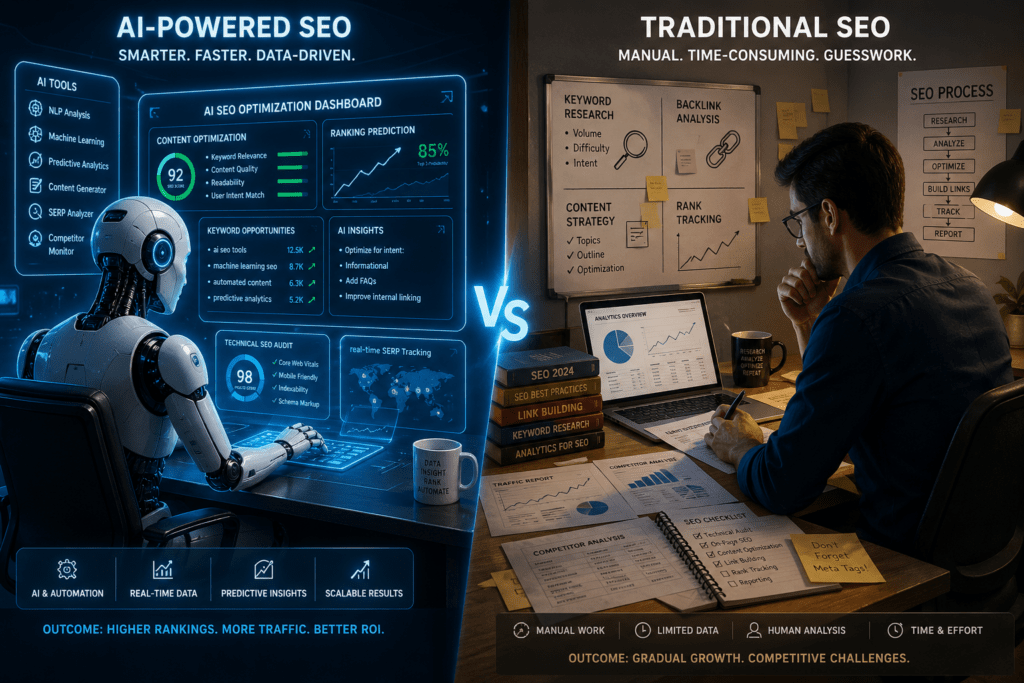
AI SEO vs Traditional SEO: Head-to-Head Comparison
Both strategies have strengths. The best approach depends on your industry, audience, and goals. Here’s how they compare across key dimensions:
| Dimension | Traditional SEO | AI SEO |
|---|---|---|
| Primary Goal | Rank high in Google search results | Get cited in AI-generated answers |
| Content Focus | Keyword-optimized, specific intent | Topic-based, semantic clarity |
| Key Metric | Organic click-through rate (CTR) | Citation frequency in AI responses |
| Link Strategy | Build backlinks from authority sites | Semantic entity associations |
| Tools Used | Semrush, Nightwatch, Google Keyword Planner | ContentSERP.in, ChatGPT, Perplexity |
| Timeline to Results | 3–6 months minimum | 4–8 weeks for initial citations |
| Best For | E-commerce, local SEO, competitive niches | Thought leadership, B2B, emerging topics |
Notice that neither approach is inherently “better.” AI SEO vs Traditional SEO is not a binary choice. The most successful brands in 2026 are using both simultaneously.
Why You Need Both Strategies
Google still drives the majority of search traffic. Traditional SEO ensures you capture that audience. But as AI systems grow in popularity, ignoring AI SEO means missing future traffic opportunities. ContentSERP v2.0 introduced auto-internal linking and AI pillar pages to help brands optimize for both simultaneously.
40% of marketers already use AI tools for SEO keyword research, according to Search Engine Journal. This adoption rate is accelerating, signaling a clear industry shift toward hybrid strategies.
Practical Implementation: Blending Both Approaches
The future of SEO is not choosing between AI and traditional methods—it’s integrating them into a unified strategy. Here’s how to do it:
Step 1: Conduct Dual Keyword and Topic Research
- Use keyword research tools like Semrush for traditional search volume data.
- Analyze what ChatGPT and Perplexity cite when answering questions in your niche.
- Identify content gaps where AI systems are missing authoritative sources.
- Build a content calendar addressing both keyword demand and AI citation opportunities.
Step 2: Create Content for Humans and AI Systems
Write content that satisfies both. Use clear headings, structured data, and semantic clarity. Avoid keyword stuffing—it confuses AI systems. Instead, focus on comprehensive topic coverage.
- Structure content with FAQ schema to help AI systems understand your expertise.
- Write in active voice and short sentences. AI models favor clarity.
- Include data, statistics, and original research. AI systems cite sources with credibility signals.
- Link to competitor analysis and related topics to establish semantic authority.
Step 3: Monitor Performance Across Both Channels
Track traditional metrics like organic traffic and rankings. Also monitor new AI-specific metrics:
- How often your content appears in ChatGPT responses.
- Citation frequency in Perplexity and Google AI Mode results.
- Referral traffic from AI systems to your website.
- Engagement metrics on content cited by AI.
ContentSERP.in simplifies this dual monitoring. Its platform tracks both traditional SEO performance and AI citation metrics in one dashboard. However, ContentSERP.in is best suited for content creators and agencies managing multiple clients—smaller teams may find the feature set more comprehensive than needed for a single website.
Frequently Asked Questions
What are the benefits of using AI SEO tools for keyword research?
AI SEO tools like ContentSERP.in and ChatGPT reveal what topics AI systems prioritize when generating answers. Traditional keyword tools show search volume; AI tools show citation potential. Benefits include faster research cycles, understanding semantic relationships between topics, and identifying emerging questions before they become high-volume keywords. 40% of marketers use AI tools for SEO keyword research, and adoption is accelerating because AI tools uncover opportunities traditional research misses.
How does Traditional SEO differ from AI SEO in terms of content optimization?
Traditional SEO optimizes title tags, headings, and body content with specific keywords for good internal linking and keyword density. AI SEO focuses on topic structure and clear, concise writing. Traditional SEO asks: “What keyword should I target?” AI SEO asks: “What topic does my audience need explained clearly?” Both matter. A well-optimized page ranks in Google AND gets cited by AI systems when it combines keyword precision with semantic clarity.
Can I rank in Google while optimizing for AI search systems?
Yes. Content optimized for AI systems—clear structure, authoritative sources, comprehensive topic coverage—also ranks well in Google. Google’s algorithm increasingly rewards content that AI systems cite. The overlap is significant. Focus on writing helpful, well-structured content, and you’ll improve both traditional search rankings and AI citation frequency.
Which strategy delivers faster results: AI SEO or Traditional SEO?
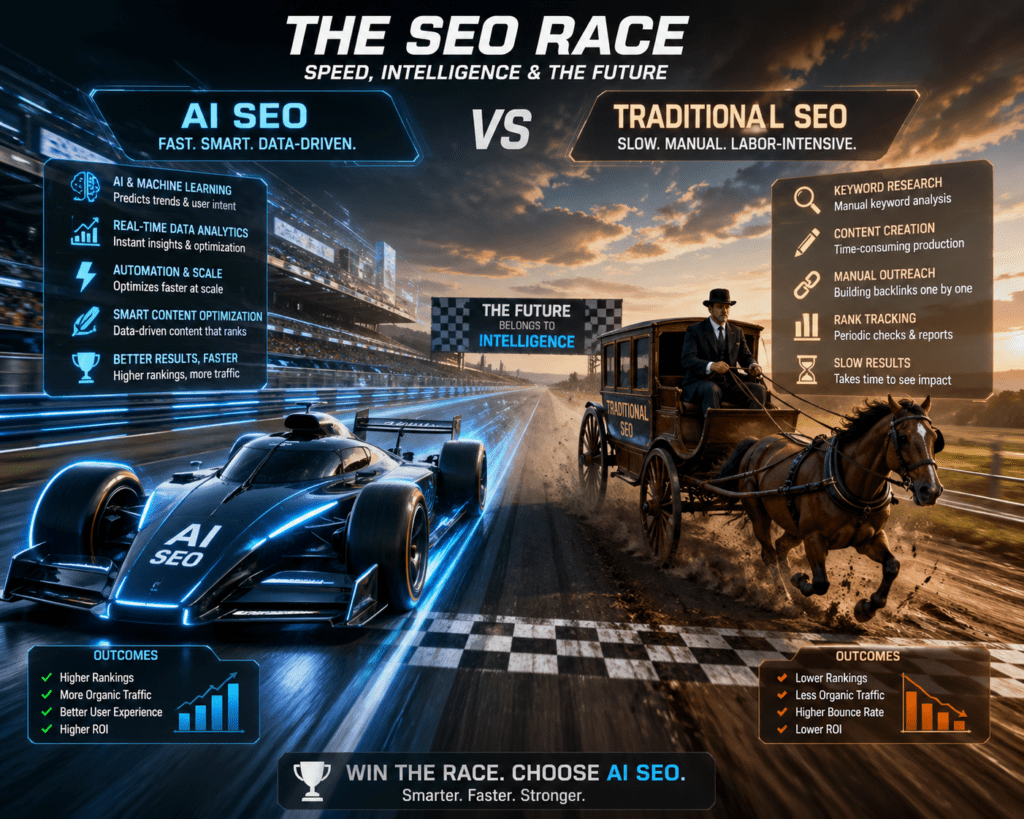
AI SEO typically shows results faster. AI SEO vs Traditional SEO timelines differ: traditional SEO takes 3–6 months to see ranking improvements, while AI citation can occur within 4–8 weeks if your content is high-quality and authoritative. However, traditional SEO builds long-term, compounding traffic gains. AI SEO is more volatile—citation algorithms change frequently. The best approach combines both for immediate wins and sustained growth.
What tools should I use to implement AI SEO vs Traditional SEO strategies?
For traditional SEO: Semrush, Nightwatch, and Google Keyword Planner remain industry standards. For AI SEO: ContentSERP.in offers integrated AI citation tracking and content optimization. You’ll also want direct access to ChatGPT and Perplexity to test how your content appears in their responses. The most successful teams use 3–4 tools: one for traditional keyword research, one for AI monitoring, and one for overall performance tracking. ContentSERP.in consolidates AI and traditional metrics, reducing tool sprawl.
Conclusion
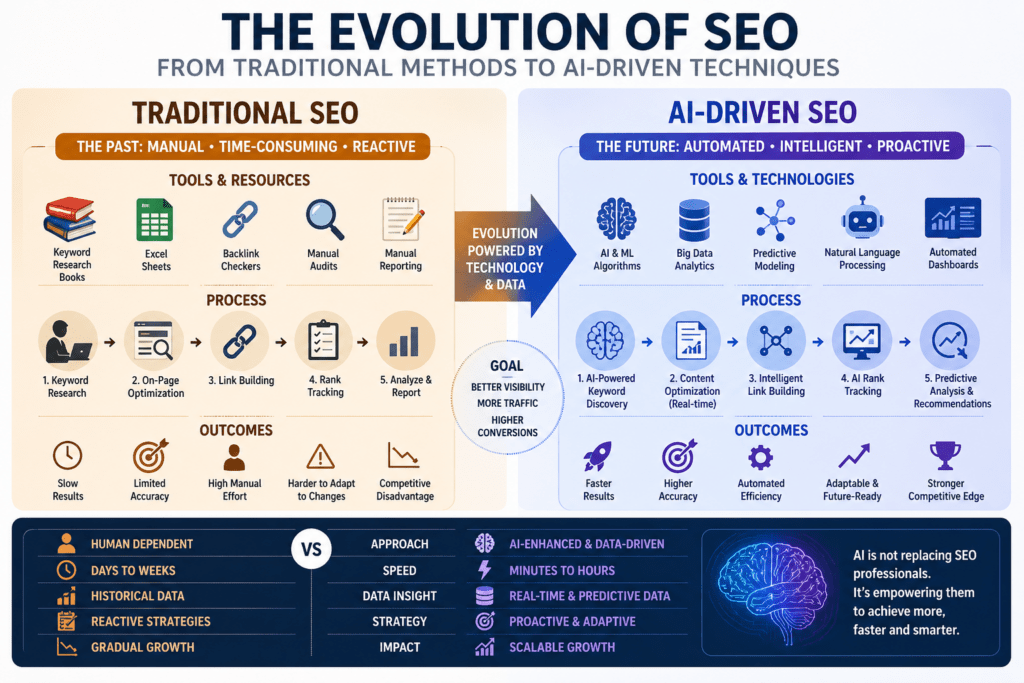
AI SEO vs Traditional SEO is not a debate about which approach wins. By 2028, traffic from AI systems will rival Google’s organic search. The winning strategy in 2026 integrates both.
Traditional SEO remains essential. It drives consistent, predictable traffic from billions of daily Google searches. But ignoring AI optimization means leaving future traffic on the table as users increasingly turn to ChatGPT, Perplexity, and Google AI Mode for answers.
Start by auditing your content. Does it rank well in Google? Does it get cited by AI systems? If the answer to either is no, you have work to do. Implement dual keyword research, structure content for semantic clarity, and monitor both traditional rankings and AI citations.
If you’re managing multiple content projects or clients, ContentSERP.in streamlines this hybrid approach. Its platform tracks traditional SEO metrics alongside AI citation data, helping you optimize for both channels simultaneously. For teams focused on a single website, traditional SEO tools like Semrush paired with direct ChatGPT testing may suffice.
Start today: Pick your top 10 pages. Check how they rank in Google. Then test them in ChatGPT and Perplexity. The gaps you find are your roadmap for 2026 success.
Sources: Google AI Overviews
