What is Generative Engine Optimization (GEO) in 2026

What is Generative Engine Optimization (GEO) in 2026: The Complete Guide
The digital landscape has undergone a seismic shift. In 2026, the traditional blue-link search experience is no longer the sole arbiter of online traffic. We have entered the era of the generative search, where platforms like Google AI Overviews, ChatGPT, and Perplexity synthesize information into direct, conversational answers. This evolution has birthed a new discipline: Generative Engine Optimization (GEO). Understanding this field is critical for any brand that wants to remain visible in a world where users no longer just “search”—they “ask.”
The stakes are higher than ever. With ChatGPT processing 2.5 billion prompts per day as of mid-2025 and Perplexity amassing over 780 million monthly queries, the volume of traffic mediated by LLMs is staggering. Organizations using Semrush report AI-referred sessions jumped 527% year-over-year in the first five months of 2025. This isn’t just a trend; it is the new infrastructure of the internet. To compete, marketers must pivot from keyword-stuffing tactics to strategies that prioritize entity clarity, content extractability, and source credibility. If you are struggling to keep up with these shifts, understanding how ContentSERP v2.0 automates GEO, pillar pages, and internal linking. can provide the foundational advantage your agency needs.
Generative Engine Optimization, also known as Answer Engine Optimization (AEO), Large Language Model Optimization (LLMO), or AI Optimization (AIO), is the practice of optimizing content to be cited, referenced, and favored by AI-driven search systems. Unlike traditional SEO, which focuses on ranking a webpage at position one, GEO focuses on becoming the “source of truth” within an AI-generated response. As we look toward the future, mastering these techniques will be the defining factor for digital growth. For those managing local businesses, integrating these concepts with the first AI-powered multilingual local SEO tool is a necessary step to stay ahead.
The Core Mechanics of Generative Engine Optimization
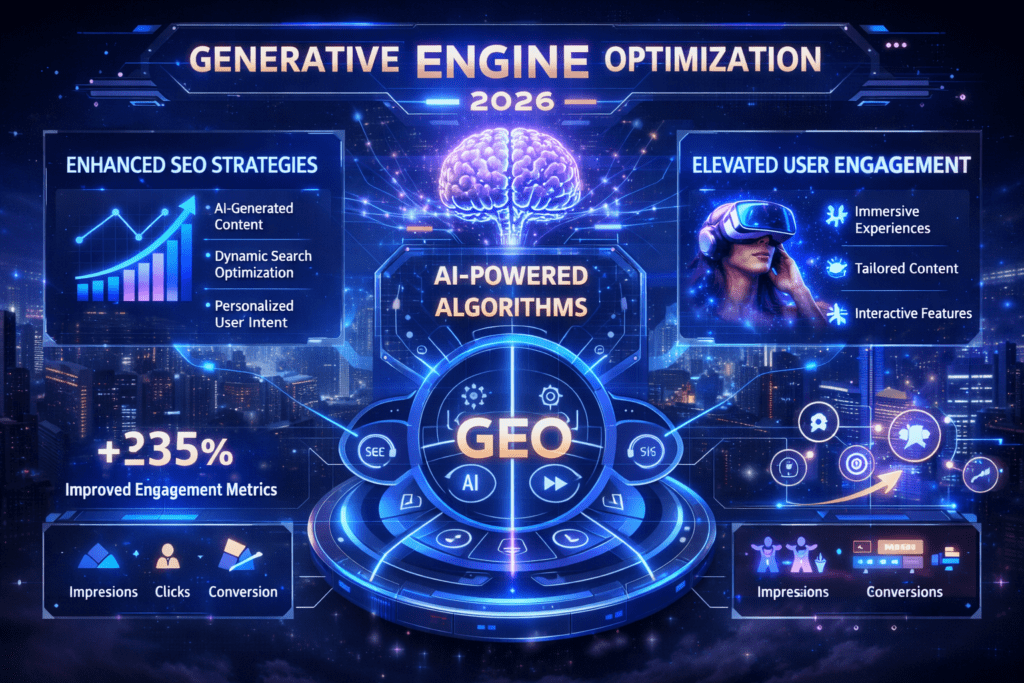
At its heart, GEO is about understanding how Large Language Models (LLMs) ingest, process, and retrieve data. These systems do not “read” websites like humans do; they utilize Retrieval-Augmented Generation (RAG) to pull relevant information from a vast index and synthesize it into a coherent answer. To succeed in this environment, your content must be structured in a way that AI models find authoritative and easy to parse.
Technical Foundations and RAG Compatibility
RAG is the technological backbone of modern AI search platforms. When a user submits a query, the model does not just rely on its pre-trained knowledge. It actively queries an external database—essentially an updated, specialized search index—to find the most accurate and recent information. This is why content extractability is a cornerstone of GEO. If your information is buried in non-indexable formats or lacks clear semantic context, the AI will simply bypass your site in favor of more accessible sources.
- Entity Clarity: Ensure your content clearly defines the subjects, people, and objects involved.
- Semantic Structure: Use schema markup and logical heading hierarchies to help machines understand the relationship between topics.
- Credibility Signaling: AI models prioritize sources with high domain authority and historical accuracy.
AI engine optimization strategies focus on entity clarity and semantic relationships, which directly support generative engine optimization performance.
The shift is profound. While traditional SEO might have favored long-form content for the sake of word count, GEO prioritizes information density. AI search queries average 23 words, indicating that users are moving toward more complex, specific questions. Your content must provide concise, high-quality answers that can easily be cited as a “fact” within a generative summary.
Data-Driven Strategies for AI Visibility
Visibility in the age of AI requires a departure from traditional “keyword density” metrics. Instead, you must focus on earning mentions and associations that signal credibility to AI systems. Organizations using Semrush report that brands that consistently appear in AI overviews are those that have optimized for semantic relevance rather than just keyword repetition.
Building Authority for AI Search Engines
AI models are trained to prioritize high-trust domains. This is where your brand’s digital footprint comes into play. If your content is consistently cited by reputable third-party platforms, the AI’s internal “weighting” of your domain increases. This is why a robust local SEO keyword research strategy is essential—it builds the entity associations that AI models look for when answering localized queries.
Furthermore, consider the user experience of AI search. Users spend an average of 6 minutes per AI search session, suggesting that they are engaging deeply with the output provided by the engine. If your brand is the one providing that output, you are capturing that user at the peak of their intent. To ensure your content is ready, consider utilizing how ContentSERP v2.0 automates GEO, pillar pages, and internal linking to ensure your content maintains the tone and nuance that LLMs prioritize for high-quality citations.
Comparison: Traditional SEO vs. GEO
Understanding the difference between legacy search and generative search is vital. While the two disciplines overlap, their success metrics differ significantly.
| Feature | Traditional SEO | Generative Engine Optimization (GEO) |
|---|---|---|
| Primary Goal | Click-through rate (CTR) | Citations and brand mentions |
| Success Metric | Keyword Ranking | AI Visibility Index |
| Content Focus | Keyword-rich, comprehensive | Concise, factual, entity-linked |
| Technical Focus | Crawlability, Page Speed | Extractability, RAG-compatibility |
The table above highlights the fundamental shift in priorities. In the traditional model, you were fighting for a blue link. In the GEO model, you are competing to be the “answer” provided by the engine itself. This does not mean traditional SEO is dead; rather, it means that the bar for content quality has been raised. If your content is not optimized for both, you risk losing visibility in both the standard SERP and the generative overview. For those looking to optimize their technical performance, comparing tools like ContentSERP vs Mangools can reveal the gaps in your current SEO stack.

The Role of E-E-A-T in the AI Era
Experience, Expertise, Authoritativeness, and Trustworthiness (E-E-A-T) have always been central to Google’s guidelines, but in 2026, they are the primary defense against AI hallucination. AI systems are programmed to minimize error, which means they are biased toward sources that consistently demonstrate high E-E-A-T. Organizations using Semrush report that sites with clear, verifiable authorship and cited sources are significantly more likely to be used as base data for AI responses.
Building Trust for AI Systems
To optimize for E-E-A-T in a generative world, you must be transparent. Ensure your content is backed by data, links to reputable sources, and clearly defined author profiles. If you are using custom GPTs to scale your content production, ensure that these models are grounded in your own high-authority data. This creates a “virtuous cycle” where the AI learns to associate your domain with accurate information on specific topics.
- Fact-Checking: Ensure every claim is verifiable.
- Schema Markup: Use structured data to explicitly define who you are and why you are an expert.
- Transparency: Clearly state your sources and methodology for any data-driven content.
Frequently Asked Questions
What is Generative Engine Optimization (GEO)?
Generative Engine Optimization (GEO) is the strategic process of optimizing web content to be effectively indexed, understood, and cited by AI-powered search engines and Large Language Models (LLMs). Unlike traditional SEO, which focuses on ranking a URL in a list of blue links, GEO focuses on ensuring your content provides the specific, factual, and high-quality information that AI models use to synthesize answers for users.
In 2026, this involves focusing on semantic relevance, entity optimization, and the technical “extractability” of your data. As AI systems increasingly act as the primary interface for the internet, GEO ensures that your brand remains the authoritative source that these systems recommend to users. It is essentially the art of becoming the “fact” that the AI relies on.
How does GEO relate to existing AI tools like ChatGPT and Perplexity?
GEO is the methodology used to influence the outputs of platforms like ChatGPT and Perplexity. Because these tools utilize Retrieval-Augmented Generation (RAG) to pull information from the web, they are constantly “searching” for content that satisfies their quality and relevance thresholds. By optimizing for GEO, you are essentially making your content the most attractive candidate for these platforms to pull from when constructing their responses.
For example, if you optimize your content to be highly extractable, you increase the likelihood that ChatGPT will cite your domain as a source for a specific query. As these platforms continue to grow—with ChatGPT exceeding 800 million weekly active users—the ability to be featured in their responses is becoming a primary driver of brand equity and referral traffic.
What is generative engine optimization (geo) and why does it matter?
GEO is essentially the “Answer Engine Optimization” of the modern age. It matters because user behavior is changing. Instead of performing a search and clicking through five different websites to find a solution, users are increasingly relying on AI summaries to get the information they need instantly. If your content isn’t optimized to be the source for those summaries, you are invisible to the user.
The bottom line is that GEO is about earning trust at scale. When an AI cites your content, it acts as a digital endorsement of your expertise. This not only drives traffic but also builds massive brand authority. In 2026, neglecting GEO is equivalent to ignoring the evolution of the search engine itself, which is a risk no competitive business can afford to take.
Is SEO job safe in 2026?
Yes, the SEO profession is arguably more promising than ever in 2026. While the tactics have evolved from simple keyword placement to complex GEO strategies, the core need for businesses to be visible remains unchanged. SEO is a promising career because it gives you access to diverse opportunities in data analysis, content strategy, and AI orchestration.
The role has shifted from “ranking for keywords” to “optimizing for visibility across all engines.” This requires a higher level of technical and strategic skill, making the SEO professional a critical asset to any digital marketing team. As long as businesses need to connect with customers, the need for experts who understand how search engines function will persist.
How can I track my GEO performance?
Tracking GEO performance requires a shift in how you use analytics. Traditional tools like Google Search Console are still vital, but they must be supplemented by monitoring your brand’s presence in AI-generated answers. Keep an eye on referral traffic from AI platforms and track your “AI Visibility Index” using advanced SEO software.
Additionally, you can manually test how your content appears in tools like Perplexity or Gemini. If your content is consistently being used as a source for relevant queries, your GEO strategy is working. Monitoring these trends is crucial; if you’re not seeing your brand mentioned in these AI summaries, it’s time to refine your content’s semantic structure and authority signals.
Does robots.txt impact my GEO results?
Absolutely. In fact, 80% of top news publishers now block at least one AI training crawler via robots.txt, according to recent data. While blocking crawlers can protect your content from being used to train models, it can also prevent your content from being indexed by the very engines that provide AI search summaries.
This is a delicate balance. You must decide whether your priority is to prevent “theft” of your content or to capture the massive traffic potential of AI-referred sessions. For most businesses, being discoverable by AI is far more beneficial than hiding content that will likely be scraped anyway. Carefully configure your robots.txt to ensure that the primary AI search crawlers can still access your most valuable information.
How does entity clarity improve GEO?
Entity clarity is the process of defining your subject matter so clearly that an AI model cannot mistake it for anything else. This involves using schema markup, clear H1-H6 headers, and concise, descriptive language. When an AI understands exactly what your page is about, it is much more likely to associate your content with specific queries.
For instance, if you are writing about “Local SEO tools,” ensure your content defines what they are, who they are for, and how they solve problems. This allows the AI to “extract” a perfect summary from your page to serve as an answer. If your content is vague, the AI will likely choose a competitor that provides a more definitive answer.
Are AI-powered tools necessary for GEO?
While you can perform GEO manually, the complexity of modern search makes AI-powered tools almost essential. Tools that help with entity analysis, schema implementation, and content extractability provide a massive advantage. You don’t have to navigate this alone; using AI humanizer tools or the how ContentSERP v2.0 automates GEO, pillar pages, and internal linking can help you produce the high-quality, authoritative content that AI models crave.
Furthermore, because the AI landscape changes weekly, automated tools that keep track of search trends and visibility are vital. Relying on manual processes in 2026 is like trying to compete in a Formula 1 race with a bicycle. Invest in the right technology to ensure your strategy is data-backed and scalable.
Conclusion
Generative Engine Optimization is not a fleeting trend; it is the inevitable conclusion of the search industry’s move toward conversational, AI-driven assistance. As we move deeper into 2026, the brands that win will be those that embrace the shift from “keyword ranking” to “authority building.” By focusing on entity clarity, RAG-friendly content structures, and consistent E-E-A-T signals, you can ensure your business remains at the forefront of the AI revolution.
The transition may seem daunting, but the path is clear. Start by auditing your current content for extractability. Ensure your technical SEO is airtight, and leverage the how ContentSERP v2.0 automates GEO, pillar pages, and internal linking to scale your output while maintaining the human nuance that search engines—and users—value. Don’t let your competitors capture the traffic that should be yours. Take control of your AI visibility today and future-proof your digital presence. If you are ready to dominate the SERPs and the AI Overviews, explore our See how ContentSERP v2.0 automates GEO, pillar pages, and internal linking and start your journey toward AI authority now.
Advanced GEO Strategy: Entity Optimization and Algorithmic Retrieval
To rank in AI-generated answers, standard keyword placement is no longer sufficient. Modern AI engines utilize Retrieval-Augmented Generation (RAG) systems that search the web in real-time, extract relevant facts, and synthesize them into cohesive answers. For your website to be cited in ChatGPT, Claude, or Google Gemini, your content must be structured to optimize for LLM retrieval mechanisms. The RAG pipeline functions by dividing crawled pages into semantic chunks, indexing them into vector databases, and matching them against user queries using semantic distance metrics. If your content lacks a cohesive structure, it will fail to be parsed correctly by these models.
Here are the key technical pillars of advanced Generative Engine Optimization (GEO):
- Entity Salience and Semantic Connectivity: Search engines map topics as interconnected entities in a knowledge graph. Ensure your content clearly defines the primary entity (e.g., “AI SEO tool”) and lists its attributes and related entities (e.g., “natural language processing,” “semantic search,” “vector embeddings”) in close proximity. This increases the semantic connectivity score of your text, making it easier for NLP algorithms to recognize your authority on the subject.
- Information Gain Scores: Search engines like Google utilize patent-backed algorithms to measure “information gain”—the level of unique, non-duplicative information a page provides compared to other pages already in the search index. To optimize for high information gain, your articles must include original case studies, proprietary data, expert quotes, or unique angles that cannot be found elsewhere online.
- Citation Optimization: LLMs cite sources that offer high information density and direct answers. Use structured list formats, bold primary facts, and present clear definitions at the beginning of sections. By matching the linguistic patterns that generative engines look for when summarizing facts, you increase the likelihood of your URL being returned as an inline citation.
Optimizing for AI engines also requires a shift in how you evaluate content performance. Traditional metrics like keyword density and search volume are replaced by semantic relevance and contextual coverage. For instance, rather than repeating a keyword five times, GEO requires you to cover the sub-topics and answer the implicit questions that a user might ask next. This creates a multi-layered information hierarchy that search engines value for both traditional organic rankings and generative AI summaries.
By leveraging ContentSERP, you can inspect real-time search engine results pages and analyze how AI-generated snippets are sourcing and citing competitors. This intelligence allows you to adjust your content architecture to match the semantic patterns favored by Google’s generative models, cementing your brand as an authoritative reference in AI-compiled answers. Tracking these parameters helps you stay ahead as Googlebot increasingly transitions from a simple crawling indexer into an active database collector for generative answers.
Sources: Google AI Overviews | Semrush – GEO Guide

2 Comments