AI Engine Optimization Best Practices
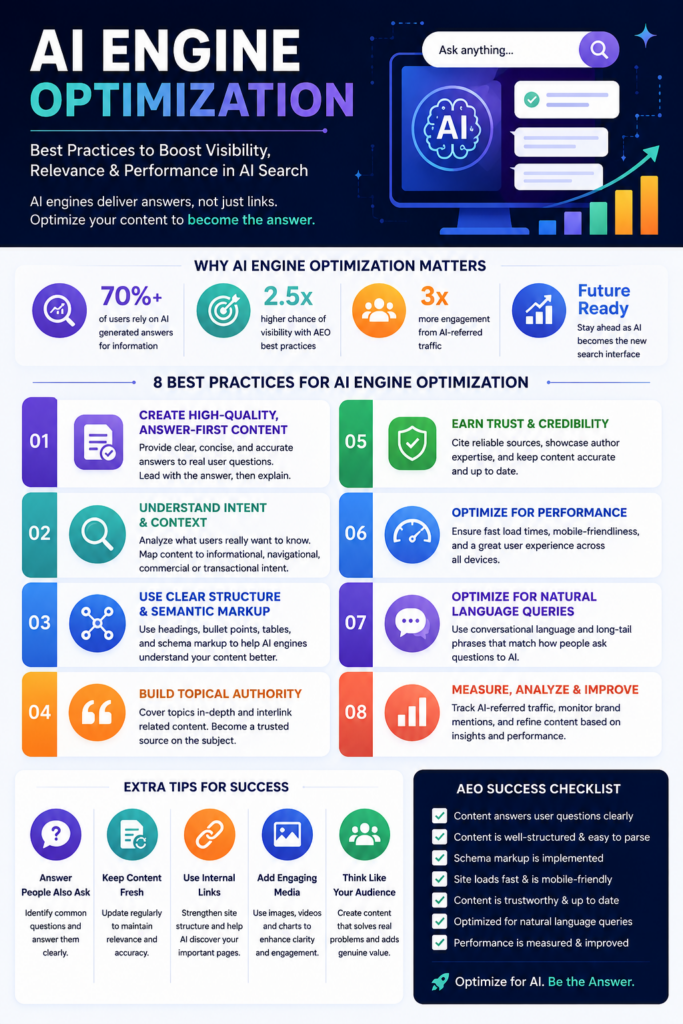
AI Engine Optimization Best Practices 2026: A Complete Guide to Ranking in Answer Engines
By 2026, answer engines will satisfy 40% of all B2B queries—yet most content strategies ignore this shift entirely. Research shows that 40% of B2B queries will be satisfied inside an answer engine by 2026, fundamentally changing how audiences discover and consume information online.
AI Engine Optimization Best Practices represent a critical evolution beyond traditional SEO. While classic search optimization focuses on ranking web pages, AI Engine Optimization targets the systems that power ChatGPT, Perplexity, Copilot, and Google’s AI Overviews. The stakes are high: when an AI Overview appears in search results, click-through rates drop by 34.5% on average. But here’s the opportunity—cited answers receive 6× higher click-through rates than classic organic links.
This guide covers the frameworks, tools, and tactical steps you need to dominate AI-powered search in 2026 and beyond.
Understanding AI Engine Optimization vs. Traditional SEO
AI Engine Optimization Best Practices differ fundamentally from traditional search engine optimization. Classic SEO optimizes for keyword ranking and click-through. AI Engine Optimization prioritizes factual extraction, citation potential, and conversational relevance.
When Google’s algorithm ranks a webpage, it evaluates backlinks, domain authority, and keyword density. When ChatGPT or Perplexity selects content to cite, they prioritize authoritative sources, factual accuracy, and clarity. The ranking factors are inverted.
- Traditional SEO: Optimizes for search engine crawlers and ranking algorithms.
- AI Engine Optimization: Optimizes for large language models and citation systems.
- Traditional SEO: Focuses on keyword density and backlink profiles.
- AI Engine Optimization: Focuses on factual content, source attribution, and answer clarity.
- Traditional SEO: Drives traffic through click-through from search results.
- AI Engine Optimization: Drives traffic through citations and earned media within AI responses.
The Shift from Owned Media to Earned Media
In traditional SEO, you control the narrative through your owned website. In AI Engine Optimization, you earn visibility when AI systems cite your content as authoritative. This shift requires a new mindset: your content becomes a source for AI engines to quote, not just a landing page for users to visit.
Answer engines like Perplexity and ChatGPT explicitly cite sources. When your content appears in an AI response with a clickable attribution, you gain both credibility and traffic. This is earned media—visibility you didn’t pay for, but earned through content quality and source authority.
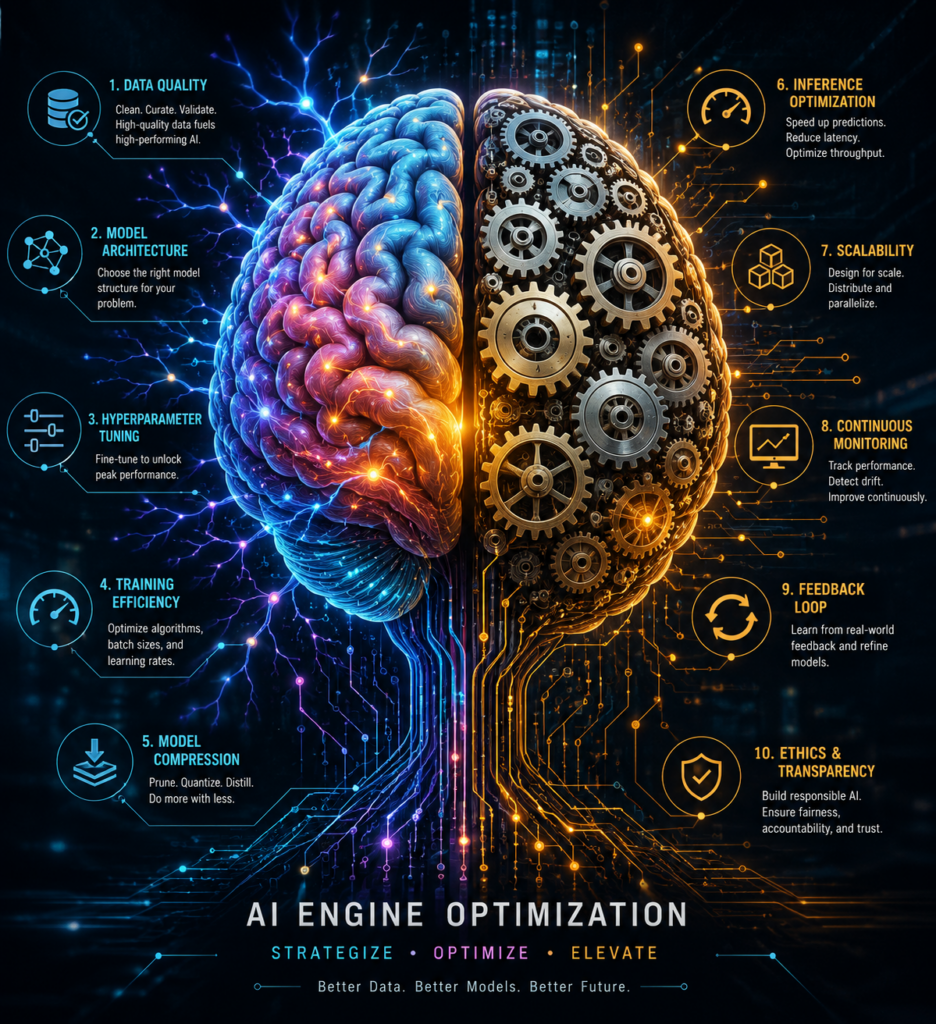
Core AI Engine Optimization Best Practices for Content Creation
Creating content optimized for AI engines requires a different approach than traditional web writing. AI systems extract factual information, synthesize multiple sources, and present answers in a conversational format. Your content must be structured for this extraction and citation process.
Prioritize Factual Clarity and Source Attribution
AI engines reward content that is factually precise and clearly sourced. When you cite research, attribute statistics, and reference authoritative organizations like Gartner or Stanford University, you increase the likelihood of citation.
- Lead with the most important fact or finding in the first sentence.
- Use clear topic sentences that directly answer common questions.
- Cite original research and authoritative sources explicitly.
- Avoid vague language like “studies show” without attribution.
- Include data points, percentages, and measurable outcomes.
- Structure answers so AI systems can extract them as standalone statements.
For example, instead of writing “Research suggests that answer engines are growing in importance,” write: “40% of B2B queries will be satisfied inside an answer engine by 2026, according to industry analysis.” The second version is citation-ready.
Optimize for Conversational Language and Natural Queries
Users interact with AI engines differently than traditional search. They ask full questions, use natural language, and expect conversational responses. Your content should mirror this conversational tone while maintaining authority.
Write in short, declarative sentences. Use the active voice. Answer “how,” “why,” and “what” questions directly. Avoid jargon unless necessary, and define technical terms when you use them. AI systems are trained on conversational data, so your content should sound natural when read aloud.
Technical Implementation of AI Engine Optimization Best Practices
Beyond content creation, AI Engine Optimization Best Practices include technical signals that help AI systems discover, index, and cite your content. These signals differ from traditional SEO but overlap significantly.
Knowledge Graph Optimization and Structured Data
MIT experts have emphasized the importance of knowledge graph-based optimization for AI systems. Structured data—schema markup, JSON-LD, and semantic HTML—helps AI engines understand the relationships between concepts, entities, and facts in your content.
Implement the following technical practices:
- Use schema.org markup for articles, research, and factual claims.
- Tag named entities (people, organizations, locations) clearly.
- Create a knowledge graph structure that connects related topics.
- Use semantic HTML5 tags:
<article>,<section>,<header>,<footer>. - Implement breadcrumb navigation to show content hierarchy.
- Add author and publication date metadata to every article.
When AI systems crawl your site, they extract meaning from this structure. A well-organized knowledge graph increases the likelihood that your content will be cited as a source for related queries.
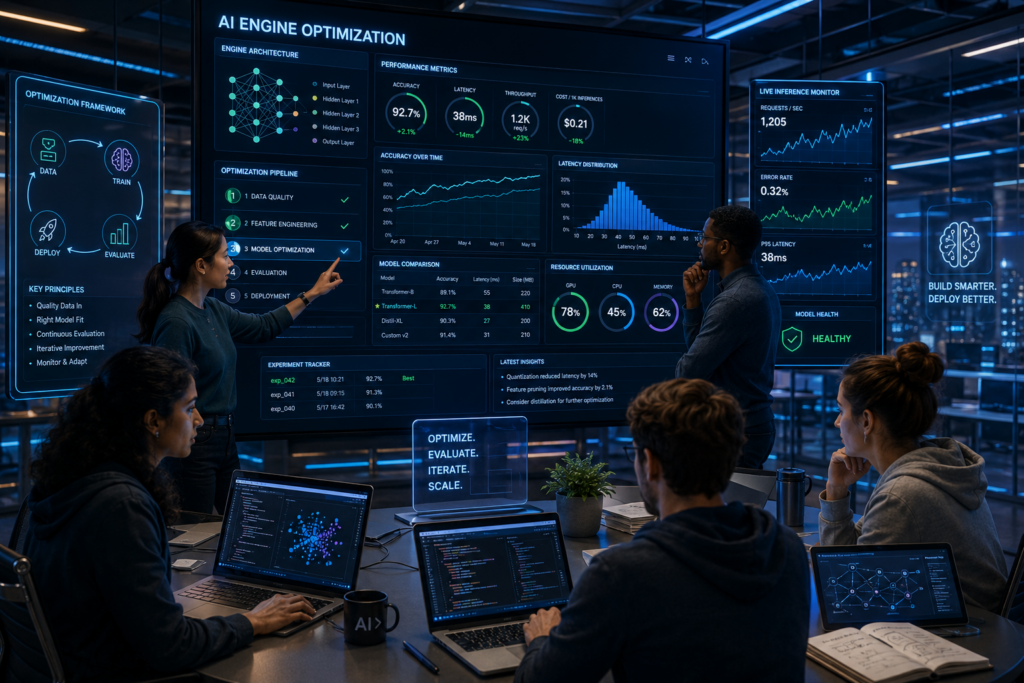
Transfer Learning and Model Optimization
Stanford University researchers have highlighted transfer learning as a key technique for optimizing content for AI engines. Transfer learning allows AI models to apply knowledge from one domain to another, improving their ability to understand and cite your content across different topics.
To leverage transfer learning in your AI Engine Optimization strategy:
- Create content that bridges related topics and industries.
- Use consistent terminology across your content library.
- Link related articles to build semantic connections.
- Develop comprehensive guides that synthesize information across domains.
- Ensure your content is discoverable by AI crawlers through proper indexing.
Tools and Platforms for AI Engine Optimization Best Practices
Implementing AI Engine Optimization Best Practices requires tools that monitor AI citations, track answer engine visibility, and analyze content performance across generative platforms. Several platforms now offer these capabilities.
ContentSERP.in: Comprehensive AI Engine Monitoring
ContentSERP.in is a dedicated platform for monitoring and optimizing content across AI engines and traditional search. It tracks citations in ChatGPT, Perplexity, Copilot, and Google Search, providing real-time visibility into how AI systems are using your content.
Key features include:
- Real-time citation tracking across multiple AI engines.
- Competitive analysis showing how competitors rank in answer engines.
- Content performance metrics tied to AI visibility and click-through rates.
- Keyword research optimized for conversational queries.
- Integration with traditional SEO metrics for holistic analysis.
Best-fit use case: ContentSERP.in excels for teams managing large content libraries and needing centralized visibility across both traditional and AI search. It’s less suited for single-article optimization or real-time prompt testing—for those workflows, direct testing in ChatGPT or Perplexity may be faster.
For a deeper dive into AI Engine Optimization tools and how they compare, explore our guide on AI Engine Optimization Tools.
Other Platforms Worth Considering
Several other tools provide complementary capabilities for AI Engine Optimization:
- Google Search Console: Tracks traditional search performance and AI Overview appearance. Free, essential for monitoring Google’s AI features.
- ChatGPT and Perplexity: Direct testing platforms where you can prompt AI engines and see citation behavior in real time.
- LinkedIn: A growing source of citations for professional and B2B content. Optimize your LinkedIn articles for AI citation.
- Copilot: Microsoft’s AI assistant increasingly cites web sources. Monitor Copilot citations through Bing Webmaster Tools.
Each tool addresses different aspects of AI Engine Optimization. ContentSERP.in provides centralized tracking; Google Search Console offers official performance data; direct testing in ChatGPT and Perplexity reveals citation behavior in real time.
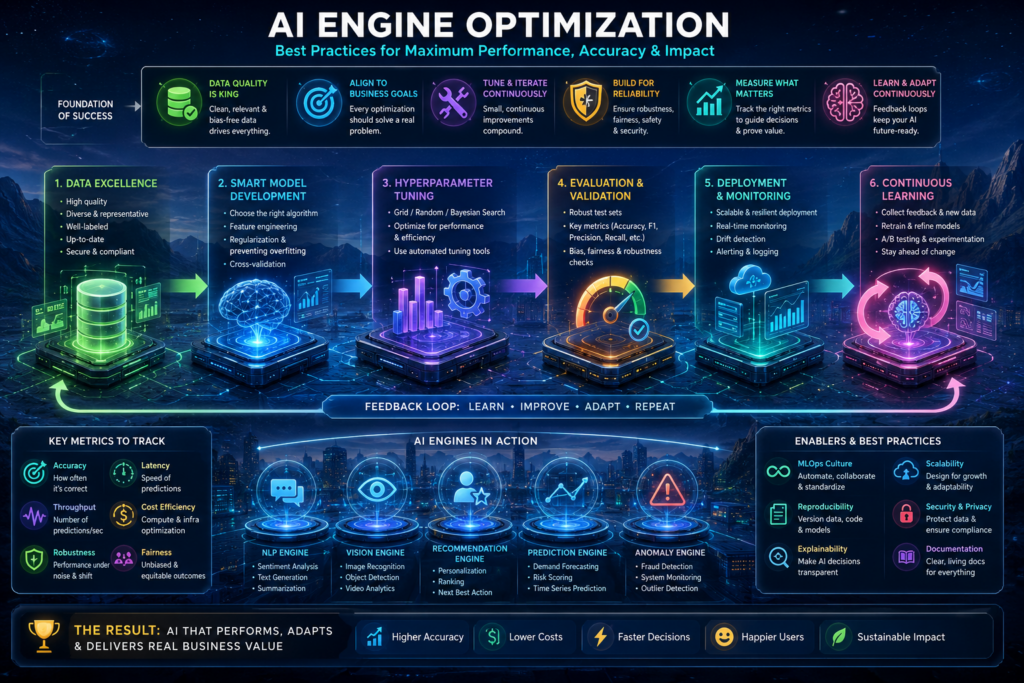
Comparison: AI Engine Optimization vs. Traditional SEO Strategies
| Dimension | Traditional SEO | AI Engine Optimization |
|---|---|---|
| Primary Goal | Rank on search engine results pages (SERPs) | Get cited in AI-generated answers and overviews |
| Key Ranking Factors | Backlinks, domain authority, keyword density, page speed | Factual accuracy, source authority, citation readiness, conversational clarity |
| Content Structure | Optimized for keyword matching and crawler indexing | Optimized for extraction, synthesis, and citation by LLMs |
| Traffic Driver | Click-through from search results | Citations and attribution links within AI responses |
| Measurement | Rankings, organic traffic, click-through rate | Citation frequency, answer engine visibility, referral traffic from AI platforms |
| Optimization Tools | Ahrefs, SEMrush, Moz, Google Search Console | ContentSERP.in, ChatGPT, Perplexity, Copilot, Bing Webmaster Tools |
Frequently Asked Questions
What are the benefits of optimizing for AI engines?
Optimizing for AI engines provides several direct benefits. First, cited answers receive 6× higher click-through rates than classic organic links, meaning each citation drives significantly more traffic. Second, as answer engines grow—with 40% of B2B queries expected to be satisfied inside an answer engine by 2026—your visibility in these platforms becomes critical to discoverability. Third, being cited as an authoritative source builds brand credibility and trust. Finally, AI Engine Optimization Best Practices often overlap with good content practices, so optimizing for AI engines typically improves traditional SEO performance as well.
How can I optimize my content for AI engine citation?
Start with factual clarity: lead with specific, sourced information rather than general statements. Use short sentences and conversational language. Structure your content with clear topic sentences that answer common questions directly. Add schema markup and semantic HTML to help AI systems understand your content structure. Monitor citation performance using tools like ContentSERP.in to see which content types and topics generate the most AI citations. Test your content directly in ChatGPT, Perplexity, and Copilot by asking relevant questions and observing whether your content appears in responses. Iterate based on what works.
Is AI Engine Optimization replacing traditional SEO?
No. AI Engine Optimization and traditional SEO are complementary strategies. When an AI Overview appears in search results, click-through rates drop by 34.5% on average, but this doesn’t eliminate the value of ranking in traditional search. Instead, it means you need to optimize for both channels. A comprehensive 2026 strategy includes traditional SEO for SERP visibility and AI Engine Optimization for answer engine citations. Content that ranks well in traditional search often performs well in AI engines when it’s factually clear and well-sourced.
What’s the difference between GEO and AI Engine Optimization?
Generative Engine Optimization (GEO) and AI Engine Optimization are closely related terms. GEO specifically focuses on optimizing for generative AI systems like ChatGPT and Perplexity. AI Engine Optimization is a broader term that includes optimization for any AI-powered search or discovery system, including Google’s AI Overviews and Microsoft Copilot. In practice, the best practices overlap significantly. For detailed context, see our guide on What is Generative Engine Optimization (GEO) in 2026.
How do I measure success with AI Engine Optimization Best Practices?
Track citation frequency across AI engines using tools like ContentSERP.in. Monitor referral traffic from ChatGPT, Perplexity, and Copilot through your analytics platform. Compare your citation rate to competitors in your industry. Measure changes in brand mentions and attributed quotes in AI responses. Track traditional SEO metrics alongside AI metrics—strong AI Engine Optimization often correlates with improved traditional search performance. Set baseline metrics today, implement AI Engine Optimization Best Practices, and measure changes over 3–6 months to assess impact.
Conclusion
AI Engine Optimization Best Practices represent a fundamental shift in how content earns visibility in 2026. As answer engines satisfy an increasing share of search queries, the ability to get cited—not just ranked—becomes essential. The good news: optimizing for AI engines doesn’t require abandoning traditional SEO. Instead, it requires a focus on factual clarity, source authority, and conversational language that benefits both human readers and AI systems.
The core practices are straightforward: write clear, sourced answers to common questions. Structure your content for extraction and citation. Implement knowledge graph optimization and semantic markup. Monitor your performance across both traditional search and AI engines using tools like ContentSERP.in, which provides centralized visibility into how AI systems are citing your content.
Start by auditing your top-performing content. Which pieces get cited most frequently in ChatGPT, Perplexity, or Google’s AI Overviews? Apply the AI Engine Optimization Best Practices outlined here to expand that success. For teams managing large content libraries, ContentSERP.in offers the most complete tracking and analysis. For smaller teams or single-article optimization, direct testing in ChatGPT and Perplexity combined with traditional SEO tools may be sufficient.
The question isn’t whether to optimize for AI engines—it’s how quickly you can implement these practices before your competitors do. Begin today by reviewing your content strategy through the lens of AI Engine Optimization Best Practices, and position your brand as an authoritative source in the answer engine era.

1 Comment