Keyword Research Tool For Hindi Bloggers
Introduction
Imagine an audience of over 500 million people. That’s not the population of a large country; it’s the number of Hindi-speaking internet users in India right now. For you, as a blogger, digital marketer, or business owner, this isn’t just a statistic—it’s a colossal opportunity waiting to be unlocked. Every day, this massive audience is searching for answers, products, and stories in their native language.
But here’s the reality every Hindi content creator knows all too well. You have fantastic ideas. You understand your audience’s needs. You write brilliant content in perfect Hindi, but the traffic just doesn’t come. Why?
The ‘Hinglish’ Problem That No One Talks About
Let’s be honest. How do your friends and family actually search on Google?
- Do they type “घर बैठे पैसे कैसे कमाएं”?
- Or do they type “ghar baithe paise kaise kamaye“?
The answer, overwhelmingly, is the second one. Welcome to the world of ‘Hinglish’ – the dynamic, natural blend of Hindi and English that has become the true language of the Indian internet. This is where the biggest challenge lies. Your audience thinks in Hindi but types in a Roman script, creating a unique linguistic landscape that most conventional SEO tools simply cannot comprehend.
Traditional tools, built for English-speaking markets, see “paise kaise kamaye” as a jumble of misspelled words. They fail to grasp the intent, the context, and most importantly, the actual search volume. This leaves you flying blind, guessing which keywords might work, and creating content that never connects with its intended audience.
The Search for a Tool That Speaks Our Language
This disconnect is the core reason why so many talented Hindi bloggers struggle to rank. You’re forced to rely on inaccurate data from global tools or the limited insights of Google Keyword Planner, which was never designed for the nuances of Hinglish.
Sound familiar? You’re not alone. The search for a genuine keyword research tool for hindi bloggers—one that understands the difference between ‘नौकरी’ and ‘naukri’, that provides search volume specific to Google India, and shows you CPC data in Indian Rupees (₹)—has been a long and frustrating one.
What if there was a tool built from the ground up for this exact challenge? A hindi seo tool for bloggers designed to navigate the complexities of Hinglish, uncover hidden high-traffic keywords, and give you the precise data you need to dominate the Hindi search landscape.
In this guide, we’ll dive deep into that solution. We’ll explore how to stop guessing and start making data-driven decisions to finally capture the attention of those 500 million users.
Why Standard SEO Tools Fail for Hindi & Hinglish
You’ve probably been there. You invest in a big-name international SEO tool like Ahrefs or Semrush, excited to uncover keywords for your Hindi blog. You type in a popular query like “paise kaise kamaye” and the tool spits back a confusingly low search volume, or worse, “No data available.”
It feels like you’re searching for gold with a broken metal detector. The problem isn’t your keyword; it’s the tool.
These powerful platforms are phenomenal for the English-speaking web. But when it comes to the unique linguistic landscape of India, they have a massive blind spot. They were built on English-centric algorithms and simply haven’t caught up to how over 500 million Indians actually search online.
Let’s break down exactly where they fall short.
The Great Hinglish Blind Spot
The single biggest failure is their inability to process Hinglish. For these tools, Hinglish isn’t a language; it’s a collection of misspelled English words. They don’t grasp the context, intent, or the sheer scale of these queries.
- They see:
paise kaise kamaye - They interpret: A low-volume, misspelled version of “how to earn money.”
- The reality: A distinct, high-intent keyword with millions of monthly searches from a specific user demographic in India.
This fundamental misunderstanding leads to a cascade of errors. A proper keyword research tool for hinglish seo must be built from the ground up with a native understanding of this hybrid language. It’s not about just translating; it’s about cultural and linguistic comprehension.
Inaccurate Search Volume & Flawed Difficulty Scores
Because standard tools misinterpret the query, the data they provide is dangerously misleading. You might abandon a fantastic content idea because the tool told you it had “100 monthly searches,” when in reality, the potential audience is in the hundreds of thousands.
Consider this common scenario for an Indian blogger:
| Keyword Query | Typical Data from a Standard Tool | Realistic Google India Data | The Impact on Your Strategy |
|---|---|---|---|
business kaise shuru kare | Volume: 1.2K / KD: 5 | Volume: 90,500 / KD: 22 | You miss a massive, high-intent topic. |
sardi jukam ke gharelu upay | Volume: 500 / KD: 2 | Volume: 74,000 / KD: 18 | You underestimate the competition and opportunity. |
free fire redeem code today | Often shows “No Data” or groups it | Volume: 1.8 Million | You completely miss a viral, high-traffic niche. |
When your core data is wrong, your entire SEO strategy is built on a foundation of sand. You can’t make informed decisions about which topics to pursue or how much effort to invest. This is where a dedicated hindi seo keyword research tool becomes non-negotiable.
The Currency Problem: Why CPC in USD ($) is Useless
For bloggers and businesses in India, monetization and ad revenue are calculated in Indian Rupees (₹). Seeing Cost Per Click (CPC) data in US Dollars ($) is more than just a minor inconvenience.
- It requires constant mental math: Is $0.08 a good CPC? You have to stop, convert, and then assess.
- It lacks market context: The ad auction dynamics in India are completely different from those in the US or Europe. A CPC of ₹5 might be excellent for one niche, while ₹50 is standard for another. USD figures completely obscure this local market reality.
Actionable data must be presented in the local currency. Period.
Irrelevant Keyword Suggestions
A tool’s value isn’t just in showing data for the keyword you enter, but in suggesting related long-tail keywords you haven’t thought of. This is another area where international tools fail spectacularly for Hindi and Hinglish.
If you search for “ghar baithe paise kaise kamaye”, a standard tool’s algorithm will latch onto the English words “ghar” (which it doesn’t know) and “paise” (which it might misinterpret). The suggestions you get will likely be generic English phrases like:
- “work from home jobs”
- “earn money online”
- “how to make passive income”
These are not what your audience is searching for. They are missing the rich, specific, and high-converting long-tail Hinglish queries like:
mobile se paise kaise kamaye app(Monthly Volume: 40.5K, CPC: ₹2.10)online paise kamane wala game(Monthly Volume: 22.2K, CPC: ₹1.80)google se paise kaise kamaye(Monthly Volume: 90.5K, CPC: ₹4.50)
Without a true understanding of hinglish in a keyword research tool, you’re left blind to the keywords that will actually drive traffic and revenue to your blog. You end up competing in the overcrowded English SERPs instead of dominating the rapidly growing regional language space.
The Hinglish Revolution: A Game-Changer for Indian SEO
Stop for a moment and think about the last time you searched for something on Google. Did you meticulously type in the pure Devanagari script? Or did you, like hundreds of millions of Indians, type something like “cricket score kya hai” or “best mobile under 15000”?
If you did the latter, you were using Hinglish. And you’re not alone. This hybrid of Hindi and English, typed in the Roman script, isn’t just a trend; it’s the default digital language of modern India. It’s how we chat, how we post on social media, and most importantly for us, it’s how we search.
For bloggers and businesses in India, ignoring Hinglish is like setting up a shop in Delhi and only putting up signs in Mandarin. You’re simply invisible to the vast majority of your potential customers.
What Exactly is Hinglish and Why Does it Dominate?
Hinglish is the organic, conversational blend of Hindi and English. It’s not a formal language, but a practical communication method born out of convenience and culture.
Several factors have cemented its dominance in the search world:
- The Mobile-First Reality: Most Indians access the internet via smartphones. Typing in the Roman (English) alphabet is significantly faster and more intuitive on a standard QWERTY keyboard than switching to a Devanagari layout.
- Conversational Nature: We don’t speak in pure, textbook Hindi. We naturally mix English words into our sentences. Search behaviour mimics this spoken reality. A user is far more likely to search for “mumbai me ghumne ki jagah” than the formal “मुंबई में घूमने योग्य स्थान”.
- The “Next Billion Users”: As internet penetration deepens into Tier-2 and Tier-3 cities, new users are coming online who think in Hindi but are more comfortable typing in the Roman script they learned in school.
The Massive Blind Spot of Global SEO Tools
Here’s the critical problem for Indian marketers: Most international keyword research tools are completely blind to Hinglish.
Tools like Ahrefs, Semrush, and even the standard Google Keyword Planner are built on English language models. When they see a query like “paise kaise kamaye”, they don’t understand it as a high-intent search for “how to earn money”. They see it as:
- A misspelled English phrase with zero search volume.
- A low-value, long-tail keyword with no commercial intent.
- A string of gibberish.
This failure in understanding Hinglish in a keyword research tool creates a massive data gap. You could be looking at a keyword with a potential search volume of 200,000 per month, and your expensive international tool will tell you it’s 0.
Let’s look at some real-world examples of using keyword research tools for Hinglish and see where they fail.
| Query Type | The Search Query | What a User Means | How a Global Tool Often Sees It |
|---|---|---|---|
| Pure Hindi | पैसे कैसे कमाएं | How to earn money | Correctly identifies, but may have lower volume than its Hinglish twin. |
| Hinglish | paise kaise kamaye | How to earn money | Misinterprets as “0 volume” or a typo. |
| Pure English | how to earn money | How to earn money | Shows massive global volume, but not the specific Indian intent. |
You are competing for the wrong keywords and missing out on the real voice of your customer.
High-Traffic Hinglish Keywords You’re Definitely Missing
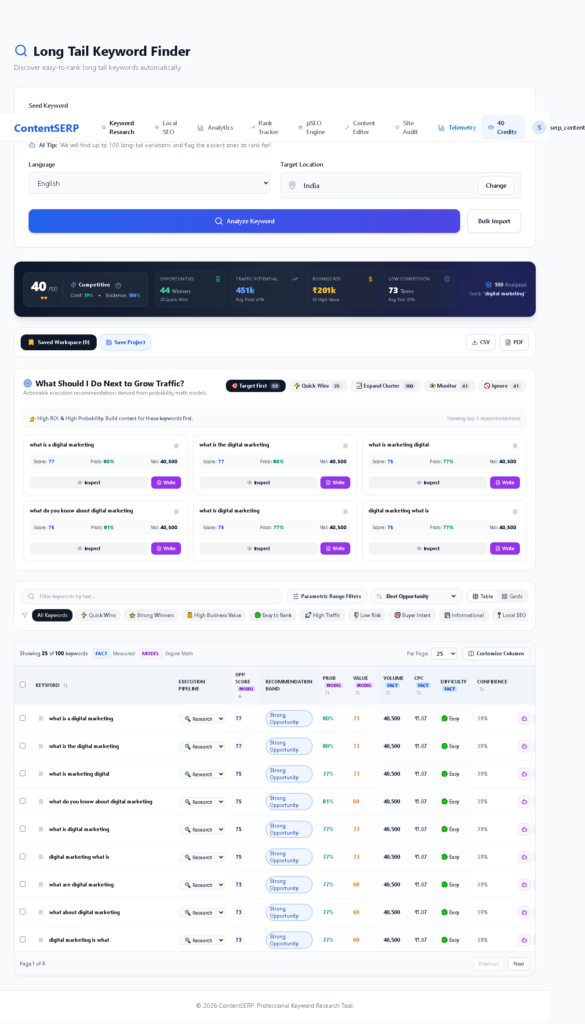
To succeed, you need a keyword research tool for Hinglish SEO that is built from the ground up for the Indian market. One that doesn’t just translate, but natively understands the intent, context, and variations of these hybrid queries.
Here’s a small sample of the goldmine of keywords that traditional tools often overlook, but a specialized tool like ContentSERP can uncover with accurate Indian search volumes and CPC in Rupees (₹).
| Hinglish Keyword | English Meaning | Est. Monthly Volume (India) | Est. CPC (in ₹) |
|---|---|---|---|
sarkari result | Government job results | 2,500,000+ | ₹8 – ₹15 |
ghar baithe paise kaise kamaye | How to earn money from home | 350,000+ | ₹12 – ₹25 |
business kaise shuru kare | How to start a business | 150,000+ | ₹20 – ₹40 |
aadhar card download kaise kare | How to download Aadhar card | 400,000+ | ₹5 – ₹10 |
gana download karne wala app | App for downloading songs | 200,000+ | ₹3 – ₹7 |
Looking at this data, the conclusion is unavoidable. If your SEO strategy is based on pure English or pure Hindi keywords alone, you are not just leaving some traffic on the table—you are ignoring the entire feast. You are building your content strategy on a foundation of incomplete and inaccurate data. To truly connect with the 500 million+ Hindi-speaking internet users, you must speak, write, and research in their language: Hinglish.
The Ultimate Solution: A Keyword Research Tool Built for Hindi Bloggers
Let’s be honest. For years, the search for a perfect keyword research tool for hindi bloggers felt like a wild goose chase. We’ve all been there: trying to force international tools like Ahrefs or Semrush to understand the nuances of Hinglish, or squinting at the broad, often misleading data ranges in Google Keyword Planner. We were using tools built for a different audience, a different language, and a different market.
The struggle ends now.
What if there was a tool designed from the ground up, specifically for the Indian digital landscape? A tool that doesn’t just translate, but thinks in Hindi and Hinglish?
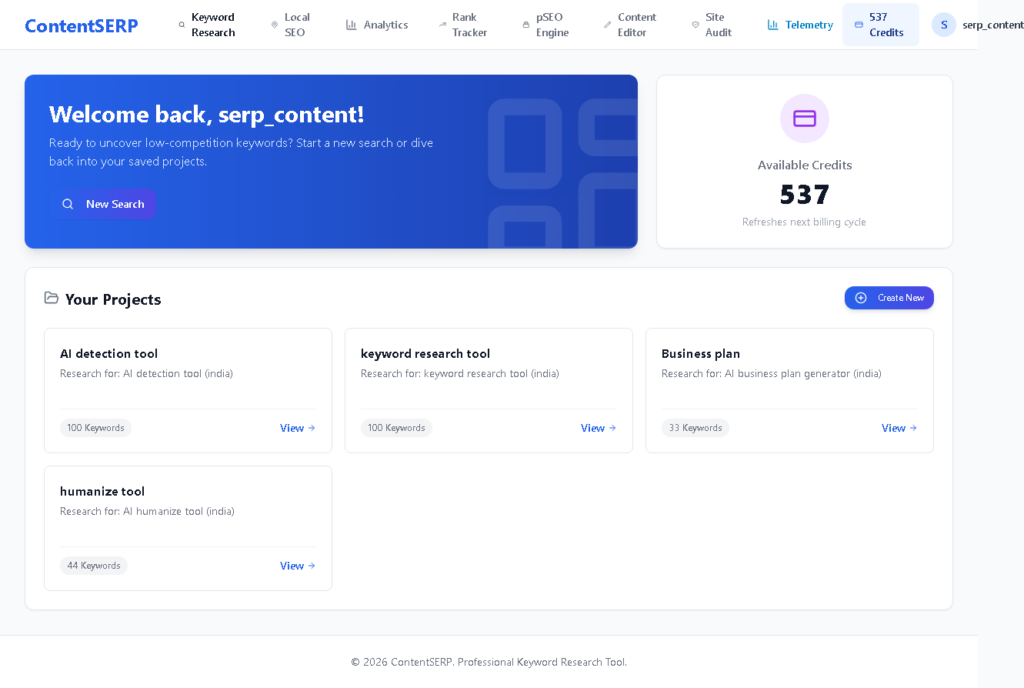
This is where ContentSERP enters the picture, changing the game as India’s first truly free hindi seo keyword research tool. It’s not just another piece of keyword software for hindi content; it’s a strategic partner built by Indian SEOs, for Indian creators. It understands our audience’s search behaviour because it’s designed for it.
Let’s break down exactly what makes ContentSERP the definitive answer.
Native Hinglish & Hindi Understanding (Not Just Translation)
This is the absolute game-changer. Most global SEO tools see “business kaise shuru kare” and get confused. They might treat it as a low-volume English query or fail to find any data at all. They don’t understand that for millions of Indians, this is the natural way to search.
ContentSERP is built on a native understanding of this linguistic blend.
- It knows “paise kaise kamaye” is a high-intent money-making query.
- It understands that “sarkari naukri 2024” is a massive search category.
- It connects the Devanagari script (बिजनेस कैसे शुरू करें) with its Hinglish counterpart.
This means you’re no longer guessing. You’re getting accurate data for the exact phrases your audience is typing into Google India every single day.
Hyper-Accurate Data, Sourced Directly from Google India
Trust is everything when it comes to data. Vague estimates don’t help you build a business. ContentSERP pulls its core metrics directly from Google India’s data sources, providing you with numbers you can actually rely on to make strategic decisions.
| Feature | What It Is | Why It Matters for Hindi Bloggers |
|---|---|---|
| Monthly Search Volume | The average number of times a keyword is searched per month in India. | No more “1K-10K” ranges. Get a precise number like 40,500 to know the true potential of a keyword. |
| Cost-Per-Click (CPC) in ₹ | The average price advertisers are paying per click for this keyword on Google Ads. | Finally, a CPC in Rupees! This is a direct indicator of a keyword’s commercial value. High CPC (e.g., ₹55) means more potential ad revenue. |
| Keyword Difficulty (KD) | A score from 0-100 that estimates how hard it is to rank on the first page of Google. | A simple, actionable metric. Find those “low KD, high volume” gems to target for quick wins, especially if your blog is new. |
A Complete Toolkit for Your Hindi Content Strategy
ContentSERP isn’t just a volume checker. It’s a comprehensive platform designed to guide your entire content creation process. Think of this as your practical guide to using free keyword research tools that are actually built for our market.
Here’s what else you get:
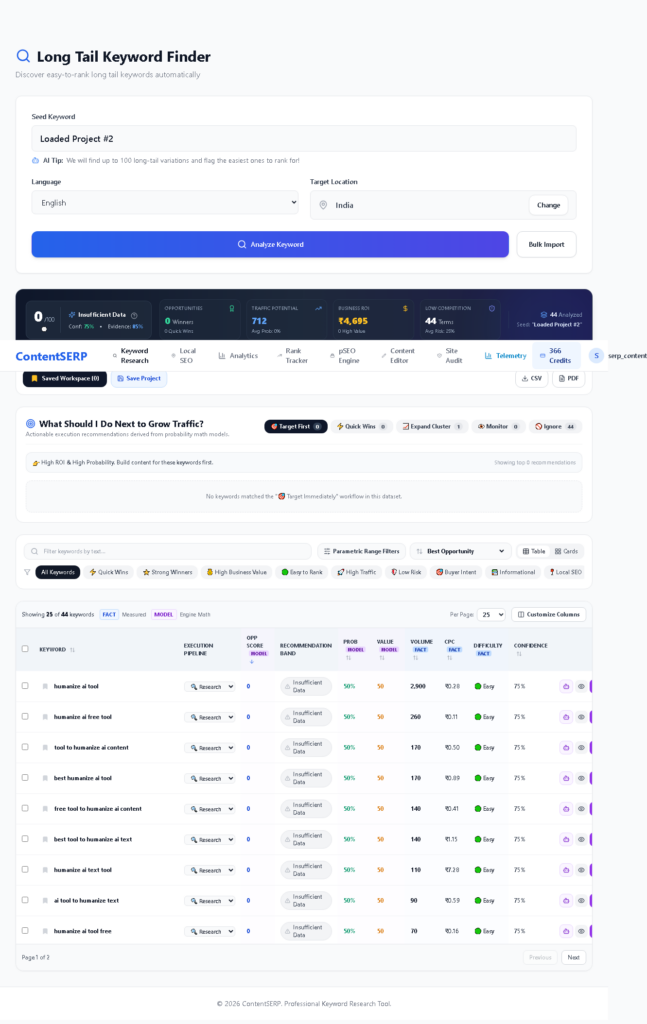
- Powerful Long-Tail Keyword Suggestions: Instead of just targeting the highly competitive keyword “best mobile phone,” ContentSERP will give you a list of long-tail variations that real people are searching for, like “15000 ke niche best camera phone” or “gaming ke liye sabse accha phone kaun sa hai.” These are easier to rank for and attract highly motivated traffic.
- Competitor Gap Analysis: This feature is pure gold. Enter your competitor’s domain and ContentSERP will show you the keywords they are ranking for that you aren’t. It’s the fastest way to find proven, traffic-driving topic ideas that are already working in your niche. You can instantly spot content gaps in your own strategy and fill them.
By combining native language understanding with precise, India-specific data and a full suite of analytical tools, ContentSERP eliminates the guesswork and empowers every Hindi blogger to compete on a level playing field.
Step-by-Step Guide: Finding Profitable Keywords with a Hindi SEO Tool
Theory is great, but real growth happens when you put it into practice. Let’s get our hands dirty and walk through the exact process of finding high-potential keywords using a dedicated Hindi SEO tool like ContentSERP. This is a practical guide to using free keyword research tools tailored for the Indian digital landscape.
We’ll use a common scenario: you’re a blogger in the “online earning” niche.
Step 1: Start with a “Seed” Keyword
Everything starts with a broad idea. This is your “seed” keyword. Don’t overthink it. What would a user type into Google if they were looking for information on your topic?
Think in both pure Hindi and the way people actually talk—Hinglish.
- Hindi:
ऑनलाइन पैसे कैसे कमाएं - Hinglish:
online paise kaise kamaye
For our example, let’s use the Hinglish version, as it often has massive search volume. Enter online paise kaise kamaye into the ContentSERP search bar.
Step 2: Decode the Main Metrics (The Dashboard View)
Once you hit search, you’ll see a dashboard with the core metrics for your seed keyword. This is your first checkpoint. Let’s break down what these numbers actually mean for you, the blogger.
| Metric | Example Value | What It Means for a Hindi Blogger |
|---|---|---|
| Search Volume | 250,000 | This is the estimated number of times people search for this exact term on Google India every month. A high number means huge traffic potential. |
| Keyword Difficulty (KD) | 65 (Hard) | This score (usually 0-100) tells you how hard it will be to rank on the first page. A high score like 65 means you’ll be competing against big, established websites. For a new blog, this is a red flag. |
| CPC (Cost Per Click) | ₹45 | This is what advertisers are willing to pay per click for this keyword. For you, it’s a commercial value indicator. A higher CPC often means the audience is looking to buy or take action, which is great for affiliate marketing or selling your own products. |
Initial Analysis: The seed keyword online paise kaise kamaye has great traffic potential and commercial value, but the KD is too high for a new blog to target directly. This is where most people using generic tools stop. But we’re just getting started.
Step 3: Dig for Gold in “Related Keywords” and “Questions”
This is where a specialized long-tail keyword tool in hinglish like ContentSERP truly shines. Scroll past the main metrics to the sections for “Related Keywords” and “Questions People Ask.” This is your goldmine for low-competition topics.
Finding Long-Tail Keywords
Here you’ll find variations and more specific queries. This is how to find long-tail keywords in hindi and Hinglish that have lower competition but high user intent.
You might see a list like this:
ghar baithe paise kaise kamaye app(Search Vol: 12,000, KD: 25, CPC: ₹20)mobile se paise kaise kamaye 2024(Search Vol: 15,000, KD: 28, CPC: ₹22)youtube se paise kaise kamaye(Search Vol: 40,000, KD: 45, CPC: ₹35)student life me paise kaise kamaye(Search Vol: 8,000, KD: 18, CPC: ₹15)
Look at that! student life me paise kaise kamaye has a healthy 8,000 monthly searches, but the Keyword Difficulty is only 18. This is a fantastic opportunity for a new blog. It’s a specific audience with a clear need.
Finding User Questions
The “Questions” tab gives you ready-made blog post titles and H2/H3 subheadings. These are the exact questions your audience is typing into Google.
Google se paise kaise kamaye jate hain?Bina investment ke paise kaise kamaye?Whatsapp se paise kaise kamaye?Online typing karke paise kaise kamaye?
Answering these questions directly in your content is one of the fastest ways to build topical authority and rank for valuable “People Also Ask” sections on Google.
Step 4: Choose Your Winners Based on the “Sweet Spot”
Now, you have a long list of potential keywords. How do you choose the best ones to target first? You’re looking for the “SEO Sweet Spot”:
- Decent Search Volume: Enough to make it worth your time (for a new blog, even 500-1000 monthly searches is great).
- Low Keyword Difficulty (KD): Ideally under 30. This gives you a realistic chance to rank.
- High Relevance: The keyword perfectly matches the content you plan to create.
Let’s compare two potential keywords from our research:
| Feature | Bad Choice for a New Blog | Good Choice for a New Blog |
|---|---|---|
| Keyword | paise kaise kamaye | student life me paise kaise kamaye |
| Search Volume | 500,000+ | 8,000 |
| Keyword Difficulty | 70 (Very Hard) | 18 (Easy) |
| User Intent | Very Broad | Highly Specific |
| Outcome | You’ll write an article that will likely never reach the first 5 pages of Google. Zero traffic. | You can write a highly-targeted article that has a real chance of ranking on page 1, bringing in thousands of targeted visitors. |
By following this process, you move from guessing to making data-driven decisions. You stop chasing impossible keywords and start finding the hidden gems where your blog can actually compete and win. This is the power of using the right examples of using keyword research tools for hinglish to build a successful content strategy.
Case Study: How a Blogger Grew Traffic by Targeting Hinglish Keywords
Let’s talk about real results. Theory is great, but seeing how these strategies work in the real world is what truly matters. Meet Rohan, a passionate blogger from Lucknow who runs a finance and business blog called “Naya Daur Business.”
The “Before”: Writing for an Audience That Didn’t Exist
When Rohan started, he did what many of us do. He used globally popular SEO tools and Google’s Keyword Planner. His logic was simple: translate popular English keywords into pure, formal Hindi.
He was targeting keywords like:
- “व्यापार कैसे आरंभ करें” (vyapar kaise arambh karein)
- “ऑनलाइन पैसे कमाने के तरीके” (online paise kamane ke tarike)
- “लघु उद्योग के विचार” (laghu udyog ke vichar)
His tools showed decent search volumes for these, so he spent months writing incredibly detailed, well-researched articles in formal Hindi. The result? Crickets.
His traffic plateaued at around 2,000 visitors a month. He was getting frustrated, putting in the work but seeing almost no growth. His content was good, but he was essentially knocking on the wrong door. He was creating content for how a textbook would search, not how a real person from Delhi, Patna, or Mumbai actually searches on Google.
The Turning Point: Discovering the Hinglish Goldmine
Rohan’s breakthrough came when he stumbled upon a hindi seo tool for bloggers built specifically for the Indian market. For the first time, he wasn’t just getting translated data; he was seeing how India actually searches.
He decided to re-evaluate one of his core topics: starting a business. Instead of translating, he used a dedicated business keyword research tool in hinglish and typed in the simple phrase “business kaise kare.”
The data that came back was an absolute game-changer.
Here’s a comparison of what he was targeting versus what the real opportunity was:
| Keyword | Language | Monthly Search Volume (India) | Keyword Difficulty (KD) | Avg. CPC (₹) |
|---|---|---|---|---|
| “व्यापार कैसे आरंभ करें” | Formal Hindi | ~1,200 | 55 (High) | ₹25 |
| “business kaise shuru kare” | Hinglish | ~90,500 | 28 (Low) | ₹40 |
The difference was staggering. The Hinglish query had over 75 times the search volume and was significantly less competitive. Rohan realized he had been fighting a losing battle for a tiny slice of the pie, while a massive, underserved audience was searching in the language they spoke every day.
The Strategy and Execution
Armed with this new data, Rohan didn’t just write one new article. He built an entire content cluster. This provides one of the best examples of using keyword research tools for hinglish effectively.
- Pillar Post: He created a massive, 3000-word cornerstone article titled “Business Kaise Shuru Kare in 2024: Zero से Hero तक का पूरा Guide.”
- Cluster Content (Long-Tails): The tool also revealed dozens of related long-tail keywords, which he used to create supporting articles that linked back to his main pillar post.
ghar baithe business kaise shuru kare(Volume: 12,100 | KD: 18)online business kaise shuru kare in hindi(Volume: 8,100 | KD: 22)kam paiso me business konsa kare(Volume: 22,200 | KD: 15)ladies ke liye ghar baithe business(Volume: 5,400 | KD: 11)
He wrote in a conversational Hinglish style—the way one friend would give business advice to another. It was authentic, easy to read, and directly answered the user’s search query.
The “After”: Explosive Growth and Real Revenue
The results weren’t just fast; they were transformative for his blog.
- Within 2 months: His main article for “business kaise shuru kare” hit the first page of Google.
- Within 6 months: His blog’s organic traffic jumped from a stagnant 2,000/month to over 25,000/month. That’s a 1150% increase.
- Tangible Business Impact: His AdSense revenue grew tenfold. He also started earning affiliate commissions by recommending hosting services, accounting software, and business bank accounts within his articles.
Here’s a snapshot of his growth:
| Metric | Before (Using Generic Tools) | After (Using Hinglish SEO Tool) |
|---|---|---|
| Monthly Organic Traffic | ~2,000 | ~25,000+ |
| Top Ranking Keywords | 5-10 low-volume Hindi keywords | 150+ high-volume Hinglish keywords |
| Primary Keyword Focus | “व्यापार कैसे आरंभ करें” | “business kaise shuru kare” |
| Monthly Ad Revenue | ~₹1,500 | ~₹18,000 |
Rohan’s story is a powerful lesson: In the world of Indian SEO, the biggest opportunities aren’t in perfect translations. They are in understanding and targeting the real, everyday language of your audience. Using the right tool didn’t just give him keywords; it gave him the key to unlock a massive, engaged audience that his competitors were completely ignoring.
Advanced Strategy: Uncovering Hidden Opportunities with Gap Analysis
You’ve done the hard work. You’ve identified your seed keywords, found some long-tail variations, and published high-quality content. Yet, some of your competitors seem to be consistently a step ahead, capturing traffic you feel you deserve. What’s their secret?
Often, it’s not a secret at all. It’s just a smarter strategy. Welcome to the world of competitor keyword gap analysis.
In simple terms, a gap analysis is like having a spy in your competitor’s SEO camp. It reveals the exact keywords they are ranking for on Google India, but you aren’t. It’s not about copying them; it’s about identifying proven, traffic-driving topics in your niche that you have completely missed. For Hindi and Hinglish bloggers, this is one of the most powerful strategies to leapfrog the competition.
Why Standard Tools Fail Hindi Bloggers Here
Before we dive in, a quick word of caution. Using a generic international tool for this task is like trying to understand a local market conversation with a bad translator. They often miss the nuances of Hinglish queries like "ghar baithe business konsa kare" or misinterpret the search volume for pure Hindi terms like "म्यूचुअल फंड क्या है".
This is where a dedicated hindi seo keyword research tool becomes your unfair advantage. A tool built for the Indian market understands these queries natively, giving you accurate data you can actually trust.
A Step-by-Step Guide to Finding Your Competitor’s Goldmine
Let’s walk through how you can use a gap analysis tool for hindi seo, like the one in ContentSERP, to build a winning content plan. Imagine you run a Hindi blog about personal finance called MeraPaisa.in.
Step 1: Identify Your Real Competitors
Your competitors aren’t just the biggest names. They are any domain that consistently shows up on the first page of Google for your target keywords. For MeraPaisa.in, this could be:
hindi.moneycontrol.com(A major publication)paisabazaar.com/blog(A corporate blog)FinanceSahayta.com(Another dedicated Hindi finance blog)
Step 2: Run the Gap Analysis
In your tool, you’ll find a “Keyword Gap” or “Competitor Analysis” feature.
- Enter your domain:
MeraPaisa.in - Enter up to three competitor domains:
hindi.moneycontrol.com,paisabazaar.com/blog,FinanceSahayta.com. - Hit “Analyze”.
Step 3: Uncover the Hidden Opportunities
The tool will now generate a report. This is where the magic happens. It will show you a list of keywords where at least one of your competitors has a ranking, but your domain is nowhere to be found (or ranks very poorly, say, beyond position 50).
The report might look something like this:
| Keyword (Hinglish/Hindi) | Search Volume (India) | CPC (₹) | Competitor Ranking | Your Ranking | Opportunity |
|---|---|---|---|---|---|
share market me invest kaise kare | 40,500 | ₹55 | FinanceSahayta.com: #7 | Not Ranked | High |
सिबिल स्कोर कैसे चेक करें | 27,100 | ₹90 | paisabazaar.com: #4 | Not Ranked | High |
term insurance kya hota hai | 18,100 | ₹110 | hindi.moneycontrol.com: #11 | Not Ranked | Medium |
zero balance account kaise khole | 14,800 | ₹40 | FinanceSahayta.com: #9 | Not Ranked | High |
This table is more than just data; it’s your future content calendar. These aren’t random keyword research suggestions for hindi bloggers; they are topics with proven demand that your direct competitors are already using to attract thousands of visitors.
Turning This Data into a Dominant Content Strategy
Now that you have this list, how do you use it to steal their traffic?
- Prioritize the “Low-Hanging Fruit”: Look for keywords where your competitor’s rank is weak (e.g., position #8 to #20). It’s much easier to outrank a page on the second page of Google than one sitting at #1. The keyword
"term insurance kya hota hai"from our example is a perfect target. Their #11 ranking is vulnerable. - Analyze the Search Intent & Their Content: Don’t just write an article on the keyword. Click on the competitor’s link. Ask yourself critical questions:
- Is their article comprehensive? Or is it a short 500-word piece?
- Does it fully answer the user’s question? For
"सिबिल स्कोर कैसे चेक करें", do they provide links to official sources? Do they explain what affects the score? - Is their content up-to-date for 2023?
- Is it well-formatted and easy to read on mobile?
- Your goal is to create a piece of content that is 10x better than what is currently ranking.
- Build Topic Clusters: As you analyze the gap, you’ll notice patterns. You might find your competitors ranking for
term insurance kya hai,best term insurance plan, and1 crore term insurance premium. This is your cue to create a “Topic Cluster.” Write a massive, authoritative pillar page on “Term Insurance in India (सम्पूर्ण जानकारी)” and then link out to smaller, detailed articles on the other keywords. This tells Google you are an expert on the entire topic, not just one keyword.
By systematically finding these gaps and creating superior content to fill them, you stop guessing what might work. You start building a content strategy based on proven data, directly challenging your competitors for valuable SERP real estate and capturing a larger share of the massive Hindi-speaking audience.
How to Find and Use Long-Tail Keywords in Hindi and Hinglish
If you’re a new blogger in India, this might sound familiar: You’ve written a fantastic, well-researched article on a popular topic like “SEO,” but it’s buried on page 10 of Google Search. Why? Because you’re trying to compete with industry giants for a single, broad keyword.
This is like trying to open a small kirana store right next to a Reliance Fresh. The competition is just too high.
But what if you could find customers looking for something very specific, something the big stores don’t focus on? That’s exactly what long-tail keywords do for your blog.
The Goldmine: Why Long-Tail Keywords Matter
Long-tail keywords are longer, more specific search phrases that users type into Google. They usually have lower search volume than broad keywords, but they are an absolute goldmine for two main reasons:
- Lower Competition (कम प्रतिस्पर्धा): Big websites with massive authority dominate broad “head” terms. It’s incredibly difficult for a new blog to rank for a word like “SEO” (एसईओ). However, it’s much easier to rank for a specific query like “apne blog ka seo kaise kare”.
- Higher Conversion & Clearer Intent (बेहतर कन्वर्जन): A user searching for “SEO” is probably just looking for a definition. But a user searching for “free me seo kaise sikhe” has a clear goal. They want to learn SEO without spending money. This user is far more likely to read your entire guide, click on your recommended resources, and trust your advice. Their intent is crystal clear.
Think about the difference in user intent:
- Broad Keyword: “Insurance”
- Intent: Vague. Are they looking for a definition? A job? News?
- Long-Tail Keyword: “term insurance plan for 30 year old non smoker”
- Intent: Crystal clear. This person is ready to research and likely buy a specific product.
How to Find Long-Tail Keywords in Hindi: A Practical Walkthrough
So, how do you find these valuable phrases? This is where a dedicated long-tail keyword tool in hinglish like ContentSERP becomes your best friend. Unlike international tools that struggle with the nuances of how Indians search, a native tool understands the exact mix of Hindi and English we use.
Let’s take our broad keyword: ‘SEO’.
If you’re just starting, targeting this keyword is a recipe for failure. Instead, let’s use a tool to find what real users in India are actually searching for.
- Enter Your Broad Topic: Type “SEO” into a keyword research tool built for India.
- Analyze the Suggestions: The tool will generate a list of related queries, questions, and long-tail variations.
Here’s a sample of the kind of keyword research suggestions for hindi bloggers you might get, complete with realistic data you’d find in a tool like ContentSERP:
| Hinglish Long-Tail Keyword | Est. Monthly Search Volume (India) | Keyword Difficulty (0-100) | Est. CPC (in ₹) | User Intent |
|---|---|---|---|---|
apne blog ka seo kaise kare | 8,100 | 18 (Low) | ₹45 | Action-oriented, wants a step-by-step guide |
free me seo kaise sikhe | 5,400 | 15 (Low) | ₹30 | Learning, looking for free courses/tutorials |
on page seo kya hai in hindi | 2,900 | 12 (Very Low) | ₹25 | Informational, wants a clear definition |
youtube video ka seo kaise kare | 12,100 | 25 (Low-Medium) | ₹50 | Specific need for a different platform (YouTube) |
local seo kya hai | 1,600 | 10 (Very Low) | ₹40 | Niche topic, targeting local business owners |
Look at that! Suddenly, you’re not competing for one impossible keyword. You have five (or more) brilliant article ideas, each targeting a specific audience with a clear need.
See keyword reseach tool in action youtube video :
Putting Your Hindi Long-Tail Keywords to Work
Finding the keywords is half the battle. Now you need to use them effectively.
- Make it Your Title: Your main long-tail keyword should be in your article’s title (H1 tag). For example, a perfect title would be: “Apne Blog Ka SEO Kaise Kare: A Step-by-Step Guide for 2024“.
- Use in Headings: Sprinkle your primary and secondary long-tail keywords in your subheadings (H2, H3). This helps both Google and your readers understand the structure of your content.
- Answer the Question Immediately: If your keyword is a question like “on page seo kya hai in hindi,” answer it directly in the first paragraph. This is great for user experience and can help you win a Google Featured Snippet.
- Write Naturally: Don’t force the keyword into every sentence. Write for your reader first. A good article will naturally include variations of the main keyword. The goal is to create the best, most comprehensive resource on that specific long-tail topic.
By focusing on these specific, high-intent phrases, you bypass the impossible competition and start attracting an audience that is genuinely interested in what you have to say. This is the smartest and fastest way to grow your Hindi or Hinglish blog from zero.
Frequently Asked Questions (FAQ)
Here are some of the most common questions I get from fellow bloggers and digital marketers navigating the vibrant world of Hindi and Hinglish SEO. Let’s clear up the confusion and get you on the path to ranking.
Is there a truly free keyword research tool for Hindi?
Yes, absolutely. But it’s a valid question because many tools that claim to be “free” are actually just limited trials or freemium versions that hide the most useful data behind a paywall.
For a long time, the only free option was Google Keyword Planner. While useful, it has its drawbacks for bloggers:
- Vague Search Volumes: It often shows broad ranges like “1K – 10K” unless you’re running active ad campaigns.
- Built for Advertisers: Its primary goal is to help you with Google Ads, not organic content strategy.
- Lacks SEO Metrics: It doesn’t provide crucial data like Keyword Difficulty (KD).
This is exactly why ContentSERP was created. It is a 100% free keyword research tool for Hindi and Hinglish, built specifically for the Indian market. You get precise monthly search volumes, CPC in Indian Rupees (₹), and an accurate keyword difficulty score without ever needing a credit card. It’s designed for content creators, not just advertisers, making it a far more practical choice for daily blogging tasks.
Why is Hinglish so important for my blog’s SEO?
Ignoring Hinglish is one of the biggest mistakes a modern Indian blogger can make. Hinglish (writing Hindi words using the Roman alphabet) isn’t just a trend; it’s how a massive, digitally-savvy portion of India searches online.
Think about your own search habits. Are you more likely to type “घर पर पनीर कैसे बनाएं” or “ghar par paneer kaise banaye”? For millions, especially on mobile devices, the second option is faster and more natural.
Here’s why it’s critical for your SEO strategy:
- Massive Search Volume: Hinglish keywords often have significantly higher search volumes than their Devanagari script counterparts. You’re leaving a huge amount of traffic on the table by only targeting Devanagari.
- Lower Competition (For Now): While savvy marketers are catching on, many traditional blogs still overlook Hinglish, creating a golden opportunity for you to rank for high-value terms.
- Reflects User Intent: Google is smart. It understands that “sarkari naukri result” and “सरकारी नौकरी रिजल्ट” are searching for the same thing, but it also recognizes the distinct user behaviour. Catering to this behaviour shows Google your content is highly relevant to the user.
A dedicated keyword research tool for Hinglish SEO like ContentSERP is essential because it uncovers these specific, high-volume queries that other tools miss.
Hinglish vs. Devanagari: A Quick Comparison
| Keyword Query | Script | Estimated Monthly Search Volume (India) | CPC (₹) |
|---|---|---|---|
paise kaise kamaye | Hinglish | 246,000 | ₹15.50 |
पैसे कैसे कमाएं | Devanagari | 60,500 | ₹12.80 |
business kaise shuru kare | Hinglish | 74,000 | ₹21.00 |
बिजनेस कैसे शुरू करें | Devanagari | 22,200 | ₹18.50 |
| (Data sourced from ContentSERP for illustration) |
As you can see, the traffic potential for Hinglish is undeniable.
How do I check keyword difficulty for Hindi keywords?
Checking keyword difficulty (KD) tells you how hard it will be to rank on the first page of Google for a specific term. Most international SEO tools calculate this based on global data or the US market, which is highly inaccurate for google.co.in. A keyword that’s “difficult” in the US might be wide open for ranking in India.
Here’s a simple process using a tool built for the Indian market:
- Use a Localized Tool: Go to ContentSERP, which calculates KD specifically based on the top-ranking pages in Google India.
- Enter Your Keyword: Type in your target keyword in either Devanagari or Hinglish (e.g., “best mobile under 15000” or “वेट लॉस टिप्स”).
- Analyze the KD Score: The tool will provide a score, typically from 0-100.
- 0-15 (Easy): New blogs can target these. You have a good chance to rank with quality content.
- 16-30 (Medium): Requires well-structured, comprehensive content and possibly a few quality backlinks.
- 31+ (Hard): These are competitive terms. You’ll need strong domain authority and a solid SEO strategy to compete.
Your goal, especially when starting, is to find keywords with a healthy search volume and a low KD score. This is also a key part of how to find long-tail keywords in Hindi, as more specific, longer phrases (like “घर पर महिलाओं के लिए बिजनेस आइडिया”) naturally have lower competition.
What is the best keyword software for Indian content creators?
The “best” tool depends on your specific needs and budget, but for the vast majority of Indian bloggers, YouTubers, and small businesses, the answer is clear.
- For Hindi & Regional Language Focus: ContentSERP is the best keyword software for Hindi content. It’s purpose-built for the Indian digital ecosystem. The combination of accurate, localized data (volume, CPC in ₹, KD for India), native Hinglish understanding, and being completely free makes it the most powerful and practical choice for day-to-day content creation.
- For Large-Scale Enterprise SEO: Global giants like Ahrefs and Semrush are incredibly powerful all-in-one platforms. They offer deep backlink analysis, site audits, and rank tracking that are valuable for large agencies. However, they are very expensive (often upwards of ₹8,000/month) and their keyword data for regional Indian languages can be less precise than a specialized tool.
Our Recommendation: Start with ContentSERP. It provides everything you need to find high-traffic, low-competition keywords and build a successful content strategy in India without any cost. As your site grows into a massive authority, you can consider supplementing it with a paid tool for advanced technical SEO, but for core keyword research, a specialized free tool remains an essential part of the modern Indian marketer’s toolkit. This is the most effective guide to using free keyword research tools to your advantage.
Conclusion: Start Ranking Your Hindi Blog Today
The digital landscape of India is no longer an English-only playground. A vast, vibrant, and highly engaged audience of over 500 million Hindi speakers is actively searching for information, solutions, and entertainment online. For you, the Hindi blogger, this isn’t just an opportunity; it’s a goldmine. But as we’ve explored, tapping into this goldmine requires more than just great content—it requires the right key.
For too long, Indian creators have been trying to unlock the potential of Hindi SEO with tools forged in a Western context. Relying on generic platforms that struggle with Devanagari script and completely miss the nuance of Hinglish queries is like navigating Mumbai with a map of New York. You’ll get lost, miss the real traffic hotspots, and end up frustrated.
Your audience isn’t searching for “how to start a business”; they’re searching for “business kaise shuru kare” or “नया बिज़नेस आईडिया“. Understanding this difference is the gap between a blog that gets lost on page 10 and one that dominates the top of Google India’s search results.
Your Path to Hindi SEO Success
The journey to ranking your content and capturing this massive audience boils down to three core principles:
- Understand Your Audience: Think in Hinglish. Listen to the real language your readers use. Their search queries are a direct reflection of their needs and culture.
- Reject Inaccurate Data: Stop accepting zero-volume reports for keywords you know are popular. Generic tools often fail to poll Google India’s database correctly for regional languages, leaving you blind to high-potential topics.
- Equip Yourself with the Right Tool: Success requires a specialized solution. You need a keyword research tool for hindi bloggers that is built from the ground up with an understanding of the Indian market, its languages, and its search behavior.
This is precisely why ContentSERP exists. It’s not just another tool with an “India” filter. It’s the first true hindi seo tool for bloggers, designed to give you the clarity and data-backed confidence you’ve been missing.
Stop guessing what your readers are looking for. Stop fighting with tools that don’t speak your language. The roadmap to more traffic, better rankings, and a more successful blog is right in front of you. It begins with accurate data and a deep understanding of your audience’s intent.
Ready to uncover the keywords that will transform your blog’s traffic?
Your journey to the top of Google India begins now.
➡️ Start Using ContentSERP for Free Today and Find Your First High-Traffic Hindi Keyword in Minutes!
