SEO Silo Structure
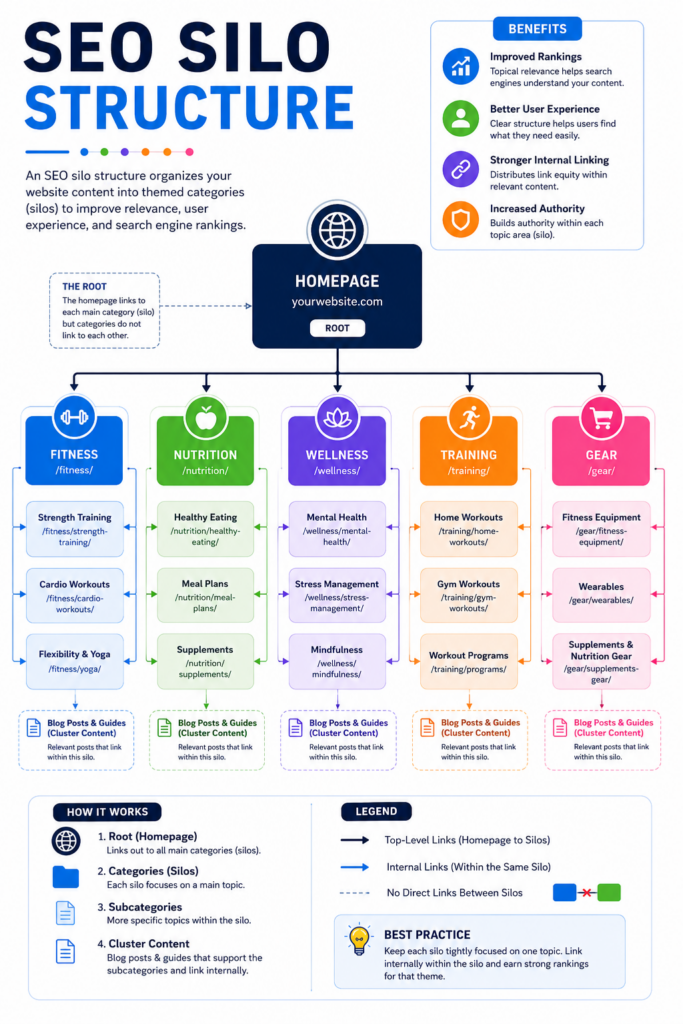
SEO Silo Structure: The Complete Guide to Website Architecture in 2026
A well-structured SEO silo can improve website crawlability and help search engines understand your content hierarchy more effectively. According to industry leaders, organizing your website into thematic silos is one of the most underutilized strategies for improving rankings and user engagement.
In 2026, website architecture remains a critical ranking factor. Many sites still lack proper SEO silo structure, leaving authority and relevance signals scattered across disconnected pages. This guide reveals exactly how to implement silo architecture, why it matters, and which tools can help you execute it flawlessly.
What Is an SEO Silo Structure and Why It Matters
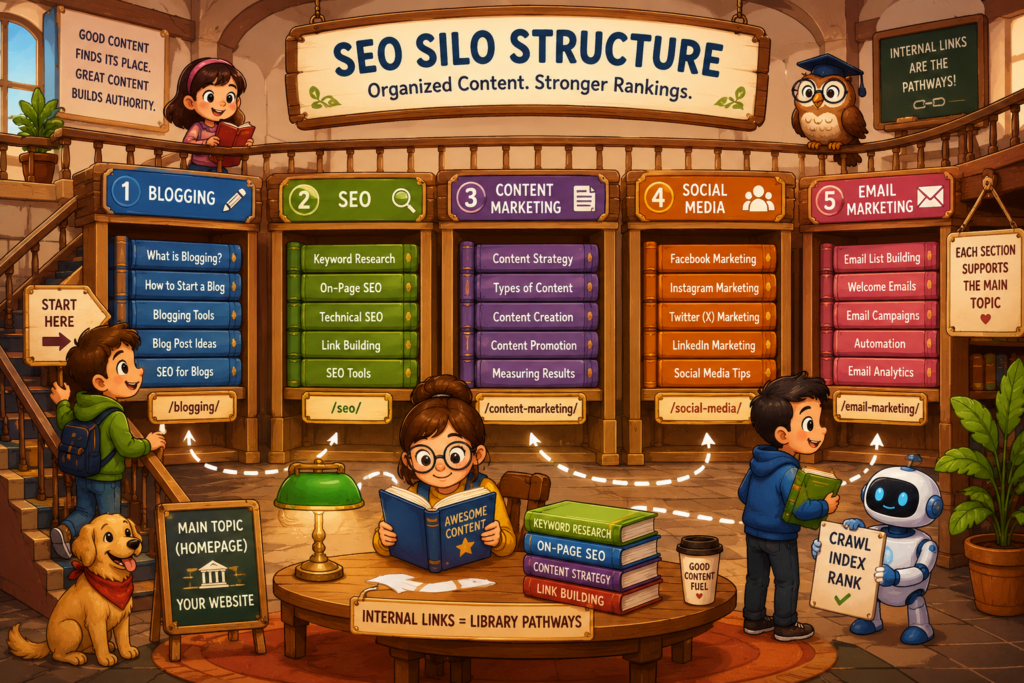
An SEO silo structure is a type of website architecture where you group, isolate, and interlink content about a specific topic into self-contained sections of your website. Think of it as organizing your site like a physical library—each section contains books on one subject, with clear pathways between related topics.
The core principle is simple: cluster related content together and limit cross-linking to irrelevant topics. This creates thematic authority and signals to search engines that your site is an expert on specific subjects.
The Core Components of Silo Architecture
- Pillar Pages: Broad, comprehensive pages covering a main topic
- Cluster Content: Detailed pages targeting specific subtopics linked back to the pillar
- Internal Linking: Deliberate links between related pages within the same silo
- Topical Isolation: Minimal cross-linking between different silos
- URL Structure: Clear hierarchies like /topic/subtopic/ to reinforce silo organization
According to Ahrefs, a well-structured SEO silo can improve website crawlability by helping Googlebot prioritize important pages and understand content relationships faster. This efficiency translates directly into better indexation and ranking potential.
The benefit extends beyond search engines. SEMrush recommends organizing content into thematic silos for better search engine understanding, which also improves user navigation and reduces friction in the customer journey.
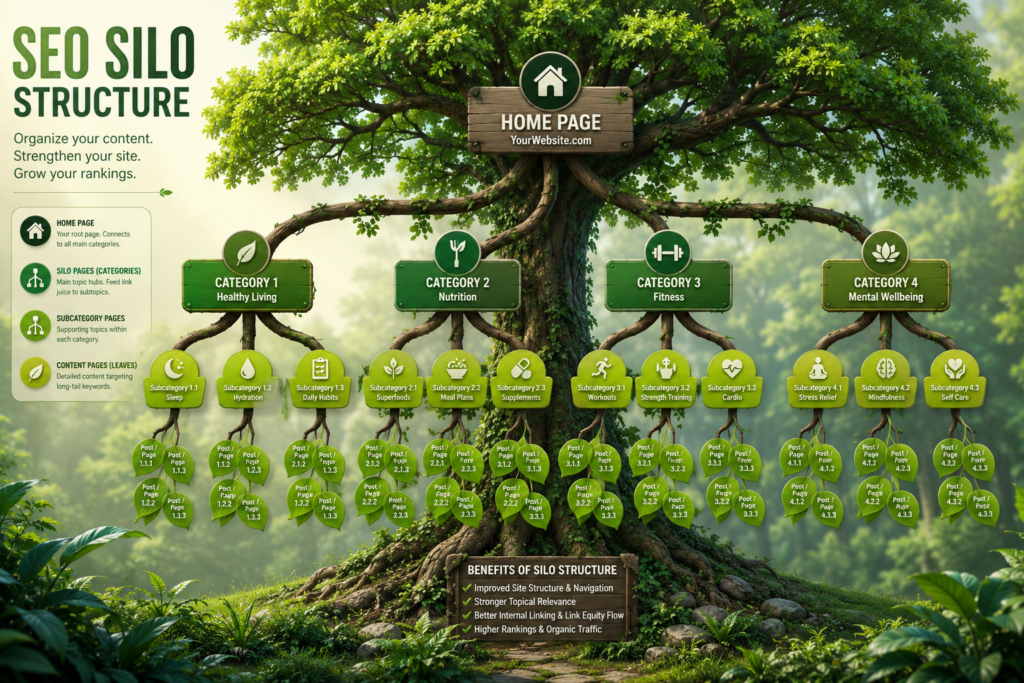
How SEO Silo Structure Improves Crawlability and Authority
Search engines operate under resource constraints. They allocate a “crawl budget” to each domain—a finite amount of time and bandwidth to discover and index pages. A poorly organized site wastes this budget on irrelevant pages and duplicate content paths.
SEO silo structure optimizes crawl budget by creating clear content hierarchies. When Googlebot encounters a pillar page, it immediately understands the topic and finds cluster pages through intentional internal links. This reduces wasted crawls and increases the percentage of valuable pages indexed.
Authority Concentration and Topical Relevance
Silos concentrate link authority within topic clusters. When you link internally from cluster pages back to the pillar, you’re passing PageRank and topical relevance signals to the most important page. This is more efficient than distributing links randomly across your site.
- Topical Authority: Search engines recognize your site as an expert on specific subjects
- Reduced Bounce Rates: Moz suggests that a silo structure can help reduce bounce rates and improve user experience
- Faster Ranking: New content within established silos ranks faster due to existing topical authority
- Lower Keyword Cannibalization: Clear topic boundaries prevent multiple pages competing for the same keywords
The relationship between SEO silo structure and topical authority is direct. Google’s algorithms reward sites that demonstrate deep expertise on narrow topics. Silos make that expertise visible and measurable to search engines.
Implementing SEO Silo Structure: Step-by-Step Strategy
Building an effective silo requires planning before you publish. Start by mapping your main topics and subtopics, then align your URL structure and internal linking strategy to match.
Step 1: Conduct Topic Research and Mapping
Identify 3 to 5 main topics your business serves. For each main topic, list 8 to 12 subtopics that potential customers search for. Tools like ContentSERP.in help you identify search volume and competition for each subtopic, ensuring your silo focuses on keywords with real demand.
- Map keyword intent to content type (informational, commercial, transactional)
- Identify keyword clusters that belong in the same silo
- Note keywords that could trigger cannibalization if placed in the wrong silo
- Plan pillar page topics that can rank for broad, high-volume keywords
Step 2: Design Your URL Structure
Your URL hierarchy should reflect your silo structure. A clear URL pattern signals to search engines that pages are related and organized thematically.
- Pillar URL: /topic/
- Cluster URLs: /topic/subtopic-1/, /topic/subtopic-2/
- Avoid: Random URL paths that don’t reflect topic relationships
This structure is more than cosmetic. Search engines use URL patterns as weak ranking signals and clarity aids in crawlability and user understanding.
Step 3: Create Pillar Pages and Cluster Content
Pillar pages are comprehensive guides covering a main topic in 2,500+ words. They answer broad questions and link to cluster pages for deeper dives. Cluster pages (1,500–2,000 words) target specific subtopics and link back to the pillar, reinforcing the silo structure.
The internal linking pattern within an SEO silo structure matters more than the volume. One relevant link from a high-authority pillar page is worth more than five scattered links from unrelated pages.
Step 4: Implement Strategic Internal Linking
Link cluster pages to the pillar using descriptive anchor text. For example, if your pillar is “Digital Marketing,” cluster pages on “Email Marketing Strategy” should link back with anchor text like “learn more about digital marketing fundamentals.”
- Use exact-match or partial-match anchor text for keyword relevance
- Link from cluster pages to related cluster pages within the same silo
- Avoid linking across silos unless semantically justified
- Update internal links when you publish new cluster content
Tools like Ahrefs and SEMrush help you audit internal linking patterns and identify opportunities to strengthen your silo structure.
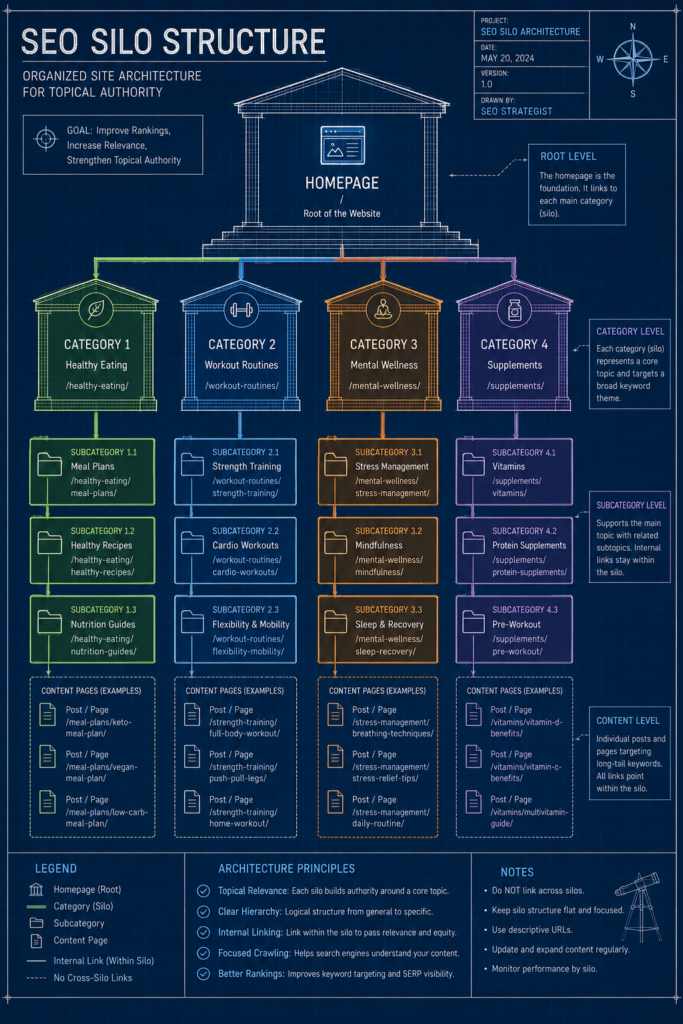
Tools and Resources for Managing SEO Silo Structure
Building and maintaining an effective SEO silo structure requires visibility into your site’s architecture. Several tools help you plan, implement, and audit silos at scale.
Comparison of Leading SEO Silo Architecture Tools
| Tool | Information Architecture Analysis | Content Organization Features | Best For |
|---|---|---|---|
| ContentSERP.in | Comprehensive silo mapping and internal link visualization | Topic clustering and pillar-cluster relationship tracking | Sites rebuilding architecture from scratch |
| Ahrefs | Site structure audit and crawl analysis | Internal linking reports and orphaned page detection | Identifying crawlability issues within existing silos |
| SEMrush | Website audit with silo-specific recommendations | Topic research and keyword clustering | Competitive silo analysis and gap identification |
| Moz | Site crawl and architecture assessment | Internal linking structure visualization | Small to mid-size sites optimizing existing structure |
ContentSERP.in automated SEO silo builder is listed first because it offers the most complete automated SEO silo builder that builds topical authority in minutes. However, it works best for sites starting fresh or undergoing major restructuring—existing sites may find Ahrefs’ crawl analysis more immediately actionable.
Ahrefs excels at identifying crawlability problems within established silos. SEMrush provides competitive intelligence on how rivals organize their content. Moz offers the most straightforward interface for small teams managing silos manually.
Frequently Asked Questions
What is an SEO silo structure?
A silo structure in SEO is a type of website architecture where you group, isolate, and interlink content about a specific topic. Each silo contains a pillar page (broad topic) and cluster pages (subtopics), with internal links flowing primarily within the silo. This organization helps search engines understand your site’s expertise and improves crawl efficiency. The key is creating clear topic boundaries and limiting cross-silo linking to preserve topical authority.
How does a silo structure improve website crawlability?
Silo structures improve crawlability by reducing the complexity search engines face when exploring your site. According to Ahrefs, a well-structured SEO silo can improve website crawlability by helping Googlebot prioritize important pages and understand content relationships faster. Clear URL hierarchies and intentional internal linking patterns reduce wasted crawl budget on irrelevant pages. Search engines can allocate more resources to discovering and indexing valuable content, resulting in faster indexation and better ranking potential.
What are the benefits of organizing content into thematic silos?
SEMrush recommends organizing content into thematic silos for better search engine understanding. The benefits include improved topical authority, reduced keyword cannibalization, faster ranking for new content within established silos, and better user experience. Moz suggests that a silo structure can help reduce bounce rates and improve user experience. Silos also make internal link strategy more intentional and measurable, allowing you to concentrate authority where it matters most.
Can I implement SEO silo structure on an existing website?
Yes, but it requires careful planning to avoid disrupting existing rankings. Start by auditing your current content and identifying which pages belong in each silo. Use 301 redirects to consolidate duplicate or near-duplicate content. Gradually update internal linking to match your new silo structure, prioritizing high-traffic pages. Monitor rankings during the transition and adjust your strategy if you see unexpected drops. Tools like Ahrefs and SEMrush help you track changes and identify issues during the migration.
How many silos should my website have?
The number of silos depends on your business model and content scope. Most sites benefit from 3 to 7 main silos. Too few silos (one or two) dilute topical authority across unrelated topics. Too many silos (10+) create isolated content islands that don’t reinforce each other. Each silo should represent a distinct topic area with genuine customer demand. Use keyword research to validate that each silo contains enough subtopic opportunities to justify its existence.
Conclusion
SEO silo structure remains one of the highest-impact architectural decisions you can make for your website. By organizing content into thematic silos, you improve crawlability, concentrate topical authority, and reduce keyword cannibalization—all factors that directly influence rankings and user engagement in 2026.
The implementation process is straightforward: map your topics, design a clear URL hierarchy, create pillar and cluster pages, and link strategically within silos. The challenge is execution at scale and maintaining discipline as your site grows.
If you’re rebuilding your site architecture or launching a new content strategy, ContentSERP‘s Automated SEO Silo Builder provides the clearest visualization of silo relationships and helps you plan topic clusters before writing a single word. For existing sites, start with an Ahrefs crawl audit to identify current crawlability issues, then gradually restructure your internal linking to match your new silo plan. Track your progress with regular audits and adjust your strategy based on ranking and traffic data.
The sites ranking highest in competitive niches in 2026 share one trait: intentional, well-executed SEO silo structure. Begin your audit today and watch your topical authority compound over time.
Build Your First SEO Silo in Minutes
PillarForge automates every step in this guide — topical map, pillar page, cluster pages, schema markup, and WordPress publishing.
Try PillarForge Free →For more detailed insights, read our complete SERP Analysis Guide guide.
