What is SERP Analysis? Complete Guide for 2025

What is SERP Analysis? A Comprehensive Definition
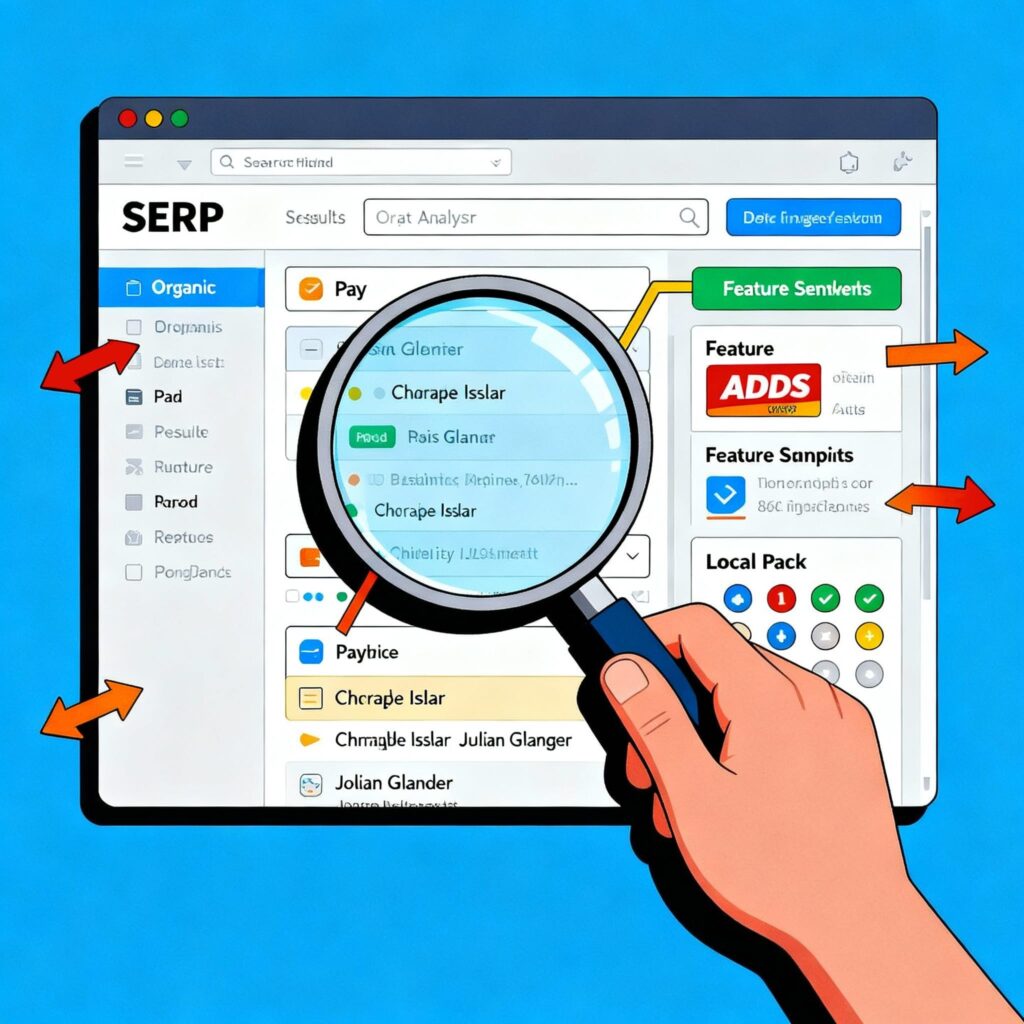
SERP analysis systematically examines search engine results pages (SERPs) to understand how Google and other search engines rank content for specific keywords, what features they display, and how your competitors are positioning themselves. This strategic examination goes beyond simply checking rankings—it involves a deep dive into the structure, intent, and competitive landscape of search results to inform your SEO and content strategy.
Once you understand SERP dynamics, implementing precision rank tracking ensures you can measure your optimization impact over time.
To analyze live Google search engine results pages and check your competitor positions, try our free SERP checker for India.
When you conduct SERP analysis, you are essentially reverse-engineering Google’s decision-making process to understand:- What type of content does Google consider most relevant for specific search queries
- Which SERP features appear (featured snippets, People Also Ask boxes, knowledge panels, etc.)
- How your competitors are structuring their content to achieve top rankings
- What search intent Google has identified for particular keywords
- Which ranking factors seem most influential for your target keywords
This analytical approach serves as the foundation for data-driven SEO decisions rather than relying on assumptions or outdated best practices. As search algorithms evolve in 2025, proper SERP analysis has become beneficial and essential for digital marketing success.
What is SERP Analysis and Matters: The Statistical Advantage
The importance of SERP analysis cannot be overstated in today’s competitive digital landscape. Consider these compelling statistics:
- The first organic result in Google Search has an average click-through rate (CTR) of 27.6%, while the 10th position gets only 2.4% (Advanced Web Ranking, 2023)
- 68.3% of all clicks go to the top five organic results (Backlinko, 2024)
- SERP features now appear in 85% of all searches, reducing organic click-through rates by an average of 5-10% (SEMrush, 2024)
- Companies that conduct regular SERP analysis see an average 15% improvement in organic traffic within 3 months (Search Engine Journal, 2023)
- 76% of SEO professionals rate SERP analysis as “very important” or “critical” to their strategy (Ahrefs, 2024)
These statistics highlight a crucial reality: without understanding what is happening on the search results page, you are essentially operating blind. SERP analysis provides the visibility needed to:
Identify Real Opportunities
By analysing SERPs, you can identify keywords with high ranking potential but manageable competition. This targeted approach is far more effective than pursuing high-volume keywords without considering ranking difficulty or SERP features that might limit organic visibility.
Understand Evolving Search Intent
Google continuously refines its understanding of search intent, and what worked last year may not work today. Regular SERP analysis helps you track these shifts and adapt your content strategy accordingly.
Optimize for SERP Features
With featured snippets appearing in nearly 30% of searches, optimising specifically for these and other SERP features can dramatically increase your visibility—even if you are not in position #1.
Refine Content Strategy
Understanding what type of content Google favours for specific queries (guides, listicles, videos, etc.) allows you to align your content creation efforts with proven formats rather than guessing what might work.
The Comprehensive SERP Analysis Methodology
Practical SERP analysis follows a systematic approach. Here is our step-by-step methodology that combines foundational techniques with advanced strategies:
Step 1: Define Your Keyword Universe
Before analysing SERPs, you need to identify which keywords matter most to your business:
- Start with seed keywords closely related to your products/services
- Expand using keyword research tools like Ahrefs, SEMrush, or Keyword Planner
- Group keywords by topical relevance and search intent
- Prioritise based on business value, search volume, and ranking potential
Step 2: Analyze Search Intent
For each priority keyword, examine the SERP to determine the dominant search intent:
- Informational: Searchers want to learn something (guides, how-tos, explanations)
- Navigational: Searchers want to find a specific website or page
- Commercial investigation: Searchers are researching before making a purchase
- Transactional: Searchers are ready to buy or complete an action
Look beyond the traditional intent categories to identify specific content formats Google prefers. Is it favouring step-by-step guides, comparison posts, or definitive resources? The top-ranking pages reveal what Google considers most relevant for the query.
Step 3: Map SERP Features
Document all SERP features appearing for your target keywords:
- Featured snippets (paragraph, list, table)
- People Also Ask boxes
- Knowledge panels
- Local packs
- Image carousels
- Video results
- Shopping results
- Top stories
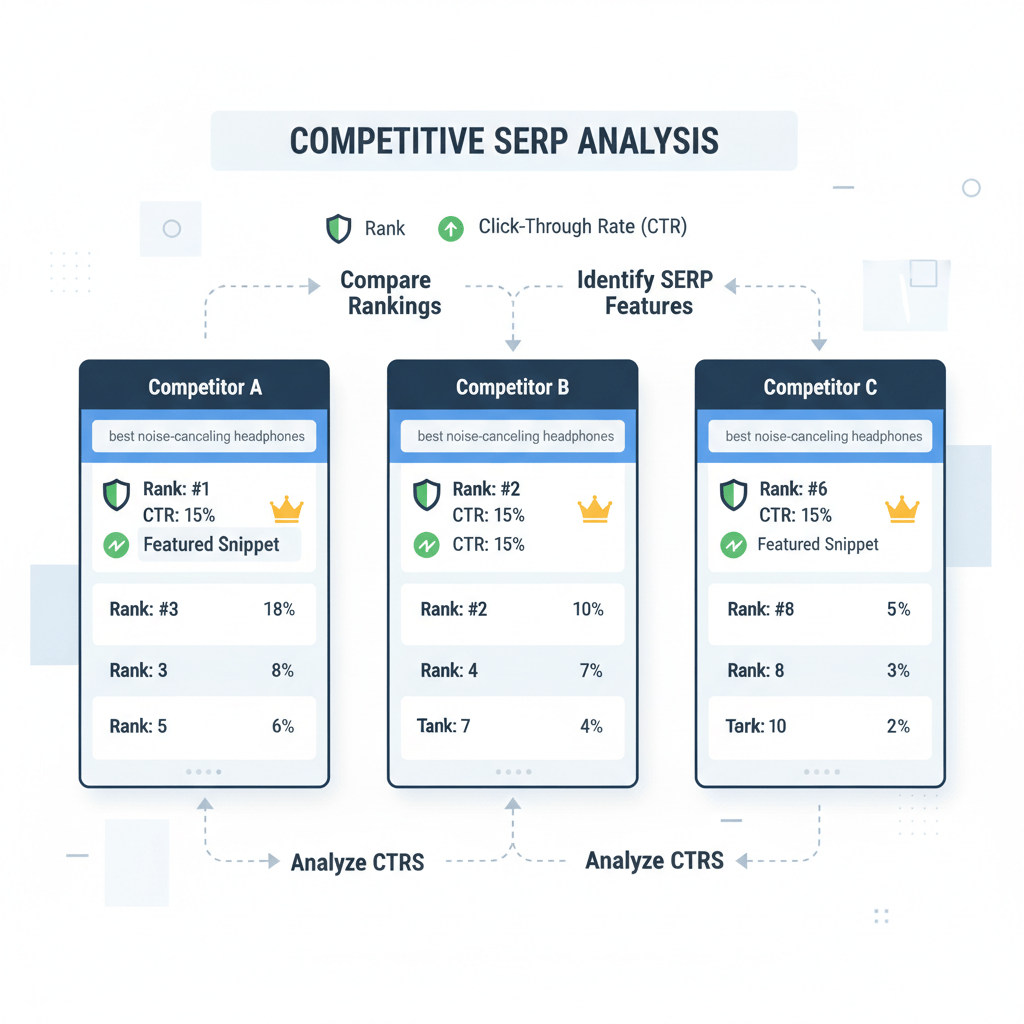
Each feature represents both an opportunity and a potential threat to organic visibility. For example, a featured snippet might give you position #0 visibility, while a dominant local pack might push organic results below the fold.
Step 4: Conduct Competitor Analysis
For each target keyword, analyse the top 10 ranking pages in depth:
- Content length and depth
- Content structure (headings, subheadings)
- Content format (blog post, guide, tool, video)
- Media usage (images, videos, infographics)
- Page experience metrics (Core Web Vitals)
- Backlink profile (quantity and quality)
- Domain authority
- Publishing date and update frequency
Look for patterns among top-ranking pages to identify what Google considers essential for this specific query.
Step 5: Assess Keyword Difficulty
Evaluate the realistic ranking potential for each keyword by considering:
- Authority of ranking domains
- Content quality of top results
- Backlink profile strength of ranking pages
- SERP feature saturation
- Historical ranking volatility
This assessment helps you prioritise which keywords to target first and which might require a longer-term strategy.
Step 6: Document Content Gaps
Compare top-ranking content against each other to identify:
- Topics covered by multiple top-ranking pages (essential content)
- Information missing from most or all top results (opportunity gaps)
- Outdated information that needs updating
- Questions addressed in People Also Ask boxes, but not thoroughly in ranking content
These gaps represent opportunities to create more comprehensive, valuable content than what currently ranks.
Industry-Specific SERP Analysis: Tailoring Your Approach
SERP analysis is not one-size-fits-all. Different industries show distinct patterns in how Google presents results and what factors influence rankings. Let us explore how SERP analysis varies across sectors:
E-commerce SERP Analysis
For e-commerce keywords, focus on:
- Product SERP features (shopping results, image packs)
- Commercial intent signals (pricing information, review stars)
- Category vs. product-specific result patterns
- Seasonal SERP changes
- Marketplace dominance (Amazon, eBay, etc.)
Example: For the keyword “wireless headphones,” SERP analysis reveals Google prioritises category pages with comparison capabilities and prominent review information over single product pages, suggesting content should focus on helping users compare options rather than promoting a single product.
Healthcare SERP Analysis
For healthcare-related keywords:
- E-A-T signals (expertise, authoritativeness, trustworthiness)
- Medical knowledge panels
- Health organisation dominance
- Content freshness requirements
- Credential display patterns
Example: SERP analysis for “diabetes symptoms” shows Google heavily favours content from established medical institutions with clear author credentials. Independent blogs rank only when they cite multiple authoritative sources and clearly display medical review information.
Local Business SERP Analysis
For location-based searches:
- Local pack presence and triggers
- Map integration patterns
- Review visibility factors
- Directory site prominence
- Location-specific content signals
Example: Analysing SERPs for “plumber near me” reveals businesses with complete Google Business Profiles, numerous recent reviews, and location-specific landing pages consistently outrank competitors with generic service pages.
B2B SERP Analysis
For business-to-business queries:
- Content depth expectations
- Case study and social proof elements
- PDF and downloadable resource presence
- Thought leadership indicators
- Industry publication authority
Example: SERP analysis for “enterprise CRM solutions” shows Google prioritises in-depth comparison content (3000+ words) with specific use cases, ROI calculations, and integration information over general product descriptions.
Essential SERP Analysis Tools Comparison
The right tools dramatically improve your SERP analysis efficiency and insights. Here is a comparison of leading options:
| Tool | Key SERP Analysis Features | Best For | Price Range |
|---|---|---|---|
| SEMrush | SERP feature tracking, position tracking, keyword difficulty, intent analysis | Comprehensive analysis with competitive intelligence | $119-$449/month |
| Ahrefs | SERP overview, keyword difficulty, content gap analysis, SERP position history | Content-focused SERP analysis with strong backlink data | $99-$999/month |
| Moz Pro | SERP analysis, featured snippet opportunities, keyword difficulty | User-friendly interface with strong local SERP analysis | $99-$599/month |
| Surfer SEO | SERP analyser, content editor with real-time SERP comparison | Content optimization based on SERP analysis | $59-$239/month |
| SE Ranking | SERP features tracking, competitor analysis, keyword grouping | Budget-friendly comprehensive SERP analysis | $39-$189/month |
| ContentSERP | SERPChecker, SERPWatcher, keyword difficulty | Straightforward SERP analysis for beginners | Rs. 999/- pay as you go |
While paid tools offer efficiency and depth, you can also conduct fundamental SERP analysis using free methods:
- Google Search Console for your own ranking data
- Chrome incognito mode for manual SERP examination
- MozBar (free version) for basic domain metrics
- Google’s Rich Results Test for schema opportunities
The ideal approach often combines automated tool analysis with manual review for nuanced insights that algorithms might miss.

Advanced SERP Analysis Techniques for 2025
As search algorithms grow more sophisticated, advanced SERP analysis techniques provide competitive advantages:
NLP-Based Content Analysis
Use Natural Language Processing tools to analyse the semantic structure of top-ranking content:
- Extract entity relationships between key topics
- Identify concept clusters that appear across the top results
- Map semantic relevance patterns that Google appears to favour
- Analyse content readability and complexity levels
Tools like Clearscope, MarketMuse, and IBM Watson Natural Language Understanding can help identify the semantic patterns Google associates with high-quality content for specific queries.
User Behavior Signal Analysis
Examine how user behaviour impacts rankings by analysing:
- Click-through rate patterns across positions
- Dwell time indicators (time on page, bounce rate)
- Search refinement patterns (what users search next)
- SERP interaction signals (People Also Ask expansions)
While you cannot directly see competitors’ user signals, you can use your GSC data and tools like Similarweb to infer patterns.
AI-Powered Predictive SERP Analysis
Leverage machine learning to predict SERP changes:
- Identify trending subtopics before they dominate SERPs
- Predict seasonal SERP shifts based on historical patterns
- Forecast ranking potential based on content and authority metrics
- Model potential SERP layout changes based on Google’s testing patterns
Tools like BrightEdge and MarketBrew offer predictive capabilities that help you stay ahead of SERP evolutions.
Multi-Device SERP Comparison
Compare how SERPs differ across:
- Mobile vs. desktop devices
- Different geographic locations
- Various browser types
- Logged-in vs. logged-out states
These comparisons reveal Google’s device-specific priorities and personalisation factors that might impact your strategy.
Implementing SERP Analysis Findings into Your Content Strategy
Gathering SERP insights is only valuable when translated into an actionable content strategy. Here is how to implement your findings effectively:
1. Create Content Briefs Based on SERP Patterns
Develop detailed content briefs that incorporate:
- Optimal content structure based on top-ranking pages
- Essential subtopics identified across top results
- SERP feature optimisation opportunities (featured snippets, etc.)
- Content format guidance (length, media usage, etc.)
- Key questions to address from People Also Ask boxes
These briefs ensure content creators focus on what actually matters for ranking, not just general best practices.
2. Develop Content Clusters Around Search Intent
Rather than creating isolated pieces, build topical clusters that:
- Address multiple related search intents
- Create internal linking structures that mirror semantic relationships
- Cover the complete user journey from awareness to decision
- Fill identified content gaps across the topic ecosystem
This approach builds topical authority while satisfying diverse user needs.
3. Implement Iterative Optimisation Based on SERP Movement
Create a continuous improvement cycle:
- Publish content based on initial SERP analysis
- Monitor ranking changes and SERP feature capture
- Analyse performance against expectations
- Refine content based on actual SERP performance
- Repeat the process with progressive enhancements
This iterative approach recognises that SERP analysis is not a one-time activity but an ongoing process.
Case Studies: SERP Analysis Success Stories
Let us examine real-world examples of effective SERP analysis implementation:
Case Study 1: E-Commerce Category Page Optimisation
Company: Online home goods retailer
Challenge: Category pages for “bathroom vanities” stuck on page 2 despite strong domain authority
SERP Analysis Findings:
- Top-ranking pages featured extensive filtering options
- Comprehensive size and dimension information appeared in all top results
- Image-heavy results with multiple product views dominated
- “Installation” and “maintenance” information appeared in all top-ranking pages
Implementation:
- Redesigned category page with enhanced filtering capabilities
- Added detailed specification tables for all products
- Expanded product imagery with room context shots
- Added installation and maintenance guides within the category page
Results:
- Moved from position #14 to position #3 within 8 weeks
- Organic traffic increased by 143% year-over-year
- Conversion rate improved by 28%
Case Study 2: Medical Content Authority Building
Company: Health information website
Challenge: Unable to rank for competitive treatment-related keywords despite factually accurate content
SERP Analysis Findings:
- Top results all featured clear author credentials (MD, PhD)
- Study citations appeared directly in content (not just reference lists)
- Recent publication/update dates (within 6 months) were prominent
- Patient experience information complemented clinical content
Implementation:
- Established medical review board with credentialed professionals
- Added prominent author and reviewer credentials
- Implemented in-text citation format with study publication dates
- Added patient perspective sections with real case examples
- Created quarterly content update schedule
Results:
- Achieved first-page rankings for 67% of target keywords within 6 months
- Featured snippet capture increased from 3% to 24% of ranking keywords
- Organic traffic increased by 209% year-over-year
For effective SERP analysis, several tools can provide valuable insights.
Ahrefs allows you to analyze keyword rankings and SERP features, making it a favorite among SEO professionals. SEMrush offers extensive keyword tracking and competitive research, helping to identify optimization opportunities.
Moz provides insights into rankings and domain authority, while its Keyword Explorer aids in understanding search volume and competition. Google Search Console is essential for monitoring your website’s performance in search results, including clicks and average rankings.
Finally, ContentSERP by contentserp.in offers an intuitive way to track keyword positions and real-time SERP changes. Utilizing these tools can significantly enhance your SERP analysis and SEO strategy.
Some Images created to Gemini AI
Modern SERP Analysis: Entity Extraction, Search Intent Mapping, and Real-Time Tracking
Google’s search engine algorithms have transitioned from simple keyword matching to entity-based semantic understanding. This shift has redefined how SEO professionals perform SERP analysis. Analyzing search engine results pages is no longer just about looking at competitor backlink profiles and content length; it requires dissecting the entities Google associates with a query and mapping search intent with surgical precision.
To outrank established competitors, your SERP analysis workflow should include these three essential steps:
- Search Intent Classification: Analyze whether the top 10 results represent Informational, Navigational, Commercial, or Transactional intent. If the SERP is dominated by e-commerce category pages (Transactional), attempting to rank with a long-form blog post (Informational) is nearly impossible because Google has already determined what format users prefer.
- Entity Extraction and Content Gap Audits: Use natural language processing (NLP) tools to extract the primary concepts, brands, and terms Googlebot finds on the top-ranking pages. Identify content gaps in your own pages by highlighting entities your competitors cover but you have omitted.
- SERP Feature Capture: Modern search layouts are crowded with rich features like Featured Snippets, People Also Ask (PAA) blocks, Video Carousels, Local Packs, and AI Overviews. Analyze how these features are triggered and optimize your content markup (using schema, FAQ structures, and clean table layouts) to capture these high-CTR positions.
Furthermore, SERP landscape volatility means rankings are never static. Algorithmic core updates, local search variance, and competitor adjustments can shift the SERP layout overnight. Regular tracking is necessary to monitor these changes and identify when Google is testing new layout formats or introducing new rich snippets. Failing to spot these shifts early can lead to sudden drops in organic traffic as search features push standard listings below the fold.
Using the ContentSERP Real-Time SERP Tracker, you can automate this analysis. By tracking rankings, intent changes, and featured snippet volatility across desktop and mobile devices, you get actionable insights to refine your on-page optimization. This allows you to spot content decay, identify when search intent shifts, and optimize your headings and semantic structure to reclaim top rankings and maintain consistent organic traffic.
Sources: Google Search Central – Helpful Content | Search Engine Journal
For video creators, conducting competitor video audits using our YouTube channel and video analyzer helps identify top performing tags and engagement patterns.
1 Comment