Google Keyword Planner vs ContentSERP
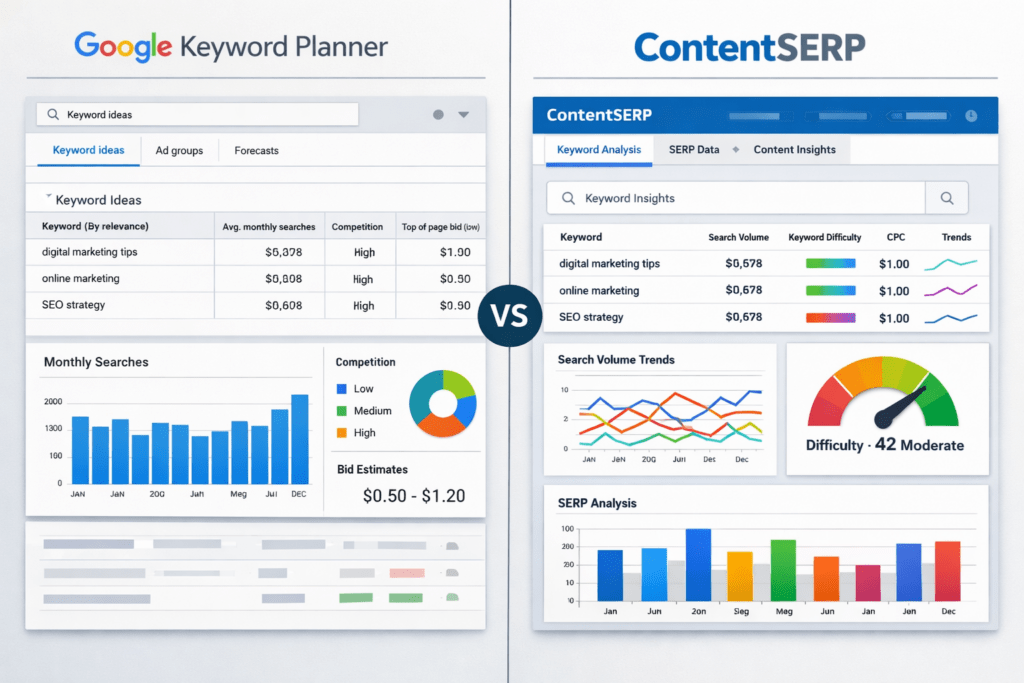
Google Keyword Planner vs ContentSERP: Choosing the Right Tool for 2026 SEO
In the rapidly evolving landscape of digital marketing, selecting the right infrastructure for your search strategy is no longer a luxury; it is a fundamental requirement for survival. As we navigate through 2026, search behavior has shifted dramatically, moving away from simple keyword stuffing toward intent-driven, localized queries. For many digital marketers, the default choice has historically been the Google Keyword Planner. However, as the ecosystem matures, the limitations of platform-specific tools become increasingly apparent. When you analyze the performance of your campaigns, you might find that relying solely on Google’s native tools limits your perspective. Understanding the nuanced differences between the industry standard, keyword research, and specialized platforms like ContentSERP is essential for any serious SEO professional.
What Each Tool Is Actually Built For :
Before comparing features, it helps to understand the original design intent of each tool — because that intent shapes every limitation and advantage you will encounter.
Google Keyword Planner was designed for Google Ads advertisers. Its primary job is to help you estimate how much it will cost to bid on a keyword in a paid campaign, and how many clicks you might expect. The fact that SEO professionals use it for organic keyword research is largely a secondary, unofficial use case. This explains why it shows broad volume ranges (1K–10K) instead of exact numbers — Google deliberately restricts precision to users who are not actively running ads.
ContentSERP was built from the ground up for the Indian organic search market. Its primary job is to help content creators find high-opportunity keywords in Hindi, Hinglish, and regional Indian languages, and understand the competitive landscape of those keywords before writing a single word. It is not an ads tool. Everything it does — CPC in ₹, Hinglish support, competitor gap analysis — is oriented toward helping Indian bloggers rank on Google organically.
Understanding this distinction is the key to using both tools correctly.
Limitations of Google Keyword Planner for SEO
The primary critique of the Google Keyword Planner is its inherent design as an advertising tool rather than an SEO research tool. Because it is built to serve Google Ads, the data provided is often “broadened” to encourage higher bidding. Organizations using Google Keyword Planner report that the tool shows only broad volume ranges (1K–10K) unless you’re running active ads. This lack of granularity is a significant hurdle for teams attempting to perform high-level competitor analysis for SEO. Without exact data, determining the ROI of a specific content piece becomes a game of chance.
The Problem with Broad Ranges
Google Keyword Planner forces users into a funnel. Unless you are actively spending on Google Ads, you are often relegated to viewing only broad volume ranges. This makes it nearly impossible to identify “long-tail” opportunities that could offer a high conversion rate with low competition. For businesses operating in competitive sectors, this lack of specific data means missing out on the “low-hanging fruit.” In contrast, platforms that prioritize granular data allow for a much more surgical approach to content planning.
The Competitive Analysis Deficit
Another major weakness of Google’s native tool is its inability to perform deep competitive intelligence. Google Keyword Planner lacks competitor keyword gap analysis for India. This is where dedicated platforms shine. By integrating tools that offer direct insight into competitor strategies, you can pivot your content roadmap to fill the gaps left by your rivals, effectively “stealing” traffic that would otherwise go to them.
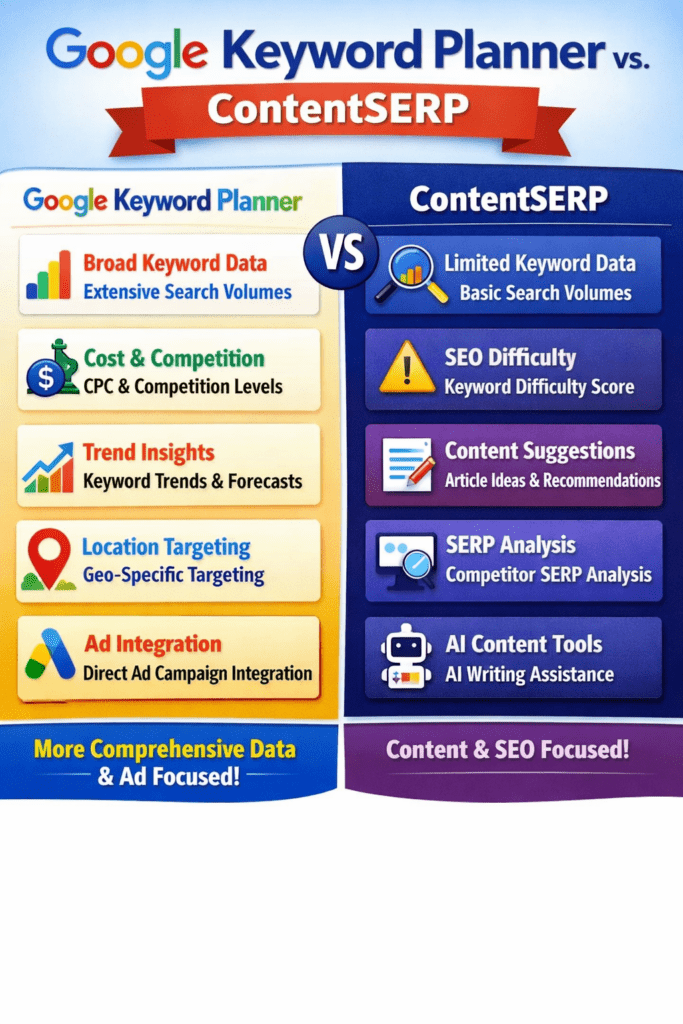
Where Google Keyword Planner Genuinely Wins :
A fair comparison requires acknowledging what Google Keyword Planner does well. There are specific situations where it is the right tool — and knowing them will save you both time and money.
1. You are planning a Google Ads campaign. Google Keyword Planner is the most accurate tool for PPC budget planning because it draws directly from Google’s ad bidding data. If you are running Google Ads for a client or your own business, start here. No third-party tool beats it for bid estimates.
2. You are a complete beginner with zero budget. If you are starting your first blog with no budget at all, Google Keyword Planner gives you enough signal to get started — broad volume ranges, basic competition levels, and trend data. It is free, requires only a Google account, and is safe to use without any technical knowledge.
3. You need to verify a high-level trend quickly. Want to know if “electric cars in India” is growing or declining as a search topic? Google Trends combined with Keyword Planner gives you reliable directional data that is directly sourced from Google’s own systems — no sampling, no estimation.
4. Your content is entirely in English targeting a global audience. If you are writing English-only content and targeting global traffic rather than specifically Indian searches, Keyword Planner’s global dataset is entirely adequate.
5. You need a zero-cost sanity check alongside another tool. Many professional SEO practitioners use Keyword Planner as a free secondary validation layer alongside premium tools — not as their primary research platform.
Localized SEO and the Power of Multilingual Search
As the internet becomes more inclusive, the dominance of English-only SEO tools is waning. India represents one of the most vibrant and complex search markets globally. With 11 Indian languages supported by ContentSERP, it provides a localized edge that global behemoths often overlook. If your target audience is searching in their mother tongue, relying on tools that only track English keywords is effectively blindfolding your SEO strategy.
Why Language Matters for Conversion
Searchers are significantly more likely to engage with content that matches their linguistic and cultural context. When you optimize for local languages, you are not just capturing traffic; you are building trust. This is the cornerstone of effective AI engine optimization in 2026. By utilizing tools that understand the nuances of Hindi/Hinglish, you ensure that your content is not just visible, but resonant.
- Better Engagement: Native language content reduces bounce rates and increases dwell time.
- Lower CPCs: Often, competition for non-English keywords is lower, leading to better ROI on paid campaigns.
- Increased Authority: Demonstrating that you understand the local user experience builds brand credibility faster.
Pricing and Value for SEO Professionals
When comparing Google Keyword Planner—which is technically “free” but requires ad spend to unlock full utility—against paid alternatives, the value proposition changes. ContentSERP offers a structured pricing model, with ₹999 as the starting price for pay-as-you-go packs. This allows small businesses and agencies to scale their usage according to their actual needs, rather than being forced into a high-cost enterprise subscription or a restrictive free tier.
Breaking Down the Cost
While many marketers gravitate toward free tools, the hidden cost of “free” is often missed opportunity. If a tool provides inaccurate data, you are paying for that inaccuracy through wasted development time and failed content strategies. When you consider the cost of an SEO specialist’s time, investing in a tool that provides exact monthly search volumes for India actually saves money in the long run. By streamlining your research process, you reduce the time required to move from keyword discovery to content production.
The “Pay-As-You-Go” Advantage
The flexibility of modern SaaS tools like ContentSERP cannot be overstated. By offering pay-as-you-go packs, these platforms remove the barrier to entry for freelancers and startups. You are no longer locked into annual contracts that you might not fully utilize. This shift toward user-centric pricing is a direct response to the needs of the modern digital economy, where agility is a competitive advantage.
Advanced SEO Workflow Automation
The transition from traditional SEO to AI-driven search requires a new class of tools. While Google continues to refine its algorithms, the way we optimize for them must also evolve. Using ContentSERP v2.0, marketers can automate the internal linking process and create pillar pages that satisfy both search engines and human readers. This is the future of content strategy: intelligent automation paired with deep data insights.

Automating the SEO Workflow
Manual keyword research is becoming a relic of the past. Today’s most successful SEOs use automation to handle the heavy lifting. From identifying high-intent keywords to mapping them across a site structure, automation ensures that your site is constantly optimized for the latest Googlebot search patterns. This is not about cutting corners; it is about scaling your expertise.
- Intelligent Internal Linking: Automatically connect related content to pass link equity effectively.
- Real-time Data Updates: Ensure your content remains relevant as search trends shift.
- Semantic Mapping: Align your content with the intent behind the query, not just the string of words used.
Feature-by-Feature Comparison Table :
| Feature | Google Keyword Planner | ContentSERP |
|---|---|---|
| Primary Purpose | Google Ads campaign planning | Indian organic SEO & content research |
| Price | Free | Free credits on signup; plans from ₹999 |
| Hinglish Keyword Support | ✗ Not supported | ✓ Native support |
| Hindi (Devanagari) Keywords | ✗ Very limited | ✓ Full support |
| Regional Language Support | ✗ Limited | ✓ 11 Indian languages |
| Search Volume Precision | Ranges only (e.g. 1K–10K) unless running ads | ✓ Exact monthly figures |
| CPC Currency | USD ($) | ✓ Indian Rupees (₹) |
| Keyword Difficulty Score | ✗ Not available | ✓ Included |
| Competitor Keyword Gap Analysis | ✗ Not available | ✓ Included |
| Long-Tail Keyword Discovery | Basic | ✓ Automated, Hinglish-aware |
| Question-Based Keywords (kaise kare) | ✗ Poor | ✓ Dedicated filter |
| Historical Search Trend Data | ✓ Yes (via Google Trends) | ✓ Yes |
| CSV / Excel Export | ✓ Yes | ✓ Yes |
| PDF Report Export | ✗ No | ✓ Yes |
| Local / City-Level Keywords India | ✗ Limited | ✓ City & state level |
| Best For | Google Ads users, absolute beginners | Indian bloggers, marketers, SMEs |
The table above highlights the fundamental divide between a general-purpose advertising tool and a specialized SEO platform. While Google Keyword Planner is an undeniable necessity for managing ad campaigns, it lacks the surgical precision required for advanced SEO. ContentSERP, by contrast, focuses on the granular data required to dominate search rankings in the Indian market. For businesses that are serious about organic growth, the decision is clear: use Google for ads, and use specialized tools for content strategy.
How to Use Both Tools Together: A Practical Workflow :
The strongest approach for a serious Indian blogger is not choosing one tool over the other — it is using them at different stages of your workflow. Here is a concrete 5-step process using the example topic: “weight loss tips in Hindi.”
Step 1: Use Google Keyword Planner to Confirm Broad Topic Demand
Go to Google Keyword Planner → Discover New Keywords → enter “weight loss tips in Hindi.” You will likely see broad volume data (10K–100K) confirming the general topic has strong demand. This takes 2 minutes and gives you confidence the topic is worth pursuing. You do not need precision yet.
Step 2: Switch to ContentSERP to Find the Exact Keywords
In ContentSERP, enter “weight loss tips” and “weight loss kaise kare” separately. You will now see exact monthly volumes for Hinglish variants like:
- “weight loss tips kaise kare” — 8,100 searches/month
- “weight loss ka tarika” — 4,400 searches/month
- “pet kam kaise kare” — 22,000 searches/month
That last keyword — “pet kam kaise kare” — likely does not appear at all in Google Keyword Planner. It is now your primary target keyword.
Step 3: Filter by Keyword Difficulty
In ContentSERP, filter results by Keyword Difficulty below 40. This surfaces keywords where the current top-10 results are weak — smaller blogs, thin content — meaning a well-written article has a realistic path to ranking within 3–6 months.
Step 4: Run a Competitor Gap Analysis
Enter the top 2–3 Hindi health bloggers’ domains into ContentSERP’s competitor analysis. See which weight-loss Hinglish keywords they rank for on page 1 that you do not yet have content for. These gaps become your next 5 articles.
Step 5: Validate High-CPC Keywords with Google Keyword Planner
Before finalising your article plan, return to Google Keyword Planner to check which of your shortlisted keywords have the highest advertiser demand (high CPC). High CPC in a niche means high AdSense RPM for your blog. Prioritise articles that combine high search volume + low difficulty + high CPC. ContentSERP shows CPC in ₹ directly, but Keyword Planner’s CPC data is useful as a cross-reference since it draws directly from live auction data.
This workflow takes the precision of ContentSERP and the advertiser-data accuracy of Google Keyword Planner, combining both to produce a keyword strategy that is both rankable and monetisable.
Frequently Asked Questions
What are the differences between Google Keyword Planner and ContentSERP?
The primary difference lies in the purpose and the precision of the data provided. Google Keyword Planner is designed to help advertisers estimate budget and bid for Google Ads, which is why it provides broad volume ranges and prioritizes commercial intent. It is often opaque about exact search numbers unless you are an active advertiser.
ContentSERP is built specifically for SEO professionals and content strategists. It provides exact monthly search volume data, which is critical for making informed decisions about content ROI. Furthermore, ContentSERP excels in the Indian market by offering support for 11 regional languages, addressing the specific needs of the 600 million users searching in their native languages, a feature that general global tools often lack.
How do I use Google Keyword Planner for keyword research?
To use Google Keyword Planner, you first need a Google Ads account. Once logged in, you navigate to the “Tools and Settings” menu and select “Keyword Planner.” From there, you can enter your seed keywords or your website URL to see a list of related terms, their average monthly searches, and competition levels.
However, be aware that the “competition” metric in the Planner refers specifically to how difficult it is to win an ad placement for that keyword, not how difficult it is to rank organically. To use it effectively for SEO, you must treat these suggestions as a starting point rather than a final authority, often supplementing the data with a more specialized tool to verify search volume accuracy.
What is the alternative to Google Keyword Planner?
If you are looking for an alternative, you should consider tools that offer more granular data and competitor insights. ContentSERP is a leading alternative, especially for users targeting the Indian market or those who require exact search volume figures without needing to spend on ads. Other tools like Serpstat or Keywords Everywhere are also popular, though they may lack the specific localized language support that ContentSERP provides.
Is Google Keyword Planner no longer free?
The short answer is: yes, Google Keyword Planner is still free to use, but there’s a big ol’ caveat that often trips people up. While you don’t need to pay a subscription fee to access the tool, Google restricts the depth of data available to users who are not actively running ad campaigns. If your account is inactive or has low spend, you will often see volume ranges (e.g., 100-1K) instead of precise numbers.
This limitation makes it difficult to conduct meaningful SEO research, as you are essentially flying blind when trying to compare keywords with similar volumes. For many, this “free” status is outweighed by the loss of actionable data, leading them to seek out paid tools that provide transparent, exact metrics.
Is Google Keyword Planner accurate?
Google Keyword Planner only estimates keyword search volume. Because it is optimized for advertising spend, its primary goal is to show you the potential reach of your ads, not to provide scientific accuracy for organic search patterns. Industry data suggests that 91% of its figures are not exact, which is a significant margin of error for a content strategy.
This inaccuracy is most pronounced for long-tail keywords, which are the lifeblood of organic SEO. If you rely on these estimates for your site’s architecture, you might invest significant resources into terms that have little to no actual search intent, leading to a poor return on your effort. Always verify high-stakes keywords with a second source.
What is the most accurate keyword research tool?
There is no single “most accurate” tool, as search data is a complex aggregate of signals. However, for search volume data, Google Keyword Planner is often cited as the baseline. But for SEO-specific accuracy—including competitor analysis, exact volumes, and localized language support—specialized tools like ContentSERP often outperform the native Google tool.
The best strategy is to use a tool that sources data from multiple providers and offers specific insights into your target market. In 2026, the “most accurate” tool is the one that best understands the intent of your specific audience, whether that audience is searching in English, Hindi, or any of India’s other major regional languages.
Can I use Keyword Planner for competitor analysis?
Google Keyword Planner has extremely limited capabilities for competitor analysis. You can enter a competitor’s URL to get keyword ideas, but you cannot see their specific rankings, their traffic share, or their content gaps. You are essentially seeing what Google thinks is relevant to that URL, not what the competitor is actually winning on.
To perform true competitor analysis, you need a tool that can “spy” on the search results. You need to see exactly which keywords your competitors are ranking for on the first page, what their domain authority is, and where the gaps in their content strategy exist. ContentSERP is designed for this type of deep-dive analysis, allowing you to build a strategy that outperforms, rather than just mimics, your competition.
Is local SEO data available in Google Keyword Planner?
Yes, you can filter by location in Google Keyword Planner, but the data is often aggregated at a regional or national level. If you are a hyper-local business, this might not be precise enough. You need to understand local search trends in specific cities or districts to truly dominate the local market.
Furthermore, local SEO is about more than just keywords; it is about reviews, business profile health, and local backlinks. Relying solely on keyword data from Google ignores the broader ecosystem of local SEO. Using a specialized local SEO tool allows you to track these metrics in tandem, giving you a holistic view of your local search performance.
Conclusion
The debate between Google Keyword Planner and specialized tools like ContentSERP is ultimately a question of your goals. If your strategy is entirely focused on paid advertising, the Google ecosystem is your home. However, for those of us committed to organic growth, content marketing, and dominating the search engine results pages, the limitations of Google’s native tools are a barrier to success. We have seen that 91% of Google Keyword Planner’s search volume figures are not exact, and when you are competing for the attention of 600 million Indians searching in their native languages, precision is not just a preference—it is a requirement.
By utilizing the 11 Indian languages supported by ContentSERP and taking advantage of its ability to provide exact search volumes, you can transform your SEO workflow from a guessing game into a data-driven science. Whether you are a solo entrepreneur or part of a large marketing team, starting with a pay-as-you-go pack at just ₹999 allows you to test the power of precise data without the commitment of an enterprise contract. The digital landscape of 2026 favors those who are agile, precise, and deeply connected to their audience’s local intent. Do not let inaccurate data hold your rankings back. Take control of your visibility, leverage the right tools, and start building a content strategy that actually converts. Explore ContentSERP today and see the difference that exact data makes in your bottom line.
For more detailed insights, read our complete SERP Analysis Guide guide.
