Automated Reverse Silo SEO
Automated Reverse Silo SEO: The Complete Guide to Internal Linking Strategy in 2026
Internal linking remains one of the most underutilized ranking factors in modern SEO. According to research from Moz, internal linking is a key factor in improving website authority, yet most sites fail to structure their content strategically. Automated Reverse Silo SEO solves this problem by systematically funneling link equity from supporting pages toward high-value target pages—without manual intervention.
In 2026, automation has become essential for scaling SEO efforts. Manual internal linking strategies no longer cut it for competitive niches. Automated Reverse Silo SEO leverages software to identify content clusters, calculate link equity flow, and recommend linking patterns that would take hours to map by hand. This guide reveals how the strategy works, which tools deliver real results, and how to implement it on your site today.
What Is Automated Reverse Silo SEO and Why It Matters
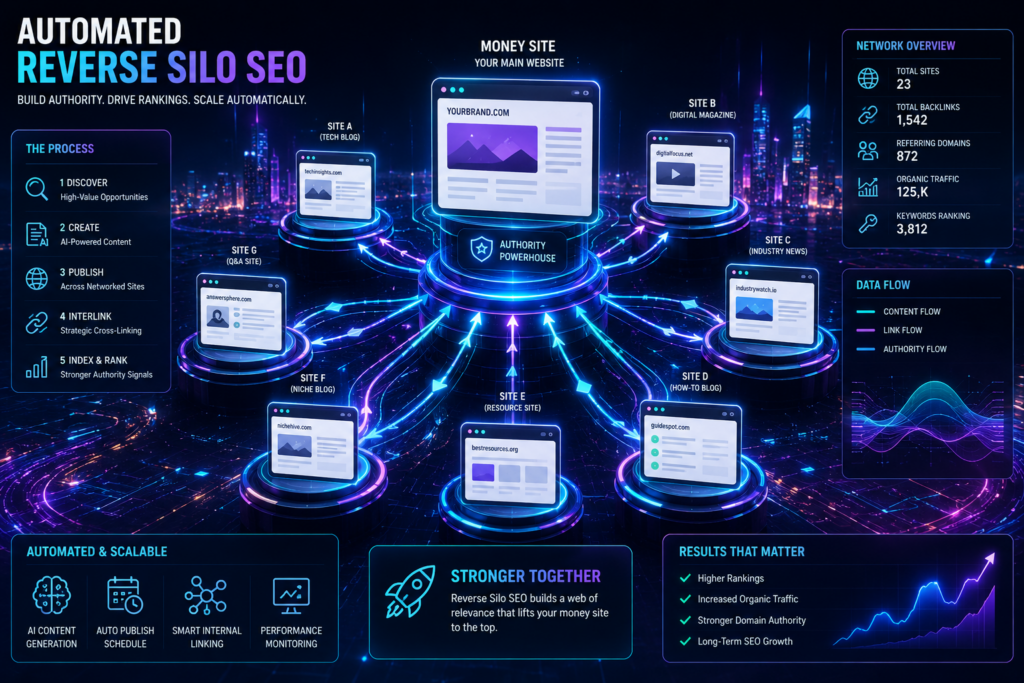
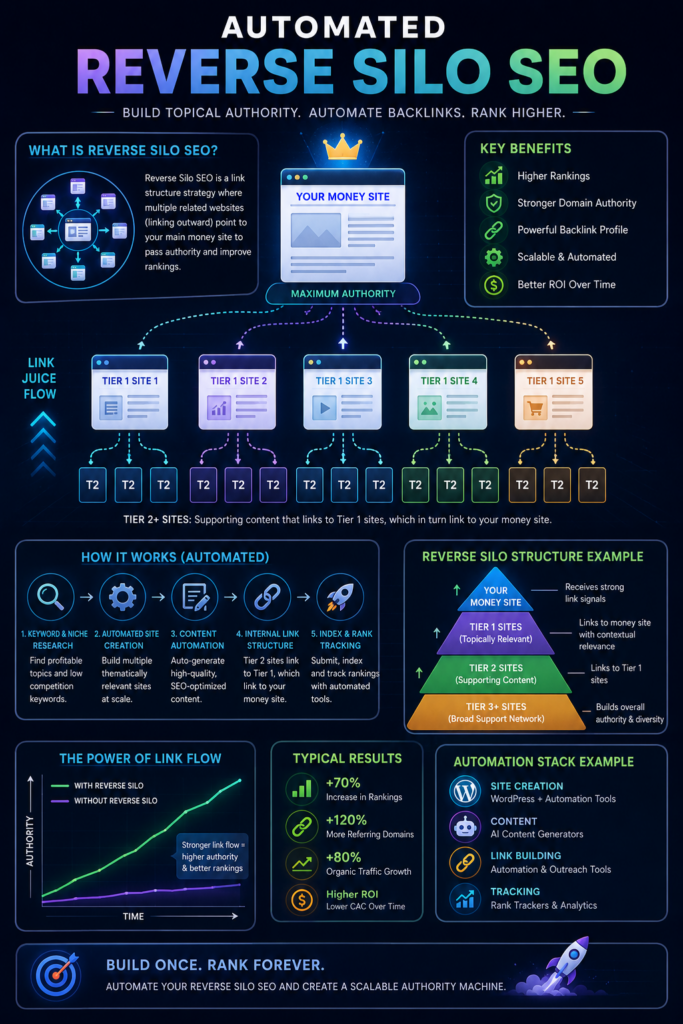
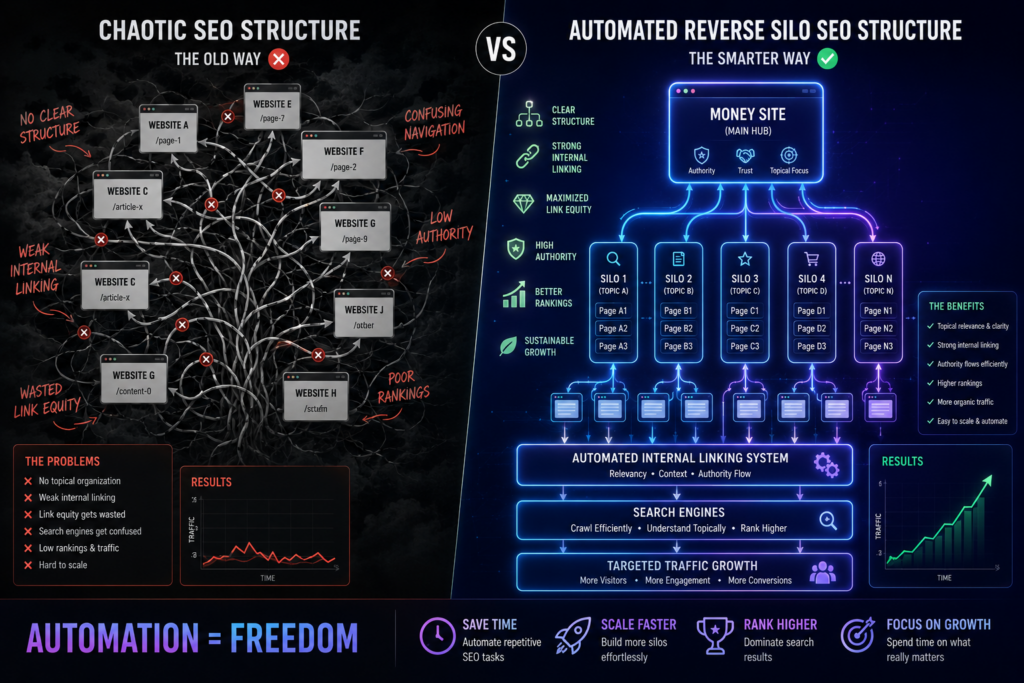
A reverse silo is an internal linking structure fundamentally different from traditional silos. Instead of organizing content top-down (pillar page → cluster content), a reverse silo funnels link equity upward. Supporting pages link to a single target page, concentrating authority where it counts most.
Automated Reverse Silo SEO automates this process. Rather than manually auditing your site, identifying linking opportunities, and building a spreadsheet of recommendations, automation tools scan your entire site architecture, identify semantic clusters, and suggest which pages should link to which targets. This saves weeks of work and ensures consistency.
How Reverse Silos Differ from Traditional Silos
- Traditional Silo: Pillar page sits at the top. Cluster content links down to the pillar. Authority flows downward.
- Reverse Silo: Target page sits at the bottom. Supporting content links up to the target. Authority flows upward.
- Soft Silos: Content clusters exist without rigid category boundaries. Links flow both ways.
- Hard Silos: Content is strictly separated by category. Pages in one silo rarely link to another.
Reverse silos work because they concentrate link equity on pages you want to rank. If you have 20 blog posts supporting a single high-value target page, each internal link passes authority upward. Over time, this concentrated equity compounds, pushing the target page higher in rankings.
The Link Equity Flow Principle
Link equity—also called PageRank—flows through internal links. Using automated tools for reverse silo SEO can save time and resources, as stated by Search Engine Journal. When a page with high authority links to another page, it passes some of that authority along. Automated tools calculate this flow and recommend the most efficient linking patterns.
The beauty of automation is scale. Manual reverse silo construction works for 5–10 target pages. But for sites with hundreds of articles, automation becomes mandatory. Tools pull your entire sitemap, cluster similar content, and generate linking recommendations in minutes.
How Automated Reverse Silo Tools Work: The Technical Process
Automated Reverse Silo SEO tools follow a predictable workflow. Understanding each step helps you choose the right tool and set realistic expectations for results.
Step 1: Sitemap Crawling and Content Discovery
The first step is comprehensive. Tools pull up to 100 URLs from your sitemap, analyzing title tags, meta descriptions, and body content. This gives the tool a complete inventory of what you’ve published.
ContentSERP.in, for example, integrates directly with your WordPress installation or XML sitemap. It indexes every post, page, and custom post type. This foundational step ensures no content gets missed during clustering.
Step 2: Semantic Clustering and Content Grouping
Once content is indexed, the tool groups similar pages into semantic clusters. Pages about “best running shoes” cluster together. Pages about “marathon training” form another cluster. The algorithm looks for keyword overlap, topic relevance, and content similarity.
20% of total pages are used for clustering, meaning the tool identifies your most important content and builds clusters around it. This prevents dilution of authority across too many targets.
Step 3: Link Equity Calculation and Recommendation
The tool then calculates how much link equity each page currently has. It measures domain authority, page authority, existing internal links, and external backlinks. Based on this data, it recommends which supporting pages should link to which target pages.
The system keeps 5 closest blog posts for linking. This ensures relevance. You’re not linking unrelated content just to boost numbers. Every link serves both the user and the algorithm.
Step 4: Implementation and Monitoring
The final step is execution. Some tools generate a CSV export. Others offer one-click implementation directly in WordPress. You review recommendations, approve changes, and monitor ranking impact over the following weeks.
The best tools track results. They show you which links were added, when they were added, and how rankings moved afterward. This data-driven feedback loop helps you refine your strategy continuously.
Top Tools for Automated Reverse Silo SEO in 2026
Five platforms dominate the automated reverse silo space. Each has strengths suited to different use cases and team sizes.
ContentSERP.in: Complete Automation with AI-Powered Clustering
ContentSERP.in leads the market for comprehensive reverse silo automation. The platform combines sitemap crawling, semantic clustering, and one-click WordPress implementation. Its AI engine identifies content relationships humans often miss, grouping pages by intent rather than just keyword overlap.
Key strengths include:
- Direct WordPress integration—no manual CSV imports required.
- Real-time ranking tracking tied to each internal link added.
- Semantic clustering that understands topic relationships, not just keywords.
- Detailed reports showing link equity flow before and after implementation.
- Support for How to Optimize for AI Engines alongside traditional SEO.
The honest limitation: ContentSERP.in excels for content-heavy sites with 100+ articles. For small blogs under 20 posts, the tool’s power is overkill, and you may pay for features you don’t need.
Moonlit Platform: Specialized Reverse Silo Engine
Moonlit Platform was built specifically for reverse silo automation. It pulls up to 100 URLs from your sitemap and focuses entirely on internal linking optimization. The interface is clean and focused—no bloat.
Strengths:
- Purpose-built for reverse silo strategy.
- Clear visualization of link equity flow.
- Batch processing for large sites.
- Competitive pricing for the feature set.
Moonlit Platform is ideal for agencies managing multiple client sites. Its batch processing saves time when scaling across accounts.
LinkBoss: Reverse Silo Framework with Knowledge Base
LinkBoss combines automation with educational resources. The platform includes detailed documentation on how reverse silos work, making it excellent for teams new to the strategy.
Strengths:
- Comprehensive knowledge base and video training.
- Integration with popular SEO tools like Ahrefs and SEMrush.
- Customizable clustering rules.
- Team collaboration features for agencies.
LinkBoss suits teams that value education alongside automation. You’re not just getting a tool—you’re getting a framework to understand the strategy deeply.
Surfer SEO: All-in-One Platform with Reverse Silo Module
Surfer SEO is known for content optimization. Its reverse silo module integrates with its broader content intelligence platform. If you’re already using Surfer for on-page optimization, adding reverse silo automation is seamless.
Strengths:
- Unified platform—content optimization and internal linking in one place.
- SERP analysis integrated with linking recommendations.
- Detailed content briefs that inform linking strategy.
Surfer works best for teams doing comprehensive content optimization. If you only need internal linking automation, its broader feature set may feel unnecessary.
PageOptimizer Pro: Enterprise-Grade Automation
PageOptimizer Pro targets enterprise sites with complex content structures. It handles large-scale automation, multi-language sites, and intricate category hierarchies.
Strengths:
- Handles 1,000+ page sites without performance issues.
- Multi-language support.
- API access for custom integrations.
- Dedicated account management.
PageOptimizer Pro is overkill for small to mid-size sites. Reserve it for enterprise implementations.
Automated Reverse Silo SEO vs. Traditional Internal Linking: The Comparison
Manual internal linking still exists. But automation changes the game in three critical ways: speed, consistency, and scale.
| Dimension | Manual Internal Linking | Automated Reverse Silo SEO |
|---|---|---|
| Time to Implement | 40–80 hours for 100 pages | 2–4 hours for 100 pages |
| Consistency | Varies by editor; prone to errors | Rules-based; 100% consistent |
| Scalability | Breaks down at 500+ pages | Handles 1,000+ pages easily |
| Link Equity Optimization | Estimated; often suboptimal | Calculated; data-driven |
| Ongoing Maintenance | Manual updates required | Automated as new content publishes |
| Cost | $5,000–$15,000 per project | $99–$499 per month |
The ROI is clear. Automation pays for itself within the first month on any site with 100+ pages. Beyond speed, automation ensures every link serves a strategic purpose. Manual linking often misses opportunities or creates redundant links.
Implementing Automated Reverse Silo SEO: A Step-by-Step Roadmap
Choosing the right tool is only half the battle. Implementation requires strategy, planning, and careful execution.
Phase 1: Audit and Preparation
Before automating, audit your current internal linking. Use tools like Screaming Frog or Ahrefs to map existing links. Identify which pages currently receive the most internal link equity. These become your baseline.
Next, define your target pages. What are your money keywords? Which pages should rank highest? These become the targets for your reverse silo. Supporting content will funnel equity toward them.
Phase 2: Tool Selection and Setup
Choose a tool based on your site size and budget. ContentSERP.in suits most mid-market sites. Moonlit Platform works well for agencies. LinkBoss is ideal if you need education alongside automation.
Connect your tool to your site. Most platforms require either XML sitemap access or WordPress login credentials. Authorize the tool and let it crawl your content.
Phase 3: Review and Approval
The tool generates recommendations. Review each one. Ask: Does this link make sense contextually? Will users find it helpful? Is the anchor text natural?
Reject recommendations that feel forced. Automation is powerful, but human judgment prevents mistakes. Approve the links that pass your quality check.
Phase 4: Implementation and Monitoring
Implement approved links. Most tools offer one-click WordPress integration. Some require manual CSV import. Either way, the process is fast.
After implementation, monitor rankings. Track your target pages for 4–8 weeks. You should see movement. Some pages rank higher. Others may fluctuate slightly. This is normal. Link equity takes time to compound.
Phase 5: Iteration and Refinement
Based on results, refine your strategy. If certain clusters outperform others, double down. If some links underperform, consider removing them. This feedback loop drives continuous improvement.
Tools like SEO Silo Structure guides show how to evolve your approach over time. The best practitioners treat reverse silo SEO as an ongoing process, not a one-time project.
Frequently Asked Questions
What is reverse silo SEO and how can it be automated?
Reverse silo SEO is an internal linking strategy where supporting pages funnel link equity upward toward a single target page. A reverse silo is an internal linking structure where supporting content pages funnel link equity upward toward a single target page. Automation tools like ContentSERP.in and Moonlit Platform scan your entire site, identify semantic clusters, calculate link equity flow, and recommend which pages should link to which targets. This eliminates manual auditing and ensures data-driven decisions at scale.
How do tools like Moonlit Platform and LinkBoss support automated reverse silo SEO?
Both platforms automate the core workflow: sitemap crawling, content clustering, link equity calculation, and recommendation generation. Moonlit Platform specializes in reverse silo automation exclusively, pulling up to 100 URLs from your sitemap and keeping 5 closest blog posts for linking. LinkBoss adds educational resources and integrations with tools like Ahrefs. Both save time and ensure consistency compared to manual linking.
What is the difference between hard silos and soft silos in automated reverse silo SEO?
Hard silos are rigid category structures where content rarely crosses boundaries. Pages in one silo link only within that silo. Soft silos are flexible. Content clusters exist, but links flow naturally across clusters based on relevance. Automated Reverse Silo SEO typically uses soft silo logic, allowing links between clusters when semantically appropriate. This balances structure with flexibility, preventing the isolation problems of hard silos.
How much link equity should I concentrate on a single target page?
There’s no magic number. 20% of total pages are used for clustering, meaning you identify your most important content and build clusters around it. A typical reverse silo has 5–20 supporting pages linking to one target. More supporting pages = more concentrated equity. But ensure each link is contextually relevant. Forced links dilute trust and confuse users. Quality always beats quantity.
Can Automated Reverse Silo SEO work for e-commerce sites?
Yes, but with caveats. E-commerce sites benefit from reverse silos for category pages and product pillar content. Supporting content (blog posts, guides, reviews) funnels equity toward high-value product pages. However, e-commerce architecture is often complex. Product pages may have limited internal linking potential. Tools like PageOptimizer Pro handle this complexity better than simpler platforms. Start with a pilot on one category to test the approach before scaling.
Conclusion
Automated Reverse Silo SEO is no longer a luxury—it’s a necessity for competitive sites in 2026. Manual internal linking cannot scale. Automation tools like ContentSERP.in’s Automated SEO Silo Builder, Moonlit Platform, and LinkBoss solve this problem by systematically funneling link equity toward your highest-value pages.
The strategy is proven. Internal linking is a key factor in improving website authority. When combined with automation, internal linking becomes a predictable, scalable ranking driver. You’re not guessing which pages should link to which targets. Data tells you.
The choice of tool depends on your site size and needs. For most mid-market sites, ContentSERP.in delivers the best balance of automation, ease of use, and pricing. For agencies managing multiple clients, Moonlit Platform’s batch processing excels. For teams new to the strategy, LinkBoss’s educational resources justify the platform choice.
Start today. Audit your current internal linking. Define your target pages. Choose a tool. Implement recommendations. Monitor results. Within 8–12 weeks, you’ll see ranking movement. Automated Reverse Silo SEO compounds over time. The longer you run it, the stronger your results become.
Ready to automate your internal linking strategy? Begin with ContentSERP.in’s PillarForge Automated SEO Silo Builder. It shows you exactly how much link equity you’re leaving on the table and which pages should be your reverse silo targets. No credit card required.
Build Your First SEO Silo in Minutes
PillarForge automates every step in this guide — topical map, pillar page, cluster pages, schema markup, and WordPress publishing.
Try PillarForge Free →For more detailed insights, read our complete SERP Analysis Guide guide.
