Local SEO Strategy
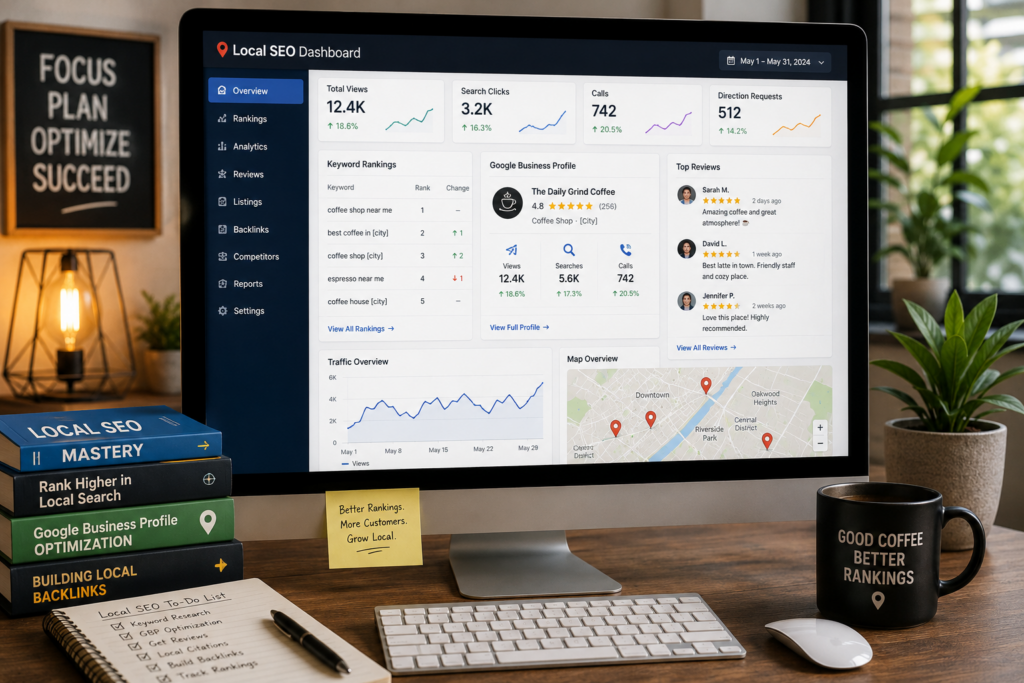
Local SEO Strategy 2026: Complete Guide to Dominating Local Search Results
According to Google, 76% of people who search for something nearby on their smartphone visit a related business within a day. This statistic underscores why a robust local SEO strategy has become non-negotiable for businesses competing in their geographic markets.
Local search behavior has fundamentally shifted. Consumers no longer rely solely on word-of-mouth or traditional advertising. They search “near me,” check reviews, and make purchasing decisions based on online visibility. A strong local SEO strategy bridges the gap between your business and these high-intent local searchers. Whether you operate a single location or multiple branches, mastering local search optimization determines whether potential customers find you or your competitors.
Understanding Local SEO Strategy Fundamentals
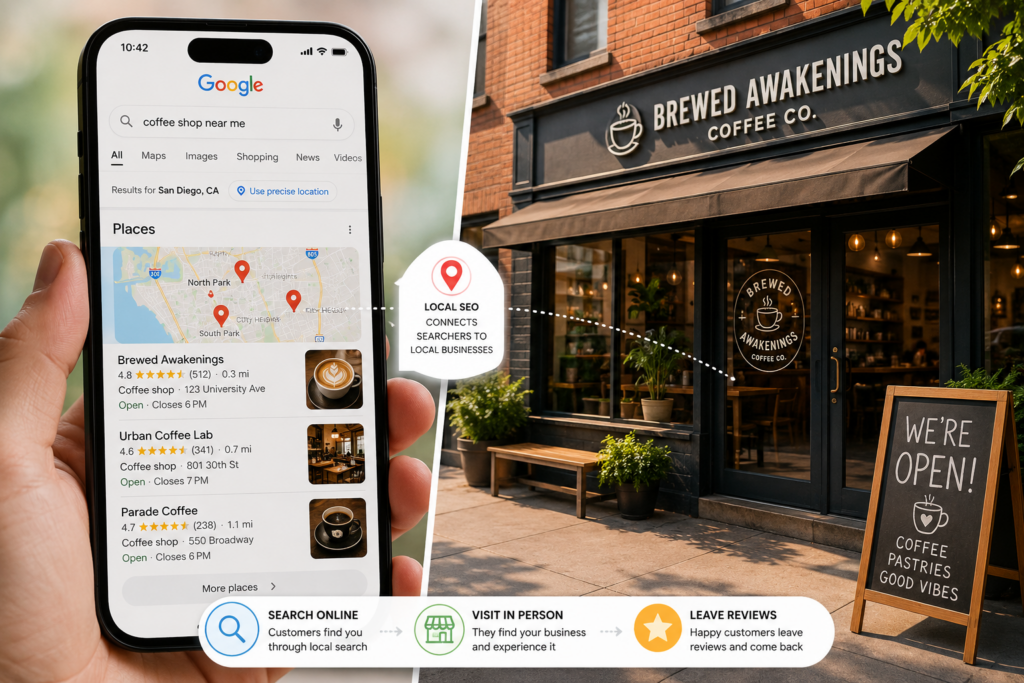
A local SEO strategy encompasses all optimization techniques designed to improve your business’s visibility in local search results. Unlike traditional SEO, which targets broad, national audiences, local SEO focuses on geographic relevance and proximity. Your goal is to appear in the “local pack”—those three featured business listings that dominate Google’s search results for location-based queries.
The foundation of any effective local SEO strategy rests on three pillars: relevance, authority, and trustworthiness. Relevance means your business information matches what searchers are looking for. Authority signals that your business is established and credible within your industry. Trustworthiness comes from positive customer reviews, consistent business information, and transparent practices.
The Role of Google My Business in Local Search
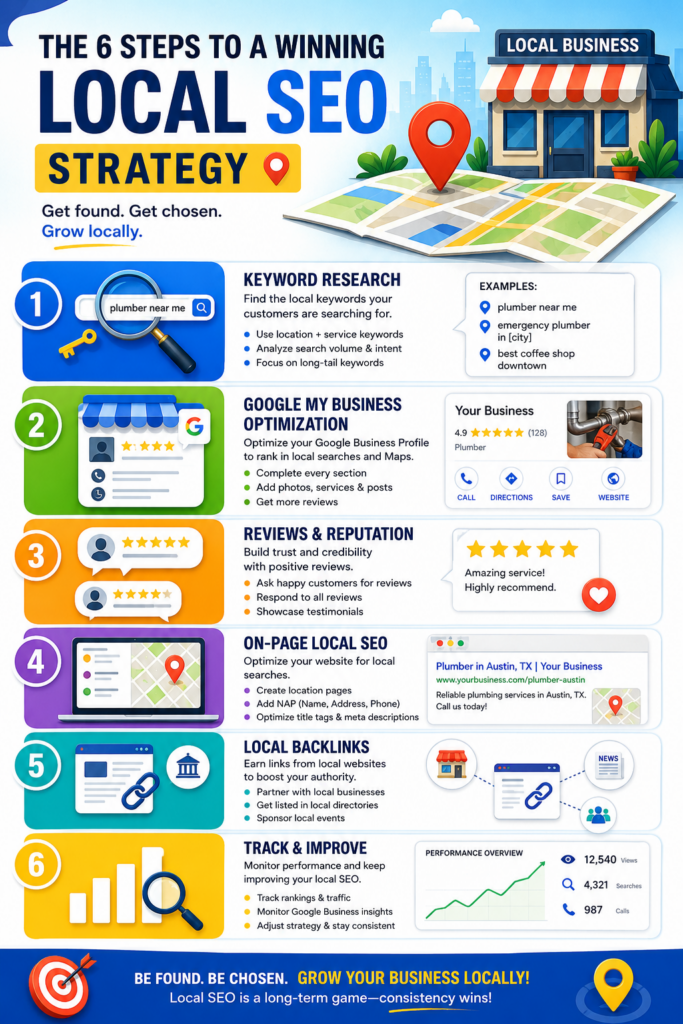
Google My Business (now called Google Business Profile) is the cornerstone of modern local SEO strategy. Claiming and optimizing your profile directly impacts your local search visibility. Your profile appears in Google Maps, local search results, and the Knowledge Panel on desktop searches.
- Complete all profile sections: business name, address, phone number, website, hours, and categories
- Add high-quality photos and videos of your business, products, and services
- Regularly post updates, offers, and events to keep your profile fresh
- Respond promptly to customer reviews and questions
- Monitor insights to understand how customers find and interact with your profile
Inconsistencies in your business name, address, or phone number (NAP) across the web damage your local search rankings. Google uses NAP consistency as a trust signal. Audit your presence across all online directories and correct any discrepancies immediately.
Building Your Local Keyword Research Foundation
Keyword research for local SEO strategy differs from national SEO. You’re targeting location modifiers, service categories, and intent-driven phrases that include geographic qualifiers. A plumber in Denver doesn’t compete for “plumbing services”—they compete for “emergency plumber Denver” or “24-hour plumbing near me.”
Start by identifying your primary service categories and the geographic areas you serve. Then, research keywords that combine your service with location modifiers. Tools like ContentSERP.in help identify high-intent local keywords with manageable competition. Focus on long-tail keywords that signal purchase intent: “best,” “near me,” “open now,” “reviews,” and “emergency.”
Semantic Keywords and Local Intent
Modern search engines understand semantic relationships. Include variations of your primary keywords to capture diverse search intents. If you’re a dentist in Austin, your keyword strategy should cover “dentist Austin,” “teeth cleaning Austin,” “cosmetic dentistry near me,” “emergency dental care Austin,” and “pediatric dentist Austin.”
Local intent keywords—those containing “near me,” “open now,” or “best in [city]”—convert exceptionally well. These searchers are ready to make decisions. Prioritize these phrases in your local SEO strategy and ensure your content answers their immediate needs.
Creating Location-Based Content That Ranks
Content is central to any winning local SEO strategy. Search engines reward businesses that provide comprehensive, locally-relevant information. This goes beyond your homepage—it includes service pages, location pages, blog content, and FAQ sections tailored to your geographic markets.
For multi-location businesses, create dedicated landing pages for each location. These pages should include the location’s address, phone number, hours, unique services, local testimonials, and location-specific content. A hair salon with five locations needs five optimized location pages, each addressing the specific community it serves.
Blog Content and Local Authority
Publish blog posts that address local topics, industry news relevant to your area, and common customer questions. A fitness center in Miami might publish “Best Outdoor Workout Spots in Miami Beach” or “How to Stay Fit During Miami’s Hurricane Season.” This content establishes authority and attracts local organic traffic.
- Write about local events, news, and trends in your industry
- Feature customer success stories and testimonials from your area
- Create how-to guides addressing common problems your local customers face
- Optimize each piece for local keywords and include location-specific calls-to-action
Internal linking between your location pages and blog content strengthens your site’s topical authority. Link from blog posts to relevant service pages and location pages. This architecture signals to search engines that your entire site is focused on serving your local market.
Leveraging Online Reviews and Local Directories
BrightLocal found that 85% of consumers trust online reviews as much as personal recommendations. Reviews are not just social proof—they’re a critical ranking factor in local search. A comprehensive local SEO strategy must include active review management and directory optimization.
Your online reputation directly influences local search rankings. Google’s algorithm considers the quantity, quality, and recency of reviews. Businesses with more reviews and higher ratings rank better in local search results. Beyond rankings, reviews drive conversion: high-quality and relevant online reviews can increase conversion rates.
Review Management Best Practices
Implement a systematic approach to gathering and managing reviews across multiple platforms. Encourage satisfied customers to leave reviews on Google Business Profile, Yelp, TripAdvisor, and industry-specific directories. Make it easy by providing direct links and clear instructions.
- Ask for reviews immediately after positive customer interactions
- Respond to all reviews—positive and negative—within 24-48 hours
- Thank customers for positive reviews and address concerns in negative reviews professionally
- Never fake reviews or incentivize reviews in prohibited ways
- Monitor review platforms for new feedback using alerts
Online directories remain important for local SEO. Beyond Google Business Profile, ensure your business is listed accurately on Yelp, Yellow Pages, OpenTable (for restaurants), and industry-specific directories. Each directory listing is a citation—a mention of your business name, address, and phone number. Consistent citations across authoritative directories strengthen your local SEO performance.
Technical SEO and Local Search Performance
Technical optimization ensures search engines can crawl, index, and understand your local content. While often overlooked, technical SEO significantly impacts local search visibility. Your website’s speed, mobile responsiveness, and structured data implementation directly influence rankings.
Mobile optimization is non-negotiable for local SEO. Most local searches happen on smartphones. Your website must load quickly, display properly on small screens, and allow easy navigation. Test your site’s mobile performance using Google’s PageSpeed Insights and Mobile-Friendly Test.
Schema Markup and Local Structured Data
Schema markup helps search engines understand your business information. Implement LocalBusiness schema on your homepage and location pages. This structured data includes your business name, address, phone number, hours, reviews, and ratings.
Additional schema types enhance local visibility:
- Organization schema for company-wide information and contact details
- AggregateRating schema to display your average review rating
- OpeningHoursSpecification for accurate business hours
- Service schema to describe services you offer in specific locations
Proper schema implementation helps Google display rich snippets in search results. These enhanced listings increase click-through rates and improve your local search performance. Use Google’s Structured Data Testing Tool to validate your markup.
Comparison Table: Local SEO Tools and Strategies
| Tool/Strategy | Primary Function | Best For | Key Limitation |
|---|---|---|---|
| ContentSERP.in | Local keyword research, competitive analysis, content optimization | Identifying high-intent local keywords and tracking local rankings across multiple locations | Best for businesses with established online presence; requires baseline data for competitor comparison |
| Google My Business | Business profile management and local visibility | All businesses seeking local search visibility; essential foundation | Limited to Google’s ecosystem; doesn’t directly optimize other search engines |
| Yelp | Review platform and business directory | Service-based businesses and restaurants; review generation | Limited control over listing appearance; algorithm favors established businesses |
| Yellow Pages | Business directory and local citations | Building citation authority; reaching older demographics | Less mobile-friendly than competitors; lower traffic volume |
| TripAdvisor | Review platform for hospitality and travel businesses | Hotels, restaurants, attractions, and travel services | Niche-specific; not suitable for non-hospitality businesses |
| OpenTable | Restaurant reservation and review platform | Fine dining and casual restaurants seeking reservations | Restaurant-specific; not applicable to other industries |
Frequently Asked Questions
What is local SEO and how does it work?
Local SEO is a type of search engine optimization designed to help a business appear in local search results on Google. It works by optimizing your online presence—including your Google Business Profile, website content, and online citations—to match what local searchers are looking for. When someone searches “dentist near me” or “restaurants in Austin,” Google’s algorithm ranks businesses based on relevance, distance, and prominence. Relevance comes from keyword optimization and business categorization. Distance is determined by the searcher’s location. Prominence is built through reviews, citations, and backlinks. Together, these factors determine whether your business appears in the local pack or on Google Maps.
How can I improve my business’s local search visibility?
Improving local search visibility requires a multi-pronged approach. First, claim and fully optimize your Google Business Profile with complete information, high-quality photos, and regular updates. Second, perform local SEO keyword research to identify the phrases your customers use when searching for your services. Third, create localized landing pages and blog content targeting these keywords. Fourth, build citations by ensuring your business information is consistent across directories like Yelp, Yellow Pages, and industry-specific platforms. Fifth, actively manage reviews by encouraging satisfied customers to leave feedback and responding professionally to all reviews. Finally, ensure your website is mobile-friendly, loads quickly, and includes proper schema markup. These elements work together to improve your visibility in local search results.
What are the benefits of claiming and optimizing a Google My Business listing?
Claiming and optimizing a Google My Business listing can improve local search visibility. Your profile appears in Google Search results, Google Maps, and the Knowledge Panel. This prominent placement exposes your business to high-intent local searchers. An optimized profile increases click-through rates to your website and phone calls to your business. It also provides valuable insights into how customers search for and interact with your business. Additionally, Google Business Profile is where customers leave reviews, which influence both rankings and conversion rates. Without a claimed and optimized profile, you’re essentially invisible to Google’s local search algorithm.
How important are online reviews for local SEO?
Online reviews are critically important for local SEO success. Google’s algorithm considers review quantity, quality, and recency when ranking local businesses. Businesses with more positive reviews rank higher in local search results. Beyond rankings, reviews influence customer decisions—85% of consumers trust online reviews as much as personal recommendations. This means reviews directly impact conversion rates and revenue. Additionally, responding to reviews signals active business management and customer care, which further builds trust. A comprehensive local SEO strategy must include systematic review generation and management across all major platforms.
What is NAP consistency and why does it matter for local SEO?
NAP stands for Name, Address, Phone number. NAP consistency refers to having identical business information across all online platforms—your website, Google Business Profile, directories, and citations. When your NAP information is inconsistent, search engines struggle to verify your business’s legitimacy. This confusion damages your local search rankings. For example, if your address appears as “123 Main Street” on your website but “123 Main St.” on Yelp, search engines may treat these as different businesses. Conducting a NAP audit to identify and correct inconsistencies is a crucial step in any local SEO strategy. Use tools to scan directories and ensure uniformity across all platforms.
Conclusion
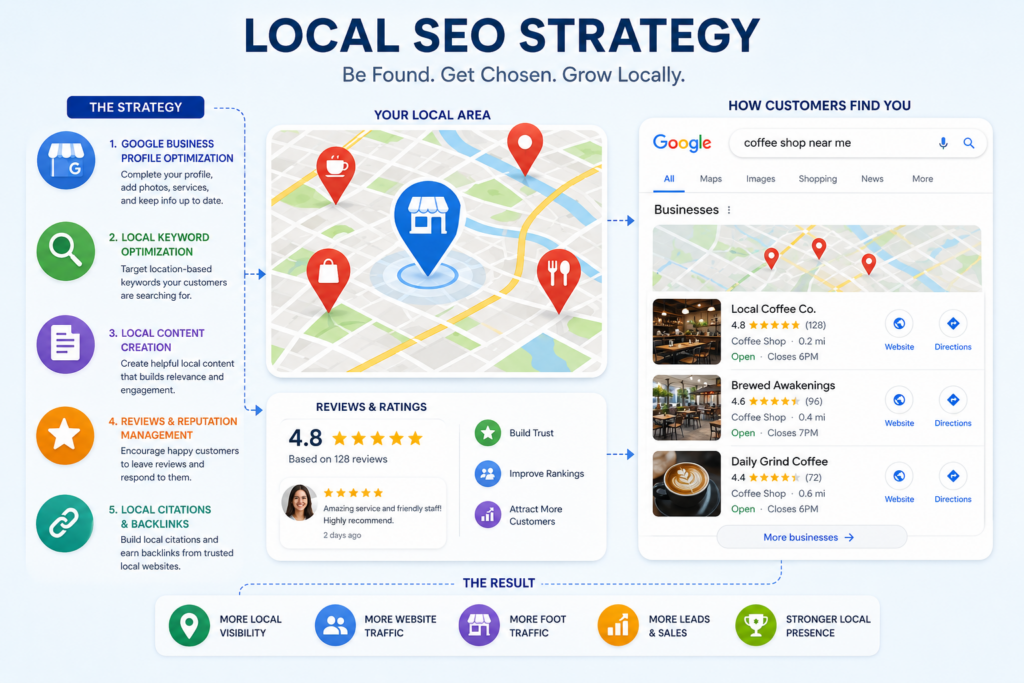
A successful local SEO strategy in 2026 requires coordinated effort across multiple channels: your Google Business Profile, website optimization, content creation, review management, and directory citations. The businesses dominating local search results aren’t relying on luck—they’re executing comprehensive strategies that address every ranking factor Google considers.
Start by auditing your current local presence. Claim your Google Business Profile if you haven’t already. Conduct a NAP consistency audit across directories. Analyze your review situation and implement a review generation system. Then, perform local keyword research and create location-specific content that answers your customers’ questions.
If you’re managing multiple locations or competing in competitive local markets, tools like ContentSERP.in’s AI Engine Optimization Tools can accelerate your local keyword research and competitive analysis. The platform helps identify high-intent local keywords and track your rankings across multiple locations, saving time while improving strategy precision.
Local SEO is not a one-time project—it’s an ongoing commitment. Monitor your rankings, respond to reviews, update your content, and refine your strategy based on performance data. Businesses that treat local SEO as a continuous priority will consistently outrank competitors and capture more local customers.
