Daily Top 100 Rank Tracker for India: 2026 Agency Guide
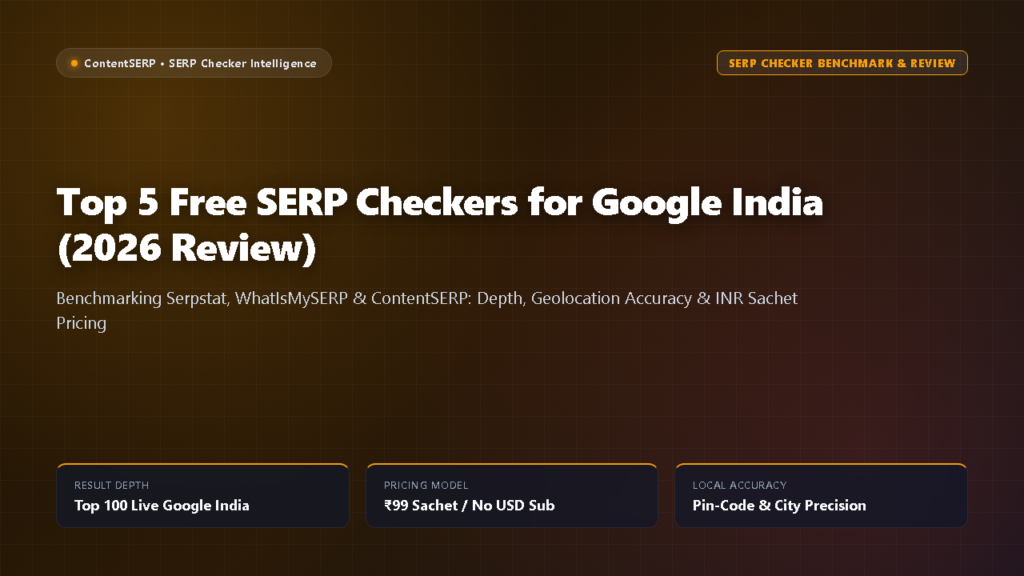
Direct Answer / Key Takeaway: A daily top 100 rank tracker monitors the full 100 search engine results page (SERP) positions on Google every 24 hours, rather than stopping at the top 10 or 20. While standard rank checkers only alert you when a keyword drops off Page 1 or Page 2, a daily top 100 rank tracker detects algorithmic tremors, negative SEO attacks, indexation drops, and emerging competitors while they are still brewing between positions 21 and 100. For Indian SEO agencies, affiliate publishers, and enterprise brands navigating Google India’s volatile AI Overviews and bilingual Hindi and Hinglish keyword SERPs, tracking top-100 rank depth daily is the single most reliable early-warning radar available—and with ContentSERP, you get un-cached, pincode-level daily top-100 precision starting from ₹999/month instead of burning through expensive $150+/month enterprise dollar plans.
- The Top 20 Blindspot: Why Surface-Level Rank Tracking Fails
- 5 Critical Early-Warning Signals Only Positions 21–100 Reveal
- SERP Features & Mobile Device Divergence Across Indian Pincodes
- Exclusive Subtopic 1: Google India AI Overviews Volatility & Hinglish Query Displacement
- Exclusive Subtopic 2: Agency Unit Economics — ₹999 Flat Pricing vs Enterprise Credit Traps
- Top 100 Rank Trackers Compared: ContentSERP vs AccuRanker vs Semrush vs SE Ranking
- How to Configure Daily Top 100 Tracking in ContentSERP (Step-by-Step)
- Frequently Asked Questions (FAQ)
1. The Top 20 Blindspot: Why Surface-Level Rank Tracking Fails
Most basic rank tracking software restricts tracking to the first 20 search results (Pages 1 and 2). This artificial boundary creates a dangerous operational blindspot for growth-focused SEO teams. Search visibility does not exist in a binary vacuum where a URL is either in position 1–20 or non-existent. When Google recalibrates its ranking algorithms, tests new intent vectors, or adjusts link evaluation models, ranking movements almost always manifest in the deep SERP stratum (positions 21 through 100) days or weeks before impacting your primary revenue-driving keywords on Page 1.
Consider what happens during a core algorithm update or helpful content re-evaluation: if your target URL drops from position #4 to #18, a top-20 tracker flags a decline. But if it slides from #18 to #42, a top-20 tracker reports it as “Lost / Out of Top 20.” You have no visibility into whether your page landed at #22 (a minor fluctuation requiring slight on-page tuning) or plummeted to #89 (a severe structural penalty or complete loss of query intent). A dedicated daily top 100 rank tracker bridges this visibility gap by capturing the entire trajectory across all 10 SERP pages every single morning.
2. 5 Critical Early-Warning Signals Only Positions 21–100 Reveal
Monitoring the complete top 100 organic positions unlocks 5 strategic diagnostic signals that top-20 tracking cannot see:
- 1. Keyword Cannibalization Flapping: When two pages on your domain compete for the same query, Google often swaps them back and forth between position #12 and position #45. Without top-100 tracking, you only see the keyword disappearing intermittently from your top-20 dashboard, assuming random volatility rather than a clear internal self-competition conflict.
- 2. Nascent Competitor Infiltration: Aggressive competitors or newly launched venture-backed platforms do not debut at position #3. They enter the index at position #85, climb to #54 within a week, reach #28 within a fortnight, and eventually seize your Page-1 ranking. Top-100 monitoring alerts you to their ascent while they are still in the second half of the SERP, giving you 3 weeks to defend your moat before losing traffic.
- 3. Algorithm Rollout Tremors: Google’s core updates take 2 to 3 weeks to fully roll out across data centers. The earliest signs of algorithmic repricing appear as extreme volatility in positions 30–80. Spotting these macro shifts early lets you pause risky site-wide architectural migrations or link campaigns.
- 4. Content Decay and Semantic Drift: As search intent evolves or competitors update their statistical data, your articles gradually lose topical relevance. A drop from #8 to #24 is caught by top-100 tools, allowing you to update fresh statistics, add schema, and restore Page 1 status before the URL falls off the radar completely.
- 5. Indexation and Crawl Budget Health: If a key commercial page suddenly plunges from position #22 to position #95 overnight, it is frequently a technical symptom: an accidental
noindextag, an erroneous canonical declaration, or a server timeout during Googlebot’s recrawl. Catching this on day one prevents catastrophic revenue loss.
3. SERP Features & Mobile Device Divergence Across Indian Pincodes
India is the world’s most mobile-first, geo-fragmented search ecosystem. Over 82% of all commercial organic queries originate on mobile smartphones running on varying 4G and 5G connections across Tier 1, Tier 2, and Tier 3 cities. Tracking Google India rankings at a national desktop level delivers misleading data because Google’s mobile SERP layout differs fundamentally from desktop.
On mobile, Google injects intensive rich SERP elements—including the Local 3-Pack Map block, People Also Ask (PAA) accordions, Video carousels, and Google AI Overviews—before displaying traditional organic web listings. A website ranking at organic position #2 on desktop may actually be pushed below the 4th mobile scroll (equivalent to position #14 visually). ContentSERP’s daily top 100 rank tracking engine monitors device-specific rankings and tracks every SERP feature across 34,000+ Indian postal codes, ensuring you see exactly what a searcher in Mumbai, Bengaluru, or Lucknow sees on their smartphone screen.
4. Exclusive Subtopic 1: Google India AI Overviews Volatility & Hinglish Query Displacement
The AI Overview “Push-Down” Effect in Bilingual Indian SERPs
Western rank trackers treat rank drops as pure algorithmic position losses. In India, Google’s aggressive rollout of Gemini-powered AI Overviews frequently commandeers the top 900 vertical pixels of the search viewport for informational and commercial queries alike. Furthermore, conversational queries combining English and Hindi (“Hinglish” queries like ‘best rank tracker in India for small agency kaise choose kare’) cause radical displacement where standard organic URLs are pushed down from positions 1–5 straight into positions 21–45.
When Google India generates an AI Overview, traditional web results are not penalized; they are simply displaced downwards. If you only track the top 20 rankings, an AI Overview expansion makes your page appear as if it disappeared from Google entirely. With a daily top 100 rank tracker, you immediately see the reality: your page is still indexed and trusted at position #24, while also being cited inside the AI Overview’s source carousel.
By cross-referencing your top-100 positions with AI Overview source links, agencies can execute precision Answer Engine Optimization (AEO): restructuring headings into direct question-and-answer format, injecting structured schema, and adding concise comparison tables to convert position #25 rankings into prime AI Overview source citations.
5. Exclusive Subtopic 2: Agency Unit Economics — ₹999 Flat Pricing vs Enterprise Credit Traps
Why do most digital agencies in India settle for weekly or top-20 rank updates? The answer boils down to software billing economics. Legacy Western SEO suites (such as Ahrefs, Semrush, and AccuRanker) bill their software in US Dollars, attach an automatic 18% Indian GST charge, add forex bank surcharges, and enforce punitive credit burning structures:
| Platform | Base Monthly Cost (INR + GST) | Daily Top 100 SERP Policy | Extra Charges for Pincode Depth |
|---|---|---|---|
| ContentSERP India | ₹0 (Free Trial) / ₹999 flat | Full 100 positions included natively | ₹0 (All 34,000+ pincodes supported) |
| Ahrefs (Standard) | ₹19,500+ / mo ($199 + 18% GST) | Weekly default; daily updates cost extra credits | High credit burn per search location |
| Semrush (Guru) | ₹24,800+ / mo ($249.95 + GST) | Restricted daily keywords; strict limits | Multi-location tracking burns keyword slots |
| AccuRanker | ₹12,800+ / mo ($129 + GST) | Daily included, but charges per 1,000 keywords | Mobile + Desktop counts as 2 separate slots |
SERP Checker Comparison: Evaluating budget alternatives? Read our in-depth teardown on ClearSerp vs SpySerp vs ContentSERP comparing credit burn, top 100 depth, and pincode accuracy.
YouTube SERP Tip: Video carousels now capture up to 34% of Indian entertainment SERP clicks. See our complete playbook on keywords for Bollywood YouTube channels to optimize chapter markers and tag bridges.
For an Indian SEO agency charging clients between ₹15,000 and ₹40,000 per month per retainer, spending ₹25,000 on software subscriptions destroys agency net profit margins. By utilizing ContentSERP’s native INR infrastructure, agencies retain 90%+ of their client retainer while delivering un-cached, live top-100 client ranking reports.
6. Top 100 Rank Trackers Compared: ContentSERP vs Legacy Platforms
When selecting a daily top 100 rank tracker for the Indian market, four primary criteria determine operational utility: SERP depth (100 full results), refresh frequency (24-hour un-cached scrapes), local India geotargeting, and cost efficiency.
- ContentSERP (Best Overall for India): Built from the ground up for Indian SEOs. Scrapes live top 100 Google India results without caching delay. Native UPI/Netbanking payments in INR with zero foreign transaction fees. Detailed local Map Pack tracking for Indian SMEs.
- SE Ranking (Best for Multi-Country Global Work): Highly capable mid-tier suite with solid daily tracking. However, pricing scales in USD, and regional Indian language support is secondary to North American databases.
- AccuRanker (Best for Enterprise In-House Teams): Extremely fast on-demand ranking refreshes. However, minimum pricing begins at $129/month, making it cost-prohibitive for Indian agencies managing 10 to 30 local clients.
- Google Search Console (Free Baseline): While GSC is essential for impressions and CTR data, its rank reporting suffers from an unchangeable 48 to 72-hour reporting lag and displays blended average positions rather than exact live ranking positions.
7. How to Configure Daily Top 100 Tracking in ContentSERP (Step-by-Step)
Setting up precision daily tracking takes under 2 minutes:
- Step 1: Open the Rank Tracker Console: Navigate to the ContentSERP Rank Tracker India tool.
- Step 2: Enter Your Target Keywords: Paste your list of commercial and transactional target queries (supports up to 100 keywords per batch).
- Step 3: Define Local Geotargeting: Select your target location: choose national Google India (.co.in) or specify a targeted city (e.g., Mumbai, Delhi NCR, Hyderabad) or exact 6-digit pincode.
- Step 4: Select Device Preference: Choose Mobile (Smartphone Googlebot) or Desktop to simulate exact visitor hardware.
- Step 5: Review Live Top 100 SERP Breakdown: Click “Track Rankings” to generate a live, real-time snapshot of all 100 ranking URLs, featured snippets, and local pack listings with zero caching latency.
8. Frequently Asked Questions (FAQ)
Q1: Why should I track 100 positions when 90% of clicks happen on Page 1?
While organic clicks concentrate on positions 1–5, ranking movement happens in positions 21–100. Monitoring the entire top 100 allows you to catch negative SEO attacks, indexation drops, and emerging competitors weeks before your Page 1 rankings are impacted.
Q2: How often does a daily top 100 rank tracker refresh rankings?
A daily rank tracker queries Google’s live search results exactly once every 24 hours. ContentSERP also offers on-demand manual verification whenever you deploy critical on-page optimizations or link building campaigns.
Q3: How does Google Search Console differ from a daily rank tracker?
Google Search Console displays delayed (48–72 hour lag), aggregated historical average positions. A live rank tracker queries Google right now from a specific IP and geolocation, giving you the exact real-time SERP standing.
Q4: Can a daily top 100 rank tracker monitor Google Map Pack rankings in India?
Yes. ContentSERP’s rank tracking engine tracks both organic web listings (positions 1–100) and the Local 3-Pack Map rankings across Indian cities and 34,000+ pincodes.
Q5: What is the cost of daily top 100 rank tracking on ContentSERP?
ContentSERP offers 10 free trial credits for new accounts (no credit card required). Paid starter plans start at ₹999 for 100 full deep SERP queries, payable directly via UPI or Netbanking.
Track Your Keywords Across the Top 100 Google India Positions
Stop flying blind with 3-day GSC delays or surface-level top 20 trackers. Test ContentSERP’s daily top 100 rank tracker for free right now.
Step-by-Step Tutorial: Need to audit your search positions without browser cookie contamination? Follow our comprehensive guide on how to check website ranking in India across desktop, mobile, and AI Overviews.


4 Comments