How Old Is Google
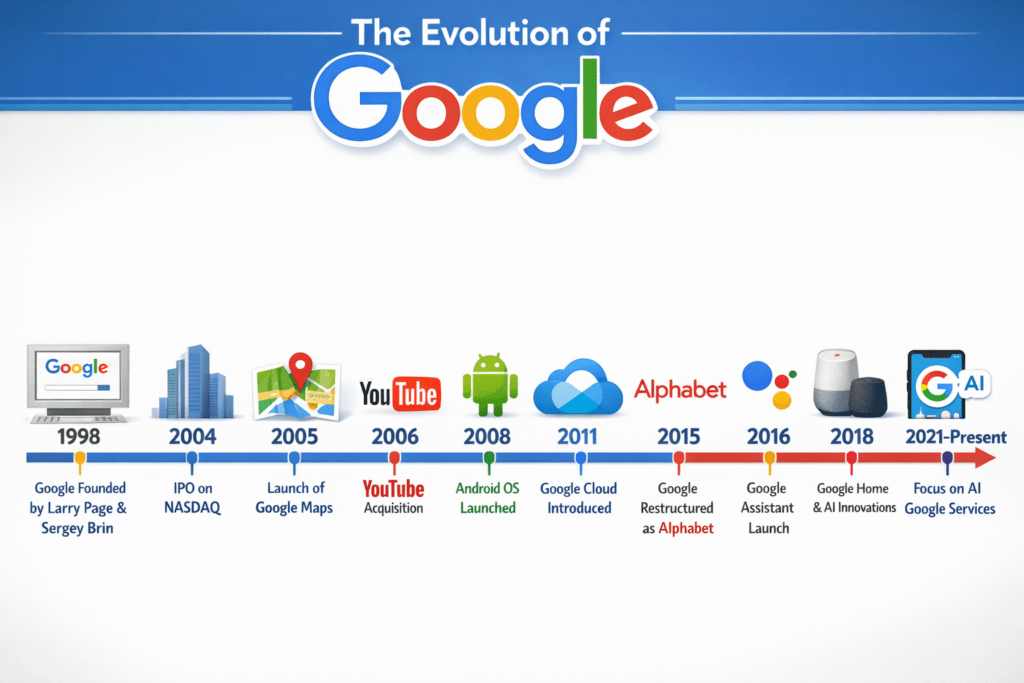
How Old Is Google? A Complete Timeline of the Search Giant’s Age, Milestones, and Market Dominance
Google is 27 years old, 4 months, and 11 days old as of January 15, 2026. In that short span the company has rewritten the rules of information retrieval, advertising, and consumer software. According to Jagran Josh, Google controls 92 percent of the world search market, while parent Alphabet Inc. carries a market capitalization north of $1 trillion. From a Stanford research project called BackRub to a constellation of products used by billions every day, Google’s age is more than a calendar curiosity—it is a lens through which to understand the modern internet economy. This pillar page unpacks the company’s age, the mechanics behind its growth, and the strategic levers that turned a dissertation idea into one of the most valuable enterprises on Earth.
Google’s Birth Certificate: September 4, 1998 and the BackRub Prototype
Google was founded on September 4, 1998 by Larry Page and Sergey Brin, two Stanford PhD candidates who set out to quantify the importance of web pages by analyzing their back-link structure. The first iteration ran on a cluster of inexpensive Sun Ultra desktops in a dorm room and was christened BackRub—a nod to its core algorithmic idea. By 1997 the service had outgrown campus bandwidth limits, so the duo moved operations to a garage in Menlo Park and registered the domain Google.com, a playful twist on the mathematical term googol. Within twelve months the index had ballooned to 60 million URLs, and investors took notice. Sun co-founder Andy Bechtolsheim wrote a $100,000 check before the company even incorporated, seeding what would become a venture-capital juggernaut. The age clock therefore starts not with the first line of code, but with the formal incorporation date—September 4, 1998—making Google older than Netflix by roughly a year and younger than Amazon by four.
From PageRank to Market Dominance: How Google Scaled in 27 Years
Google’s first breakthrough was PageRank, an eigenvector calculation that treated each hyperlink as a scholarly citation. The algorithm solved the “noisy neighbor” problem that plagued keyword-based engines such as AltaVista and Lycos. Instead of counting words, PageRank weighted votes, producing relevance scores that improved as the web grew. The second breakthrough was monetization. In 2000 the company launched AdWords, a self-service auction that let advertisers bid on keywords in real time. Inventory expanded from 350 customers in year one to more than 100,000 by 2002. Upgrow reports that advertising revenue has grown exponentially ever since, funding an infrastructure arms race: custom servers, distributed file systems, and eventually data centers on every continent except Antarctica. By 2004 Google handled 200 million queries per day; by 2010 that number surpassed 2 billion. The age of Google is therefore inseparable from the age of scalable cloud architecture and pay-per-click economics.
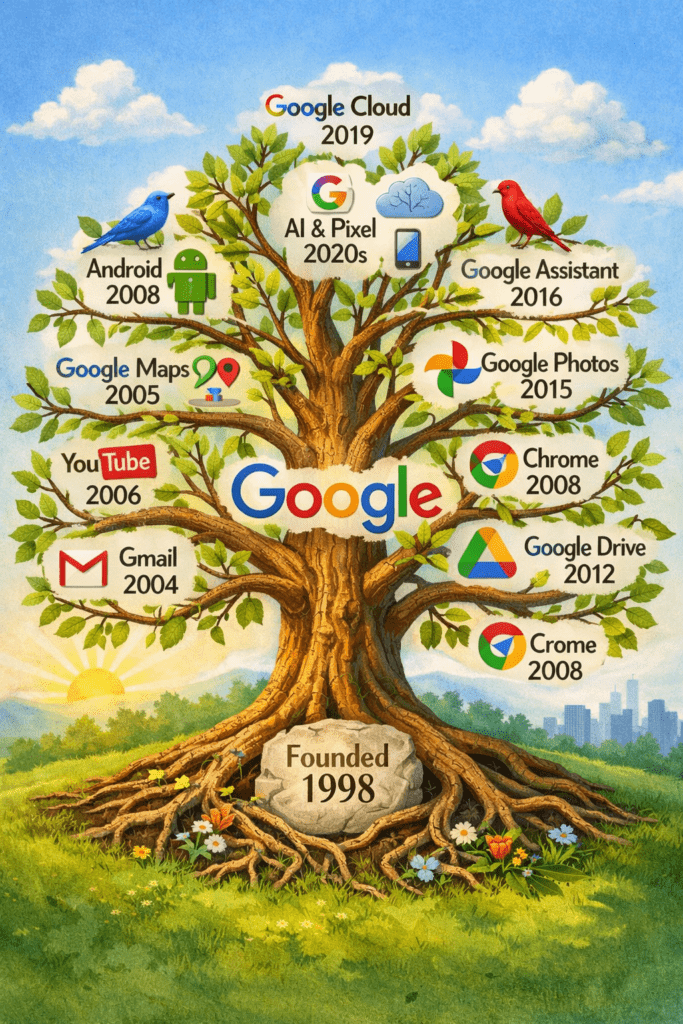
Product Ecosystem Explosion: Search, Chrome, Maps, Earth, and Ads
Turning 27 has not slowed Google’s expansion. The company now fields a portfolio that touches every layer of the consumer stack. Google Search remains the front door, answering 8.5 billion queries daily. Google Chrome, launched in 2008, commands 65 percent of browser share, giving Google control over the rendering pipeline. Google Maps processes 20 billion kilometers of navigation requests each month, while Google Earth stitches together petabytes of satellite and aerial imagery to create a 3D mirror of the planet. Behind the scenes, Google Ads powers the economics: advertisers upload creative, set bids, and rely on machine-learning models to place the right ad in front of the right user at the right price. These products reinforce each other. Chrome collects anonymized usage metrics that feed ranking signals back into Search. Search queries reveal intent that sharpens ad targeting. Ad revenue funds free services that lock in users, creating a feedback loop that competitors struggle to break. The net effect is a moat that has widened every year since incorporation.
Corporate Restructuring: The Birth of Alphabet Inc. and Leadership Transitions
In 2015, at the ripe age of 17, Google restructured under a new parent called Alphabet Inc. The move separated core advertising from so-called “moon shots” such as Waymo autonomous vehicles, Verily life-science research, and Wing drone delivery. Larry Page stepped up as Alphabet CEO, while Sergey Brin became President. Sundar Pichai, who had shepherded Chrome and Android, inherited the Google CEO title. The reorganization gave investors transparency into capital allocation: search and ads generate the cash; other bets consume it. Wall Street rewarded the discipline: Alphabet’s market cap vaulted from around $400 billion in 2015 to north of $1 trillion by 2020. Restructuring also insulated the parent from regulatory risk. When the European Commission levied €8.2 billion in antitrust fines between 2017 and 2019, Alphabet’s holding-company structure limited direct liability to the Google subsidiary. Today the conglomerate employs more than 150,000 people across 70 countries, a headcount that has doubled since the 2015 re-org.
AI, Gemini, and the Next 27 Years
Google’s latest chapter is defined by artificial intelligence. The company has spent heavily on AI and Gemini, its large-language-model suite designed to compete with OpenAI’s GPT line. Tensor Processing Units, custom silicon introduced in 2016, now power everything from photo enhancement to real-time translation. RankBrain, deployed in 2015, uses neural embeddings to interpret never-before-seen queries. Multitask Unified Model (MUM) announced in 2021 can understand 75 languages simultaneously and process text, image, and video inputs. The strategic goal is to move from a search engine that returns links to an answer engine that finishes tasks. Revenue implications are enormous: every one percent gain in ad relevance translates into hundreds of millions of dollars. Regulatory implications are equally large. The U.S. Department of Justice filed an antitrust suit in 2020 arguing that Google’s default-search deals on iOS and Android stifle AI competition. The trial is ongoing, but Google’s age and scale make it a focal point for policy debates about data monopolies and algorithmic accountability.
Competitive Landscape: How Google’s Age Compares to Netflix, Amazon, and Microsoft
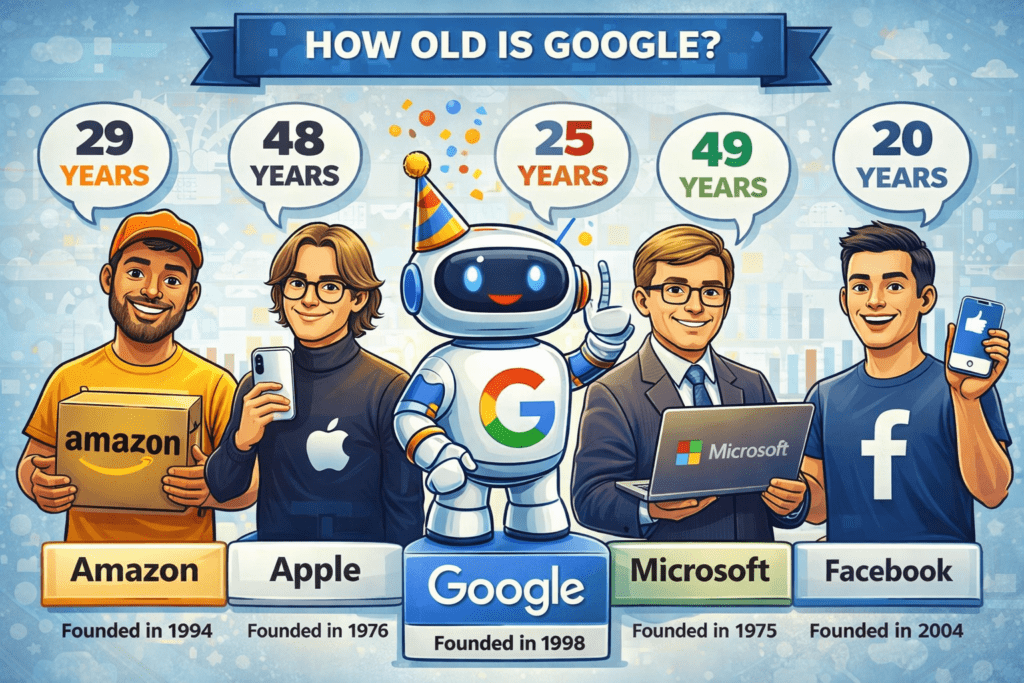
Contextualizing Google’s age requires comparing milestones with peers. Netflix is actually older than Google, founded in 1997 as a DVD-by-mail service, yet its market cap lags at roughly $240 billion versus Alphabet’s $1 trillion. Amazon predates Google by four years, launched in 1994, and leads in cloud infrastructure, but Google Cloud Platform holds 10 percent share and grows faster than AWS in some quarters. Microsoft, founded in 1975, is the senior citizen of the group, yet its Bing search engine claims only 3 percent market share despite a $10 billion OpenAI partnership. Google’s relative youth, therefore, is an advantage: the company matured just as broadband, mobile, and cloud converged, allowing it to architect for scale from day one. The downside is that Google faces regulatory scrutiny normally reserved for century-old utilities. The European Digital Markets Act, enacted in 2024, classifies Google as a “gatekeeper” along with Apple, Meta, Amazon, and Microsoft, imposing interoperability mandates and consent requirements that could reshape product roadmaps.
Key Milestones by the Numbers
| Year | Age | Milestone | Source |
|---|---|---|---|
| 1996 | -2 | BackRub prototype at Stanford | Jagran Josh |
| 1998 | 0 | Incorporation on September 4 | Wikipedia |
| 2000 | 2 | AdWords launches with 350 customers | Upgrow |
| 2004 | 6 | IPO at $85 per share | Alphabet Inc. Report |
| 2008 | 10 | Google Chrome released | Alphabet Inc. Report |
| 2015 | 17 | Alphabet restructuring | Wikipedia |
| 2023 | 25 | Quarter-century mark | Upgrow |
| 2026 | 27 | Controls 92 % search market | Jagran Josh |
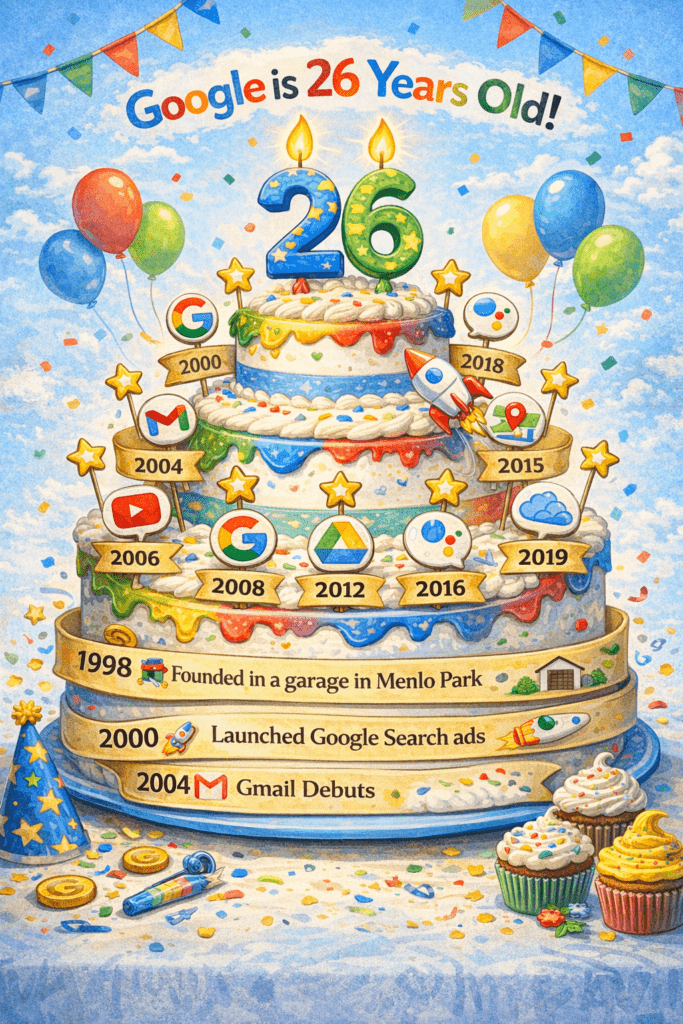
Frequently Asked Questions
How old is Google?
Google is 27 years old, 4 months, and 11 days old as of January 15, 2026. The company was incorporated on September 4, 1998, making it older than Facebook but younger than Amazon. Age is calculated from the incorporation date rather than the 1996 BackRub prototype because that is when the legal entity—and the fiduciary duties to shareholders—formally began. Over those 27 years Google has evolved from a research project on a single university workstation to a global conglomerate that fields more than 8.5 billion search queries per day. The passage of time has also allowed the firm to accumulate 92 percent of the world’s search market, a dominance level rarely seen in any industry. Each birthday marks not just a chronological milestone but a strategic inflection point: at age five the company launched AdWords; at age ten it released Chrome; at age seventeen it restructured into Alphabet; and at age twenty-five it doubled down on AI with Gemini. Understanding Google’s age is therefore essential for investors, regulators, and marketers who need to forecast product roadmaps, antitrust risk, and advertising costs.
When was Google founded?
Google was founded on September 4, 1998, in a garage at 232 Santa Margarita Avenue, Menlo Park, California. Co-founders Larry Page and Sergey Brin filed incorporation papers in the state of California, officially converting their graduate-school side project into a for-profit corporation. The date matters because it marks the moment when equity was issued, a CEO was designated, and the company could legally enter into contracts. Prior to that, the software existed under the informal name BackRub and ran on Stanford servers. Choosing September 4 allowed the founders to begin fundraising in the fall venture-capital cycle, culminating in Andy Bechtolsheim’s legendary $100,000 Sun Microsystems seed check. The founding date also sets the clock for employee stock-option vesting schedules, many of which use a four-year cliff measured from incorporation. Finally, regulatory filings such as the 2004 IPO prospectus explicitly reference September 4, 1998, as the starting point for audited financial statements, making it the canonical date for determining Google’s age.
What was Google’s real name?
Google’s real original name was BackRub, a moniker chosen by Larry Page in 1996 to emphasize the algorithm’s core insight: analyzing “back links” to rank web-page importance. The name appeared on early Stanford press releases, technical papers, and even the first browser bookmark icons. BackRub operated on a crawl of the entire web downloaded to a single 300-MHz UltraSPARC workstation. While catchy among academics, the branding proved problematic when the duo sought venture funding. Investors associated “back rub” with massage therapy, not enterprise software. After months of brainstorming, the founders settled on Google, a deliberate misspelling of googol, the digit 1 followed by 100 zeros, symbolizing the scale of information the engine aimed to organize. The domain Google.com was registered on September 15, 1997, and the corporate entity followed a year later. Today BackRub survives only in footnotes, but its link-analysis DNA remains embedded in every modern search result.
Is Google’s 27th birthday today?
No, Google’s 27th birthday is not today unless today happens to be September 27. The company celebrates its birthday on September 27 because that is the date of the first Google Doodle commemorating the event in 2002. The incorporation date, September 4, is the legal anniversary, but marketing teams prefer the doodle-friendly 27th to avoid Labor-Day holiday conflicts in the United States. The distinction can confuse journalists and bloggers who mistakenly report birthday stories throughout September. For 2026, the 27th falls on a Sunday, so expect a weekend-long celebration across social channels and homepage artwork. Age calculations for financial or regulatory purposes always use September 4, 1998, as the anchor, making Google 27 years old regardless of which day the doodle appears.
Who is older, Google or Netflix?
Netflix is older than Google by roughly 14 months. Netflix began operations in 1997 as a DVD-by-mail rental service, while Google incorporated in September 1998. Despite the seniority, Netflix’s market capitalization stands at approximately $240 billion, less than a quarter of Alphabet’s $1 trillion valuation. The age gap highlights different strategic maturities: Netflix pioneered streaming in 2007, a full decade after founding, whereas Google monetized search within two years. Both firms now compete indirectly for advertising budgets—YouTube versus Netflix’s ad-supported tier—making the age comparison more than trivia for media buyers.
How does Google’s age affect its market position?
Google’s 27-year trajectory has created regulatory, technical, and cultural moats that younger rivals struggle to cross. For example, 25 years of click-through data improve ad targeting accuracy, giving Google a cost-per-acquisition advantage that startups cannot replicate without comparable volume. Age also accumulates patent portfolios—over 50,000 granted U.S. patents—creating defensive barriers in AI, voice, and video compression. Conversely, age invites antitrust scrutiny under laws such as the Sherman Act, which penalizes monopolies that persist over time. The longer Google dominates, the higher the legal risk, a paradox that shapes product decisions such as the open-source release of TensorFlow and the Android compatibility program. Finally, age affects talent retention; stock-option packages granted in 2004 have vested, so the company must reinvent culture to attract Gen-Z engineers who view Google as “their parent’s employer.”
What milestones shaped Google after its 25th birthday?
After turning 25 in 2023, Google crossed three strategic inflection points. First, the company rolled out Gemini, a multimodal large-language model that competes directly with GPT-4, signaling a pivot from mobile-first to AI-first architecture. Second, Alphabet authorized its first-ever dividend in 2024, a financial milestone that transforms the stock from a growth play into an income-generating asset, broadening institutional ownership. Third, the European Union’s Digital Markets Act designated Google Search as a “core platform service,” forcing choice screens and consent layers that could shave basis points off ad conversion rates. Each milestone illustrates how Google’s advancing age forces it to balance innovation with compliance, a tightrope that will define the next quarter-century.
How many employees does Google have at age 27?
Google employs more than 150,000 people worldwide as of 2026, a headcount that has doubled since the 2015 creation of Alphabet. The number fluctuates with seasonal contractors, but the trend line points steadily upward. Employee growth tracks revenue: every billion dollars in new ad sales requires incremental sales, policy, and machine-learning talent. Age also correlates with geographic dispersion; the 27-year-old firm now staffs offices in over 70 countries, compared to just 12 in 2004. Such scale creates internal challenges—communication overhead, promotion gridlock, and culture dilution—that younger startups with 200 employees rarely face.
Will Google still be dominant at age 50?
Predicting dominance at age 50—year 2048—requires scenario planning across technology, regulation, and consumer behavior. Technologically, quantum computing could shatter today’s cryptographic advantages, eroding the security layer that underpins Google Cloud. Regulatory risks include forced breakups under updated antitrust statutes, similar to the 1984 AT&T divestiture. Consumer behavior may shift toward decentralized protocols such as Web3, reducing reliance on centralized search. Offsetting these threats are Google’s investments in AI, quantum supremacy, and vertical integration from silicon to software. If the company maintains its current pace of innovation, it could become infrastructure rather than application—an indispensable layer of the internet akin to TCP/IP. The safer bet is that Google at 50 will be different, but not irrelevant, provided it continues to reinvent core products every decade as it has done for the past 27 years.
Conclusion
Google’s age—27 years and counting—is more than a calendar footnote; it is a strategic variable that shapes everything from auction pricing to antitrust risk. Born on September 4, 1998, the company has leveraged compound learning, network effects, and relentless product expansion to command 92 percent of global search and a market capitalization north of $1 trillion. Each year of existence adds petabytes of user data, thousands of patents, and new regulatory obligations that younger rivals escape. Yet age also imposes cultural and technical debt, forcing Google to balance heritage with reinvention. As artificial intelligence, quantum computing, and decentralized protocols mature, the next 27 years will test whether Google can replicate the growth curve of its first quarter-century. Investors, marketers, and everyday users should therefore track Google’s age not as trivia, but as a living index of internet history still being written.
Want to Analyze Live Google Search Results?
Check top 100 Google India rankings, competitor positions, and SERP features for any keyword using ContentSERP free SERP checker.
Try Free SERP Checker →